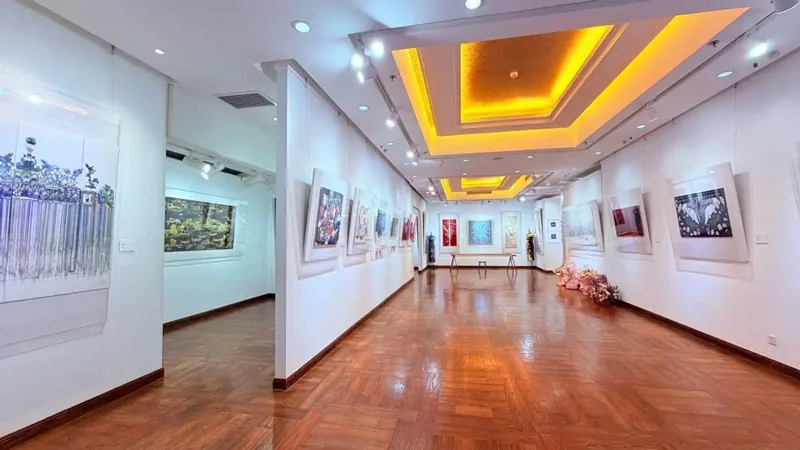
A fourteen-panel screen runs 10.2 metres along the gallery wall, and it took two years to finish. It is the centrepiece of a retrospective that opened on October 17 at the Beijing Gold Lacquer Inlay Art Museum, marking seventy years of a workshop tradition that began inside the Qing court’s own manufacturing office. Some 200 people attended the opening, among them representatives of the national lacquer and court-arts committees, master craftsmen, heritage workers, and staff from colleges and museums. The public gets in from October 19; the show closes on December 30.
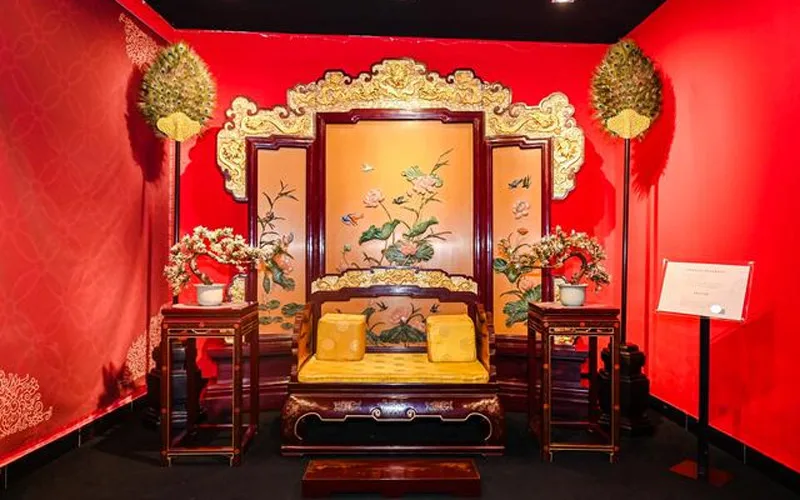
The exhibition gathers 108 sets of work covering the four techniques that define gold lacquer inlay: incised-and-filled carving, painted lacquer, inlay, and carving into an ash ground. Alongside the screen are a black-lacquer centenarian-pattern table, a court vase decorated with a moonlit spring scene, a screen inlaid with jade and precious stone, and a nine-panel flower screen with a hooded top. Photographs and documents trace the workshop from 1956 onward.
The Screen That Took Two Years
Its twelve scenes come from a set of Qing court paintings made under the Qianlong emperor, in which court painters divided the lunar year into twelve months and filled each with festivals, market life and palace interiors. Translating that into lacquer meant combining carved-and-filled work, painting, precious-stone inlay, flat-polished mother-of-pearl, gold tracing and gold-lacquer wood carving on a single object. Hu Xin and Wang Xuebing, both first-class Beijing arts and crafts masters, designed and supervised it. The organizers describe the scale as unprecedented for the medium.
An object that size sets its own market. Very few buyers can take a 10.2-metre screen, and the exhibition makes no pretence otherwise. What it does instead is establish the top of a range, the piece that proves the workshop can still execute at court standard, while the rest of the display covers the smaller objects that actually sell, including national gift pieces and lacquerware made for specific ethnic markets.
Techniques Layered on a Single Surface
The four techniques are worth separating, because visitors tend to read the whole surface as one craft. Carved-and-filled work incises the pattern into the lacquer and fills the cut with colour or gold. Painted lacquer mixes pigment into the lacquer itself and brushes it on directly. Inlay sets mother-of-pearl, precious stone, jade or bone into the ground. Ash-ground carving cuts through a layered putty base to reach the colour beneath. Court pieces routinely use several at once, which is exactly what makes the big screen hard to read at a glance.
Alongside the show, the museum published the transmission genealogy of gold lacquer inlay from the Qing imperial workshops, four lines of which are still active. Over seventy years the network has grown outward: it helped found the Beijing Yanjing Baju association, built three heritage museums in the capital, set up six campus exhibition halls in Morin Dawa in Inner Mongolia and Fengning in Hebei, which together reach more than 20,000 students, and established a training base in Dachang, Hebei, that links heritage work across the Beijing-Tianjin-Hebei region.
A Trade Group and Its Succession Line
Bai Qun, president of the Yanjing Baju association, chair of the museum and a national-level inheritor of the technique, described the craft as a fusion of lacquer work, metalwork and inlay, carrying both court formality and a workshop sensibility. He also named the pressure the sector is under, and said practitioners intend to keep pushing regardless.
Ding Xuebing, party secretary and chairman of the Yangzhou Lacquer Factory, was more specific at the opening. Chinese lacquer, he noted, runs back some eight thousand years, and both the northern and southern lines began their modern institutional lives in the 1950s. What the sector faces now, in his account, is a shortage of people to carry the skills, weak conversion into sellable product, and too few practitioners who can handle both. For work at this level of labour intensity the survival strategy has been to run three tracks at once: museum-grade pieces to set the standard, gift and souvenir lines to pay the workshop, and campus programmes to refill the bench. Visitors book through the museum’s WeChat account.