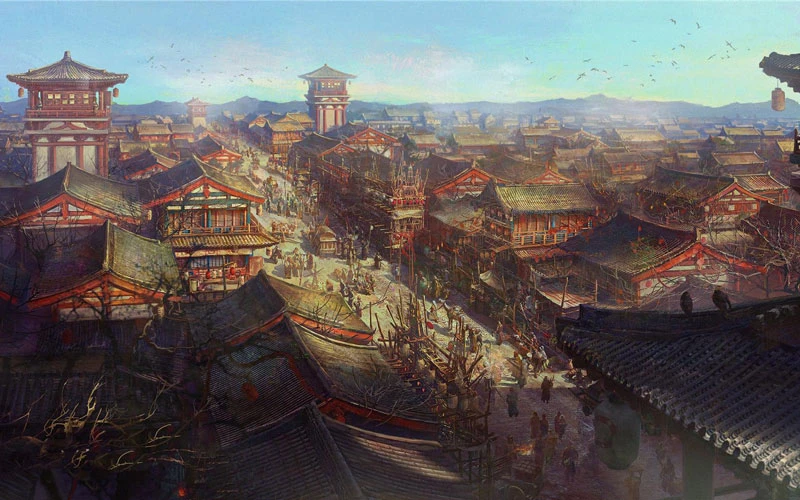
Beitang, the old port quarter at the northern edge of Tianjin’s Binhai New Area, has spent most of its history as a working waterfront. It sits where river meets sea, made its money from grain transport, fishing and salt, and once served as the coastal garrison that guarded the approach to Tianjin. On October 11 a project called Eastern Guard City opened there for trial operation, built into the existing street fabric rather than beside it.
The first phase covers 120,000 square metres and organises itself around three historical threads: the six-hundred-year history of the Tianjin garrison, the compilation of the Yongle Encyclopedia, and the voyages of Zheng He. Streets, walls and the riverbank serve as stages, with more than thirty song, dance and opera pieces performed in rotation across three performance zones, indoors and out.
Three Storylines Under One City Wall
Chronology here is loose on purpose. A visitor entering the immersive area crosses a market street of Tianjin food brands, passes acrobats and traditional magic acts, and reaches a section of wall with gun emplacements still in place. Costumed performers work the same lanes, so the historical layer is walked through rather than watched from a seat.
Dress is the first thing that makes the setting legible. On opening day, a visitor surnamed Li came with her husband and child, all three in period clothing. The evening light was the draw, she said, but the actors carried it: you are inside the story within a second of arriving. When visitors and performers share a visual vocabulary, a rebuilt street stops reading as a film set.
Wang Guanghai, deputy general manager of the company that developed the project, described the approach as tracing the old to present the new. The point was not to replicate ancient buildings, he said, but to present Tianjin’s river-and-sea culture through contemporary means, so that visitors walk into the story instead of watching it.
The Water Stage Behind the Wall
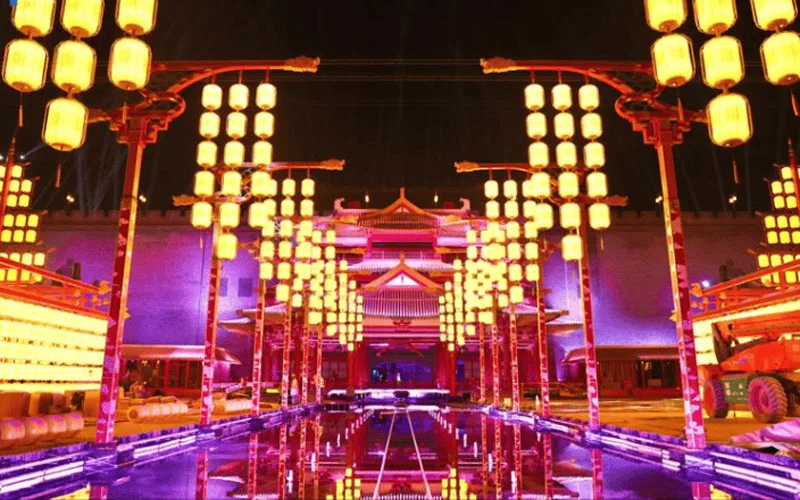
The centrepiece is Yongle Splendour, an outdoor production staged on a 14,000 square metre water theatre, roughly the footprint of two football pitches. More than a hundred performers work against the city wall as a backdrop, with water screens, fog, lighting and projection carrying scenes from the garrison’s founding through the compilation of the encyclopedia to Zheng He’s fleets leaving harbour.
Each performance runs sixty-five minutes, and two are staged nightly. The scale explains the economics: a show this size needs volume to justify itself, and the trial period suggests the volume is there. Six thousand people came on the first day, and bookings for the following three days reached ninety-four percent of capacity.
The catchment is regional rather than local. About sixty percent of visitors come from Tianjin itself, with Hebei above twenty percent and Beijing above ten, which is the pattern a Binhai attraction needs if it is to pull overnight stays rather than day trips.
What Binhai Was Missing
Binhai holds 153 kilometres of coastline and a cluster of established attractions, among them the National Maritime Museum of China and the TEDA Aircraft Carrier Theme Park, with marine culture, military tourism and coastal leisure as its established products. What the district had almost none of was a night-time format built on Chinese period design.
Wang said the project plans to link with neighbouring attractions through joint ticketing and packaged routes, and to keep drawing visitors with regular performances and themed programming, with the aim of stretching a one-day visit into two or three. That ambition depends on the trial period producing fixes. Visitors have praised the density of the period setting and the scale of the water show, and have also flagged unclear wayfinding in some areas, too few places to sit, and interactive games that are simpler than the setting around them.
The developer says the trial period is being used to collect that feedback before the offer is expanded into study programmes and longer stays. For Beitang, the test is whether a quarter that once handled grain and salt can hold a visitor past dinner without the wall doing all the work.