A question comes first at the Luoyang Ancient Tomb Museum, before any object: if you could live your life again, would you still walk into this world of joy and grief? It is printed at the entrance to the underground route and repeated at the exit. Between those two points, across roughly two and a half hours, the museum issues no labels and no audio guides. It issues a coloured ribbon and a list of errands.
That inversion is the interesting part. A tomb museum has an obvious problem with audiences: the material is grave goods, carved brick and corridor geometry, dense but not immediately legible. Rather than answer it with more captions, this one answered it with casting, staging and a scoring system.
What the Luoyang Ancient Tomb Museum Is
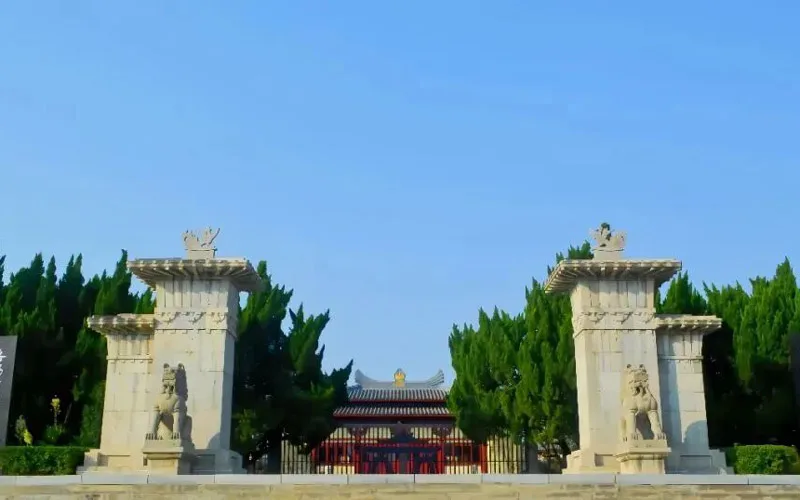
The Luoyang Ancient Tomb Museum is the only museum in China dedicated to ancient tombs as its sole subject, and Luoyang media describe it as the first of its kind anywhere. It stands at 6 Jichang Road in the Laocheng district, occupies about 130 mu of ground and holds 21,567 square metres of floor space. It was approved in December 1984, began admitting visitors in April 1987, and now carries fifth-batch national first-class museum status.
Its holdings divide into three permanent parts. The Grand View of Burial Systems gathers 25 tombs from nine dynasties, moved here from their excavation sites and rebuilt, and arranges them in four chapters that run from the ancient tombs of Qingyang through the bronze camels of thorn and the clouded ridges of Beimang (北邙) to tomb painting. Inside that section sit A Thousand Autumns Below, which shows murals lifted from Henan tombs between the Han and the Republic, and Brick Paintings Through History, which holds Song and Jin carved bricks in three categories.
| Section | What is inside | Scale |
|---|---|---|
| Grand View of Burial Systems | Typical tombs rebuilt in four thematic chapters | 25 chambers, nine dynasties, Western Han to Song-Jin |
| A Thousand Autumns Below | Murals lifted from tombs across Henan | 18 groups, 65 panels, 185 square metres |
| Brick Paintings Through History | Song and Jin carved bricks | 106 bricks in three categories |
| Northern Wei Imperial Tombs | The excavated Jingling (景陵) palace, left in place | Open to visitors since April 1992 |
Behind the main galleries lies the second part, the Northern Wei imperial cemetery built around the excavated Jingling palace of Emperor Xuanwu. The third is a conservation facility rather than an exhibition hall: a mural conservation and research centre that opened in March 2019 and remains the only base in Henan equipped to lift, restore, store and study tomb murals. Money followed the conservation work. An upgrade approved in September 2020 with a budget of 131 million yuan closed the site for two years, and it reopened in September 2022.
Seven Stations on the Underground Route
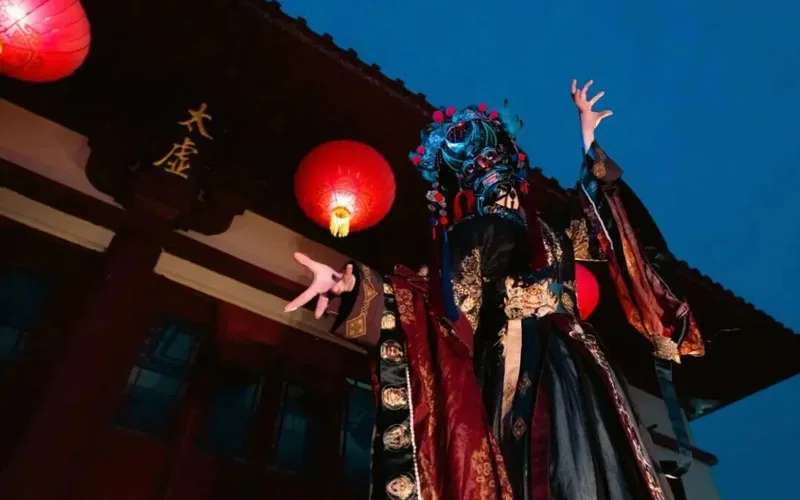
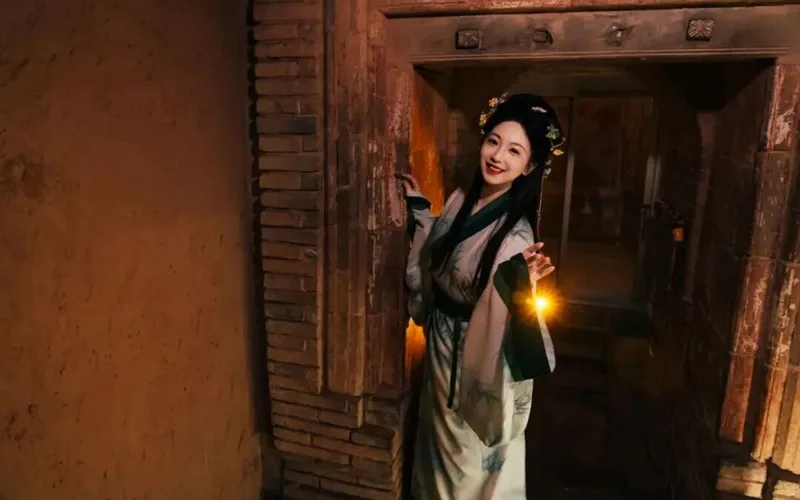
Gates open at 19:30 in front of Taixu Hall, where each visitor draws a ribbon. Red, blue or green, handed out at random, and the colour decides the route: three groups move through one night in three different orders. Between 19:50 and 21:40 visitors move freely between the underground galleries and Jingling, and at 22:00 everyone returns to Taixu Hall for the Lamp Prayer finale.
Seven stations carry that movement:
- Taixu Hall, The Question of Crossing: a masked dance opens the night and the first lamp is lit.
- Qiongge Square, Testing Nerve: an actor appears without warning and tests the visitor’s reaction.
- Mural Square, First Light of the World: three short scenes on greed, anger and delusion share one stage.
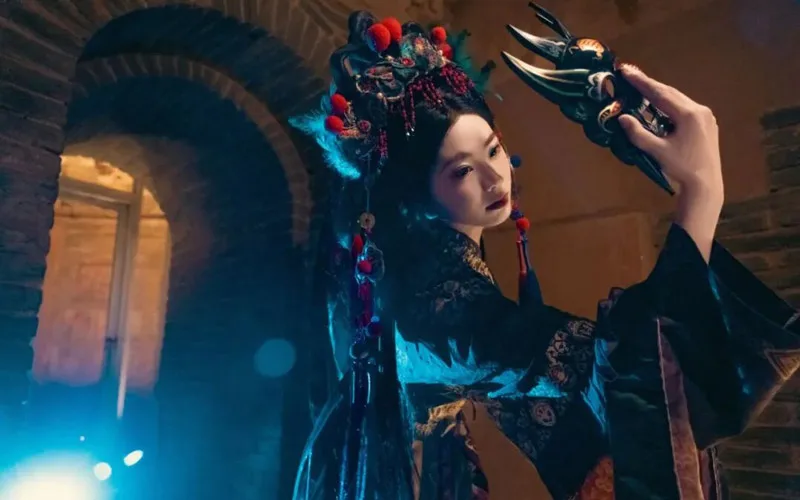
- Jieyou Alley, Seven Passions: the busiest stop, where seven costumed performers set games and pay out vouchers.
- Underground galleries, Four Dynasties, Four Choices: Western Han asks about obsession, Wei-Jin about integrity, Song-Jin about the weight of filial duty, Song about vanity.
- Mural hall, Silk Road Phantom: a talking camel walks the last stretch of road into Luoyang.
- Jingling, A Lone Boat of Imperial Heart: the long corridor, and a monologue from an emperor who holds everything except the person he wants.
Mechanics are unusually concrete. Three walking theatre pieces, 20 non-player characters, 10 main quest lines and 11 historical figures are distributed across those stops, and the ferry-note vouchers and stamps collected along the way are exchanged for limited-edition merchandise at the end. Visitors do queue to redeem them, which is the quiet point of the design: a route that pays in goods keeps people moving and keeps them counting.
Restored Chambers and the Original Jingling Palace
Two kinds of space sit inside one ticket, and the difference matters more than any caption. The 25 chambers in the main galleries are relocations: tombs dismantled at their original sites elsewhere in Henan, then rebuilt here in their recorded form. Jingling is not. It is the excavated underground palace left where it was found, and its corridor, ceiling and burial chamber are the site itself.
What that offers a visitor is a choice of evidence. A rebuilt chamber can be measured with the body, which is the only way the numbers become real: how long the ramp runs, where the corridor turns, which wall carries the carved relief, how the coffin platform sits against the mural. An in-situ palace gives something no reconstruction can, the sense of ground that was never moved. Reconstructions can therefore be staged, lit and performed in. The original can only be protected.
Three things repay attention in either case. The first is the difference in chamber form between dynasties, read through ramp structure, corridor length and ceiling treatment. The second is subject matter in the carved brick and the murals, which records what a family expected of the afterlife rather than what it owned; reading tomb murals for dress detail is a skill in itself, since paint survives where textiles do not. The third is the seam between rebuilt and original: once you can see where the reconstruction stops, the museum starts making sense as an argument rather than a set.
For dress and material history the same logic applies, and tomb archaeology is where most of that work has been done. The Mawangdui tomb finds reset what scholars could say about Han robe cutting and layering. The Northern Wei figurines held in Luoyang do the same for sixth-century dress and hair, and the Xianbei costume features visible in Northern Wei material are the immediate context for anything Jingling raises. Detail on each belongs in those specialist pieces rather than here.
A City That Runs Museums After Dark
None of this happens in isolation. Henan’s provincial cultural-heritage bureau recorded 36 museums on extended hours across the National Day and Mid-Autumn holiday, with the Henan Museum and the Yinxu Museum staying open until 20:30, the Luoyang Museum until 19:00 and the Nanyang Museum until 18:30. The Luoyang Museum runs its own after-hours format, putting actors into the permanent galleries. The tomb museum takes the underground shift.
Audience data explains the appetite. Attendance ran to 1.4 million in 2023 and passed 2 million in 2024, after the post-upgrade surge, and the museum’s own reading is that close to 70 percent of its visitors are under 35, an audience that treats a museum as one stop in a trip rather than a half-day. Deputy director Zhou Hui has said the daytime building can feel like a market, and that the night slot offers something the day cannot.
Policy arrived to support the experiment. Eight municipal departments issued measures on piloting cultural-creative product development in museums, encouraging longer opening hours and permitting independent development, partnership or licensing; the tomb museum was among the first five pilot institutions. A call for creative partners in February drew more than 30 proposals inside a month. In the Q3 2026 museum popularity index, seven Luoyang museums reached the national top 100, the Luoyang Museum placed 27th overall and third among municipal museums, and the tomb museum entered the list for the first time at 84th.

Booking the Night Tour
Daytime entry is free and does not include the night programme. The museum opens at 9:00, stops admitting at 16:30 and closes at 17:00, Tuesday through Sunday, and shuts on Mondays except public holidays. The night route runs on reservation only, with dates and sessions announced through the museum’s own channels. Roughly 200 places are released each night, and they have been selling out.
Practical notes worth having before you go. The underground galleries hold a steady chill and the route includes slopes, so shoes matter more than a coat; two and a half hours on stone floors runs longer than it sounds. The programme carries scripted interaction and emotional scenes, worth weighing before bringing small children. Day and night also use different routes: daytime is the better visit for reading mural and brick detail at your own pace, the night one for the building as a stage.
Zhou Haitao, the museum’s director, said the institution controls the script and its direction, and does not deliberately chase thrills. That single sentence explains the whole format. Thrills date quickly and attract complaints from the families who own the graves; grief, obsession and vanity do not, and they let a 2,000-year-old burial site run a nightly programme without turning into a haunted house. Two years of continuous operation is the number that matters here, more than any single season’s ticket sales.