Many readers first meet exile through Water Margin (水浒传). A hero can guard a haystack, sip wine, and still find strength to fight. Real law offered less comedy. Exile ranked fifth among the five punishments—whipping with light stick, whipping with heavy stick, penal labor, exile, death—so it sat just under death. The court pulled a body back from the edge, then let a long road and the remaining years wear it down. If a sentence sent you away in old China, life split into three stages. Each stage asked a different question: can you survive the road, the work, and the silence of no return?
On the Road
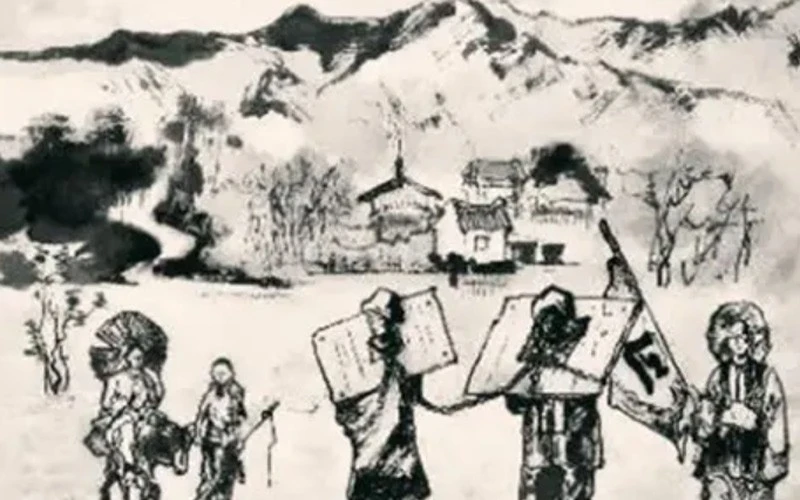
The verdict did not just move a person; it renamed him. Under the Tang dynasty, officers read the crime, fastened the prisoner, and sent him to a distant post for reform. The Qing dynasty added paperwork: the Board of Punishments fixed the case, the Board of War counted carts, horses, guards, and iron. Couples shared one chain; other men and women were paired two by two, each with a lock. Once the cangue closed, “someone” became “exile so-and-so.” Distance was not abstract. Tang law set three grades: 2,000, 2,500, and 3,000 li (里). Qing orders often sent people 3,000 or 4,000 li to Ningguta (宁古塔) or Heilongjiang City (黑龙江城).
A daily limit of fifty li sounds bearable until the body is counted. A wooden cangue of tens of jin (斤) pressed the neck; iron dragged at the ankles. In dry weather a prisoner could shuffle. In rain, the wood drank water, swelled, and bent the spine. Guards ate official grain. The prisoner ate a ration meant only to keep breath, often half of normal. Fever, frostbite, a blow from a guard—none needed a dramatic cause. The road made ordinary weakness fatal.
The court knew. In the ninth year of Kangxi (康熙), an edict described October through January: poor exiles had thin clothes, and people who did not deserve death froze on the road. The order stopped dispatches in the coldest months. Mercy had a border, though. It avoided ice, not distance. Every mile waited in spring.
Arrival Work
Arrival did not end the sentence; it sorted the prisoner. A common convict at the Ningguta official farm joined ten workers: one head, nine laborers, all set to farm, hunt, or burn charcoal. The yearly quota was blunt: twelve shi (石) of grain, 300 bundles of fodder, 100 jin of pork, 100 jin of charcoal, 300 jin of lime, 100 bundles of reeds. Work began before dawn and ended after midnight. Spring planting, summer weeding, autumn harvest, winter storage—the yield went to the office. Fang Gongqian (方拱乾) watched a young woman pound rice all night, then carry water barefoot in thin clothes. The path was slick, the pole heavy. He noted that such women came from wealthy families of the central plains.
A scholar or former official might escape the field. He could be sent to a post station, office, or mine for odd jobs. The body stayed cleaner, but the leash remained: report on the first and fifteenth of each month. Wu Zhaoqian (吴兆骞) reached Ningguta with almost nothing. He chopped ice with an axe for water and boiled coarse millet. Friends helped; his wife came from Suzhou (苏州) with money and a maid. Only then did life become barely settled. He joined a small poetry circle that met three times a month. Wine and verse looked graceful, but they were a tool against despair.
Privilege softened labor, not uncertainty. A monthly report turned freedom into a schedule. A clean hand still belonged to the state. The farm worker and the poet stood in different lines, yet both learned to watch the calendar, the guard, and the weather. Survival was a routine skill, practiced one ordinary day at a time.
No Return
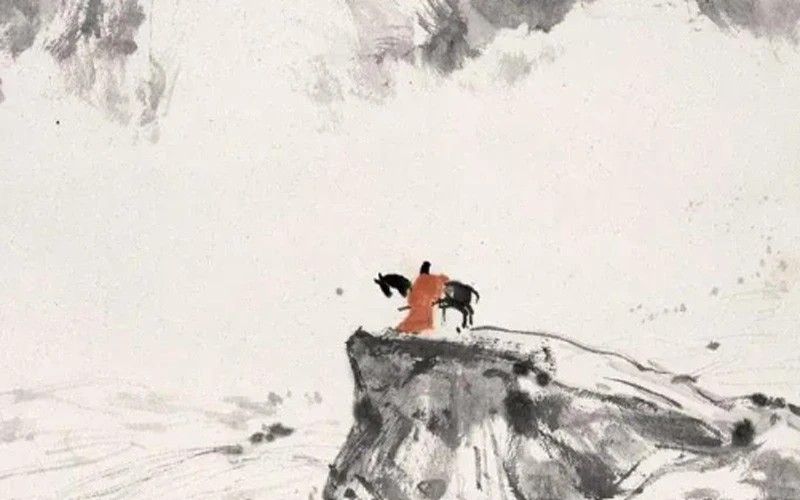
The worst part was not one sharp pain. Exile removed control over the rest of life. Under the Ming dynasty, conscripts served until death or passed service to sons and grandsons, who remained bondsmen. Qing exiles might receive pardon, yet many had left half a life on the road. Wu’s letters preserved Fang’s sentence: people call the yellow spring road terrible, but after Ningguta, ten yellow springs would not frighten them. The speaker had been there. The line was not decoration.
The land itself was not always barren. Around Mudanjiang (牡丹江), Heilongjiang had a “little south”: fat fish in the river, fine wild vegetables in the hills. Wu later recalled shooting pheasants on the white mountain and fishing in the Songhua River (松花江). Lingnan (岭南) and Hainan (海南) frightened officials with malaria, yet exiled people carried farming methods and books into those places. Their tools and words changed local life.
For the person under the cangue, those changes were someone else’s story. He felt the weight, the snow, the guard’s cough. One night he tried to picture home and found the tree by the gate gone from memory. That small blank held more truth than any grand account of development. Exile did not always kill at once. It taught a person to live while feeling erased.