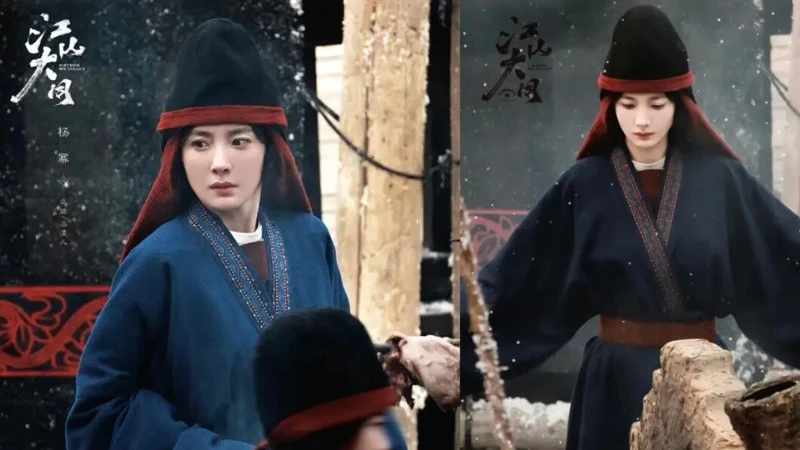
Yang Mi’s (杨幂) latest historical drama, Jiangshan Datong (江山大同), has sparked online buzz before its release. A leaked set photo shows her as Empress Feng (冯) of the Northern Wei (魏) dynasty, dressed in an early Xian Bei (鲜卑) outfit. Viewers are asking: why does it look so odd? The answer lies in three striking features—a soft hood with dangling fabric, a left-over-right collar, and a tight-sleeved jacket paired with tied leggings.
These elements scream “nomadic” rather than “Han Chinese.” But look closer, and you’ll see subtle Han influences too. This isn’t random costume design; it’s a visual story of cultural clash, identity, and survival. Let’s break down each piece and uncover what Yang Mi’s strange outfit really tells us.
The Hood That Fights Wind
The most eye-catching part is the Feng Mao (风帽), a signature Xian Bei headwear also called the “skirted hood.” It has a round, soft top and long cloth flaps hanging from the back and sides, reaching the shoulders. You might think it’s for decoration, but it’s purely practical. The Xian Bei were steppe nomads, constantly exposed to harsh winds and sand. This hood blocked dust while protecting their braided hair—a lifesaver on the grasslands. Early versions were made of leather or felt for warmth. Plain ones served commoners, while aristocrats used brocade.
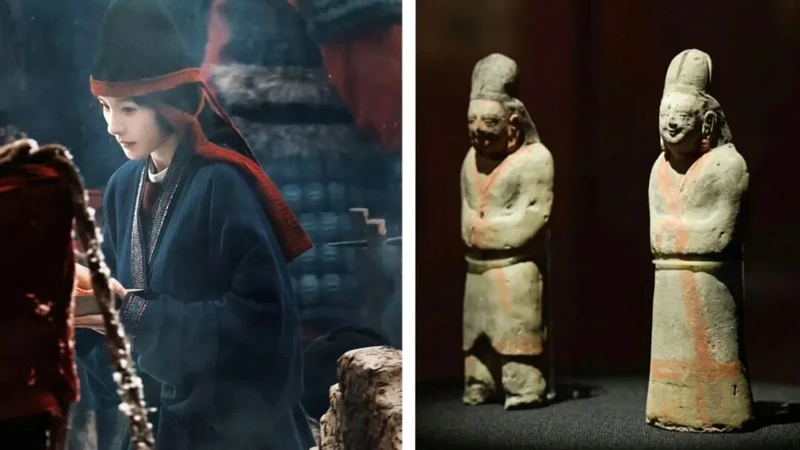
In the drama, Yang Mi’s character starts as a lowly slave. So her Feng Mao is coarse black-brown hemp, simple and rough. It fits her status perfectly. Interestingly, before Emperor Xiaowen (孝文) pushed sinicization reforms, the Feng Mao was everyday wear for Xian Bei people. Even after the reforms, it didn’t disappear—soldiers and commoners still used it often. You can see it on pottery figurines from the Wei and Jin (魏晋) periods. That’s how iconic it was.
What’s clever here is that the hood does double duty. It’s not just a costume piece; it tells you who she is—a steppe woman trapped in a foreign court. The soft, drooping flaps also create a unique silhouette, completely different from the stiff crowns or elaborate buns of Han Chinese nobles. That visual contrast alone screams “outsider.” No wonder viewers find it strange; it’s deliberately alien.
The Left Lapel Speaks
Now look at the collar. Traditional Han clothing uses You Ren (右衽)—the right side folds over the left, forming a Y-shape. That’s a ritual symbol of Han identity. But the Xian Bei and other nomads preferred Zuo Ren (左衽), folding the left side over the right. In ancient China, this was the most obvious visual difference between “Hu” (barbarian) and Han. Yang Mi’s early outfit—a coarse hemp long coat with a narrow, crossed collar—is standard Zuo Ren. Underneath, she wears a round-neck inner layer. The coat hits her knees, cinched with a leather belt. It’s clean, practical, and perfect for horse riding and hunting. Loose robes? Not for nomads.
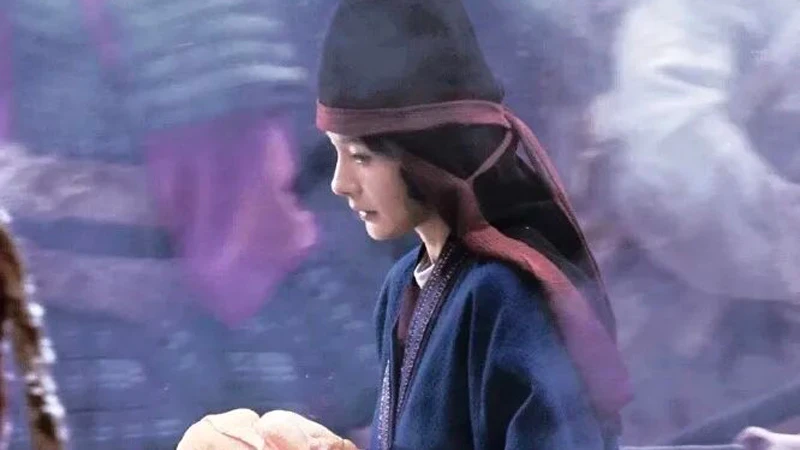
But the left lapel isn’t just about function. It carries a character metaphor. At this stage, she’s a conquered slave from a fallen kingdom. Wearing Zuo Ren marks her Xian Bei ethnicity and highlights her lowly status. It’s like a label saying, “I’m not one of you.” Later, when she rises to become dowager empress, her costume switches to You Ren and wide sleeves. That shift mirrors her real-life political transformation—she abandoned Xian Bei traditions, pushed sinicization, and ruled the court. The left lapel vanishes as she assimilates into Han power structures.
This detail is historically accurate and narratively smart. Costume designers often ignore such nuances, but here, the left lapel becomes a silent storyteller. It tells you where she came from, what she lost, and what she had to change to survive. No dialogue needed. Just a flipped collar.
Jacket and Trousers for Action
The third element is the Zhe Yi (褶衣) with Fu Ku (缚裤)—basically a jacket-and-trousers combo. This was the core daily wear for Xian Bei people and a key reason why nomadic fashion influenced Chinese clothing for centuries. The Zhe Yi is a narrow-sleeved, crossed-collar top, sometimes made longer but never past the knees. The cut is sharp and uncluttered. On the lower half, she wears small-mouth trousers, often with boots and a Die Xie belt (蹀躞带) that held small tools like knives and flint. Perfect for riding and labor.
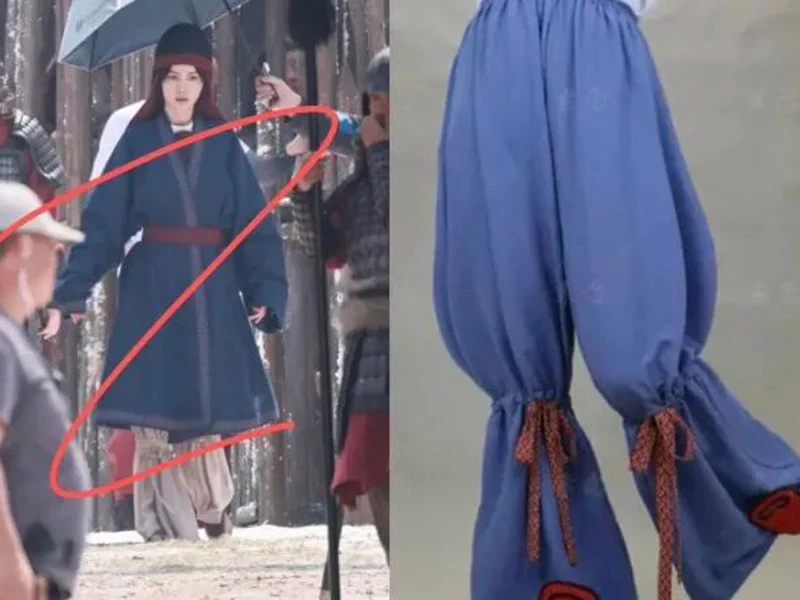
In the leaked photo, Yang Mi’s stone-green coarse hemp coat is tight at the waist with narrow sleeves. Even the fabric patterns—honeysuckle and linked pearls—are common motifs on Northern Wei artifacts. These are not random decorations; they show the fusion of Hu and Han aesthetics. The Xian Bei didn’t just impose their style; they absorbed and adapted. That’s the real story of this outfit. It’s not purely nomadic or purely Han. It’s a hybrid born on the frontier.
The influence of the Zhe Yi-Fu Ku combo was enormous. From the Northern Dynasties through the Sui (隋) and Tang (唐), it evolved into the round-collar robe and the slit-side shirt. These shapes dominated East Asian fashion for nearly a thousand years. So when you see Yang Mi in that strange, tight-sleeved jacket and trousers, you’re actually looking at the ancestor of much later Chinese clothing. Strange? Yes. But also revolutionary.