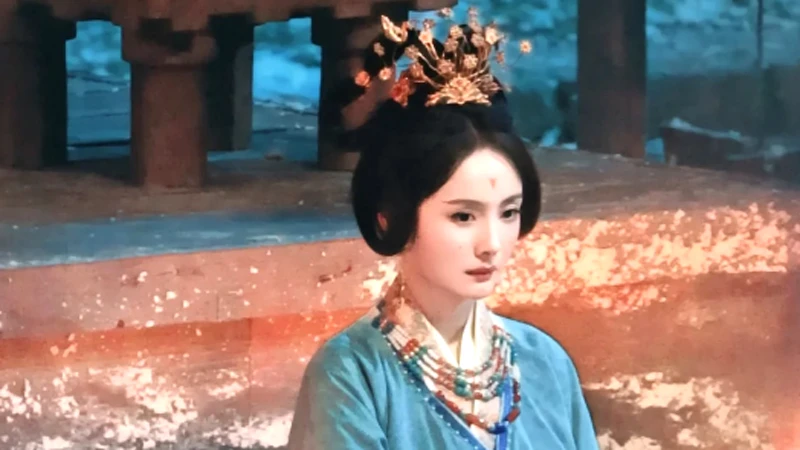
When photos from Jiangshan Datong (江山大同) appeared online, one look worn by Yang Mi (杨幂) caught attention. A blue-green cross-collar top, a color-blocked skirt, and a golden floral headpiece did not match the soft, flowing gowns many viewers expect from palace dramas. Some called it foreign. Others suspected a modern stylist had invented it. The truth sits in Northern Wei, a dynasty that ruled northern China during the Northern and Southern Dynasties. The show’s team drew from real clothing systems, then adjusted them for camera and character. The result is neither a museum copy nor pure fantasy. It is a costume argument about history, memory, and how television makes the past visible.
Golden Branch Step
The most talked-about piece is the headdress. It looks like a small golden crown, with branches, flowers, and leaves. Its historical name is the flower-tree buyao (步摇), a headpiece that sways when the wearer moves. Unlike the long beaded buyao many people know, the flower-tree version was popular in the Wei and Jin periods. Elites in the central plains and northern tribes wore it. Gold was shaped into twigs, then decorated with small blossoms, thin leaves, and tiny pendants. Such an ornament signaled rank. A famous example came from the Beipiao Fangshan Tomb (北票房身墓) in Liaoning (辽宁). It spreads like a miniature tree. The Admonitions Scroll (女史箴图) also shows a woman wearing one. The drama simplifies the branches into a compact crown, fitting her tied hair.
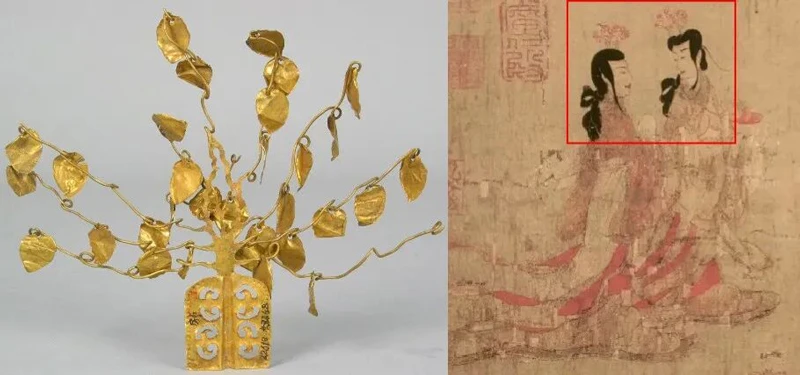
Why simplify? A large, spreading buyao would read as a canopy on screen. It would hide expressions and fight the camera. The smaller crown keeps the gold visible while letting the face lead. This choice shows how television translates archaeology. It keeps the silhouette and status clue, then trims weight and scale. Viewers who pause the frame can still recognize the type. Those who simply watch get a sharp image of power. The headpiece also connects her character to a world where gold, hair, and hierarchy were linked. In that sense, the change is not a mistake. It is a practical edit for storytelling.
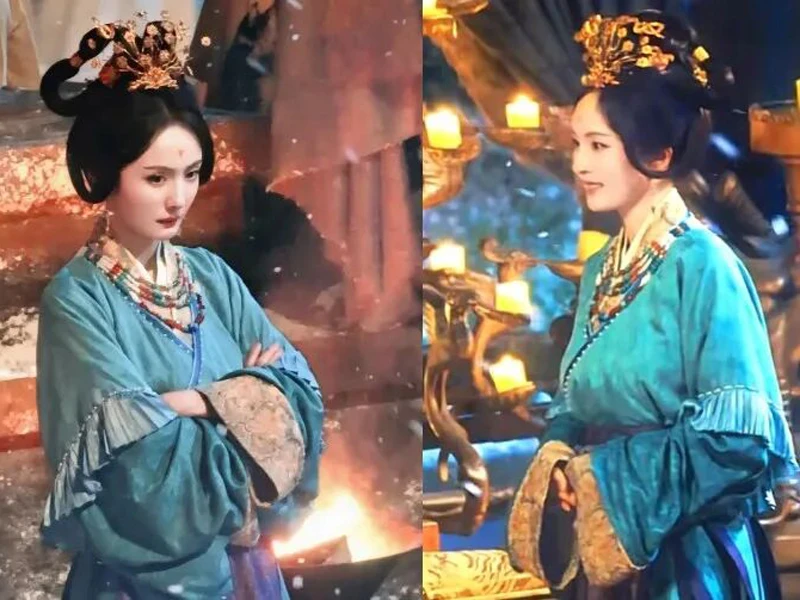
Some online comments called the look “barbarian” or “foreign.” That reading misses the period’s mix. Northern Wei joined Xianbei (鲜卑) traditions with Han Chinese court rules. Dress could show both. A golden tree on the head did not belong to one pure group. It moved across borders, courts, and graves. The show’s headpiece, with its small flowers and gold shine, carries that layered past. It is rare in recent dramas because few productions spend time on Northern Wei. When a popular actress wears it, the image travels fast. The debate itself proves the costume is doing work: it makes people ask where it came from.
Layered Skirt Codes
The top and skirt have their own history. The blue-green cross-collar top has a ruffled half-sleeve. Half-sleeves existed in the Han dynasty as casual wear. People wore them at home or at informal gatherings. After the Wei and Jin periods, they became more common, with richer fabric and trim. The ruffle is not a modern invention. Old tailors added a strip of cloth to cuffs and collars for strength and decoration. Layered folds created a wave-like edge. Han and Northern and Southern Dynasties figurines, plus the Empress Wenzhao Worshipping Buddha (文昭皇后礼佛图), show similar shapes. The sleeve follows that logic.
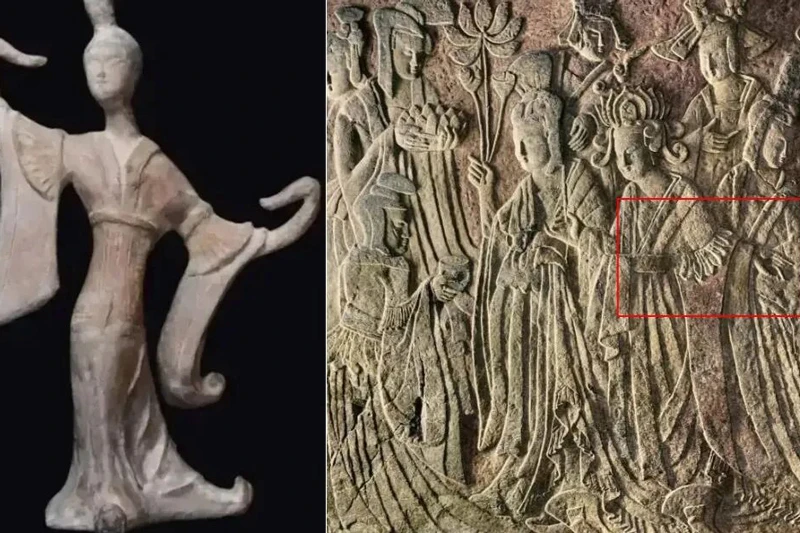
The lower half is more complex. A dark cloth hangs at the waist and reaches the knees. Many viewers mistake it for a belt ornament. It is a bixi (蔽膝), or knee cover. This piece is ancient. It appears on formal robes in the Shang and Zhou dynasties. Made of leather or cloth, it marked rank and ritual. In the Qin, Han, Wei, Jin, and Northern and Southern Dynasties, elite women still wore it for ceremonies or formal dress. Materials and patterns changed with status. The Explaining Names (释名) mentions women using it. Lacquer screens from the Sima Jinlong Tomb (司马金龙墓), Dunhuang (敦煌) murals, and stone reliefs show it too. The drama places it center-front, giving the body a strong vertical line.
Behind the bixi is a vertical color-block skirt. Its historical name is the jianse skirt (间色裙), a favorite in the Northern and Southern Dynasties. Tailors sewed strips of different colors side by side into one skirt. The contrast made the garment easy to recognize. A Eastern Jin tomb at Huahai in Gansu (甘肃) yielded an example. Dunhuang murals show female donors wearing similar skirts. In the show, green and deep purple strips frame the center. The bixi sits over them. This arrangement follows period dress while lengthening the figure on screen. It also adds movement: walking breaks the strips into shifting bands. The design is historical in structure, not in exact copy.
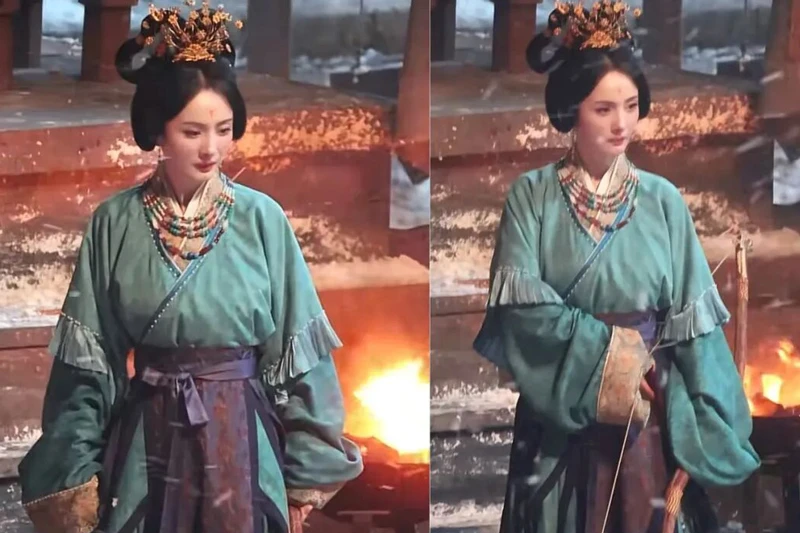
Together, these pieces explain the look. The team did not clone a single grave find. It studied headwear, sleeves, knee covers, and skirts, then adjusted proportions for television. The main shape stays. The gold tree becomes a small crown. The half-sleeve gets a cleaner edge. The bixi and jianse skirt keep their roles. This is how costume drama can teach without a lecture. A single outfit can carry dynasty, status, gender, and taste. The next time a viewer sees a golden flower or a striped skirt, the past may feel less distant. The question is not whether the look is real. It is how well it makes history visible.