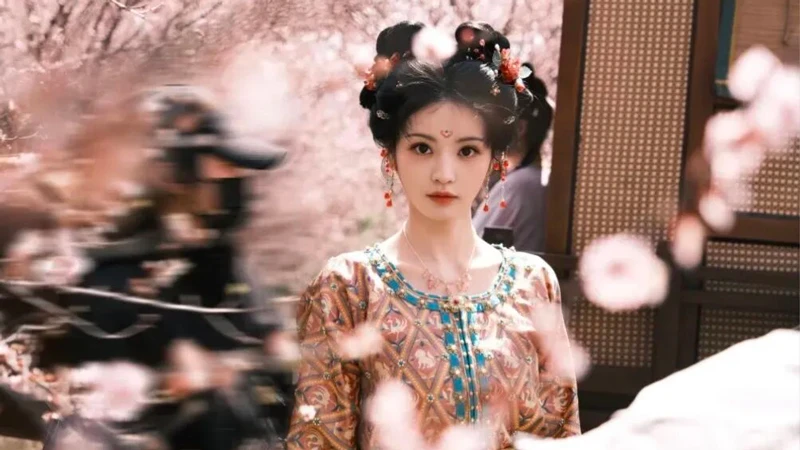
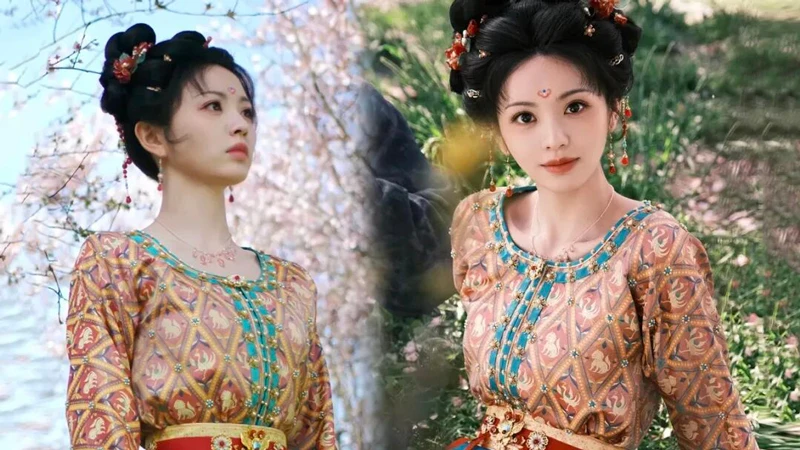
When Tian Xiwei (田曦薇) appeared in Moonlit Reunion (子夜归) wearing a diamond-lattice top, viewers split quickly. Some enjoyed its foreign flavor; others called the styling chaotic, overdecorated, and simply odd. The quarrel, however, misses the real issue. The lozenge pattern is not the villain. For thousands of years, this geometric motif has traveled through Chinese ceramics, woven cloth, cave murals, and court dress. It can be bold or restrained, sacred or everyday.
What failed on screen was not the grid itself but the way costumers stacked colors, motifs, and trims until its clean rhythm vanished. To see why the criticism landed, follow the pattern’s long life across time, trade, and taste. Its story is bigger than one costume.
Ancient Grid, Modern Shock
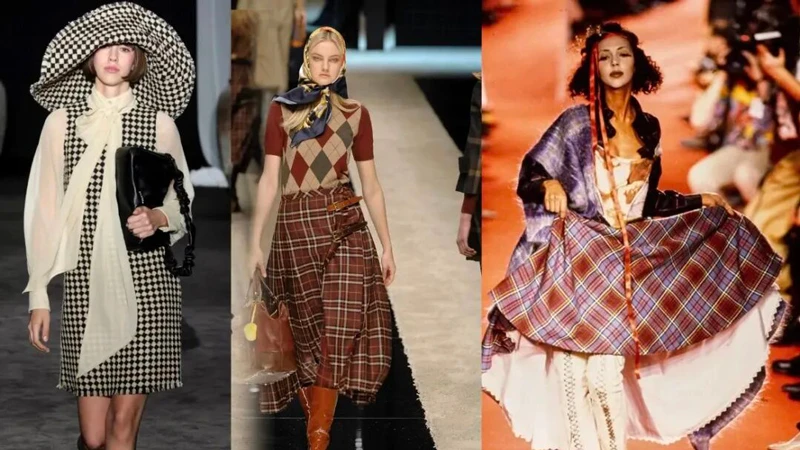
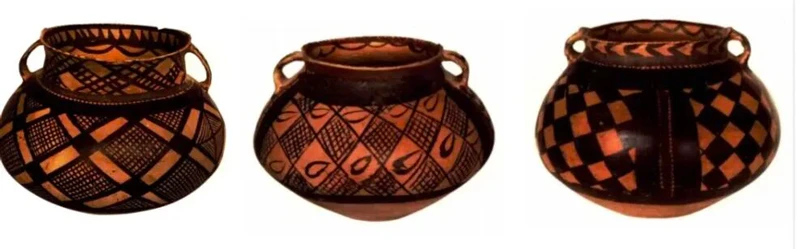
Many people assume checked and diamond patterns belong to modern fashion, especially Scottish tartan. Chinese evidence says otherwise. The lozenge appears on painted pottery from Banshan culture (半山文化), where makers drew red outlines and filled them with black. Inside each diamond, they often placed dots, net lines, or crosses. The result was orderly yet alive, never mechanical. That balance—a strict frame with tiny surprises—became a lasting habit in Chinese ornament. It also shows that early craftsmen were not merely decorating pots. They were building a visual language of rhythm, repetition, and variation that later weavers, painters, and tailors would inherit. Even a simple shape can carry memory when each generation adjusts it. The pattern did not need later approval to matter.
A textile found at Yanghai Cemetery (洋海墓地) in Turpan gives the story a startling turn. Roughly 3,000 years old and linked to the Western Zhou period, it uses red, blue, and brown stripes in a check arrangement. The design looks uncannily close to tartan cloth later tied to Scotland and “British style.” Yet this object was made far earlier. It does not prove that one culture copied another. It does suggest that similar answers can grow from weaving itself, where warp and weft naturally create grids. Still, the Yanghai cloth weakens any claim that checked fashion began only in the West. Cloth, like language, can develop parallel sentences in separate places. Similar forms can emerge when hands face similar tools.
During the Warring States period, the lozenge became more ambitious. Artisans added curled scrolls, small blossoms, and layered borders around the basic diamond, turning a simple shape into complex geometric fields. By the Han-Jin period, advanced weaving allowed those designs to appear in cloth. At Niya (尼雅) Ruins, a pair of brocade socks carried the character “Yang” (阳) and four-petal flowers within a diamond grid. The socks were practical, but not plain. They show how a frame can hold text, nature, or abstraction without losing unity. This flexibility explains why the motif survived dynasties, regions, and changing tastes. It was never frozen; it kept absorbing new details while preserving its core. That is why it feels both ancient and adaptable.
Tombs, Then Runways
Silk production expanded over centuries. In the Sui dynasty, Emperor Yang of Sui (隋炀帝) hosted a huge meeting in Zhangye (张掖), attracting envoys and merchants. Textiles, beliefs, and styles traveled the Silk Road. Inside Mogao Caves near Dunhuang, murals show bodhisattva robes combining lozenges with pearl roundels and Persian animals. At first such patterns belonged to sacred figures. Soon nobles adopted them, using fabric to display taste, wealth, and contact with distant places. The lozenge worked as a meeting frame: local geometry, imported motifs, and religious imagery could share one surface without argument. Trade did not erase difference; it rearranged it into new beauty. The cave walls preserve what fabric could not.
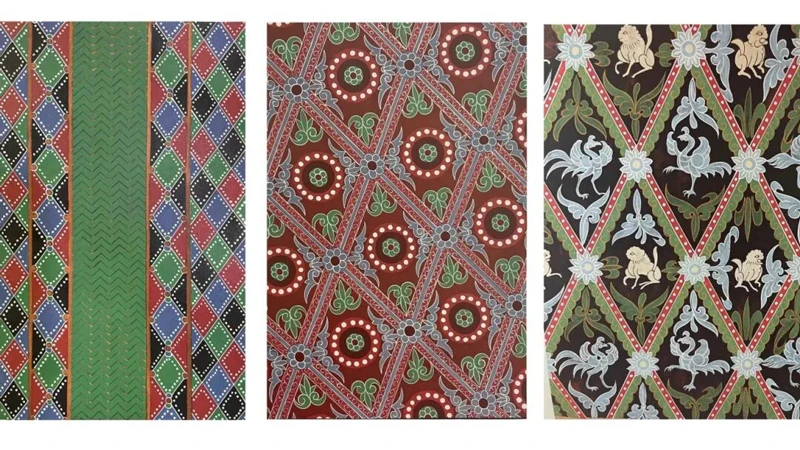
Why does this pattern still appeal? A diamond guides the eye. Depending on how it is placed, it can lengthen the body, narrow the face, or frame the neck. In Moonlit Reunion, Tian’s top uses vertical lozenges to set off her slender neck and clear features, mixing classical grace with a sharp modern edge. The idea is sound. The execution is crowded. Too many colors and ornaments compete for attention, so the grid no longer reads as elegant structure. A restrained palette and cleaner spacing would have let the geometry do its quiet work. Sometimes the strongest design choice is subtraction, not addition. Tian’s costume had the right idea, but not enough air.
Painted pottery, woven brocade, cave murals, and contemporary runways all carry the lozenge. It is abstract enough to fit any era, yet structured enough to feel familiar. Designers can shrink it, stretch it, fill it with flowers, or leave it empty. That adaptability is why it never truly goes out of style. The costume debate around Moonlit Reunion is useful for one reason: it reminds viewers that old patterns are not dusty relics. They are living visual tools. When television treats them as decoration to overload, it weakens them. When it respects their balance, it lets centuries speak through a single garment. So look again at that simple diamond. It holds more history than the noise around it suggests. That conversation is worth having, even when the first outfit misses.