
Ask most people what the Feiyufu (飞鱼服) looks like, and they will describe a red-robed officer of the Jinyiwei (锦衣卫, Embroidered Uniform Guard) with a saber at his waist — the image endlessly recycled by martial-arts cinema. The real Ming dynasty story is different on both counts. The Feiyufu was never the Jinyiwei's uniform, and it was never a single fixed cut of garment. "Feiyufu" is a generic term: any robe decorated with flying-fish motifs belongs to the family. This guide walks through the garment's structure, its motifs and fabrics, the bestowal system that governed who could wear it, and the ways it has come back to life in modern Hanfu culture.
A Motif, Not a Cut
The first thing to clear up is the name. "Feiyufu" describes a category of robes embroidered or woven with the flying-fish pattern, not one specific garment pattern. As Yu Qin (于芹), director of the Calligraphy and Painting Department at Shandong Museum, puts it: "The feiyufu is a generic term — any garment decorated with flying-fish motifs can be called a feiyufu." In the Ming dynasty the motif could be woven onto a Yesa (曳撒), a Tieli (贴里), a Zhishen (直身), a Yuanlingpao (圆领袍) or a Daopao (道袍); if the pattern was a flying fish, the garment was a Feiyufu.
Why does the general public picture a leather-clad Jinyiwei officer instead? Because of cinema. The Feiyufu first became widely known through the Jinyiwei-themed martial-arts films that appeared one after another — New Dragon Gate Inn (新龙门客栈), Flying Swords of Dragon Gate (龙门飞甲), and Brotherhood of Blades (绣春刀) — which gave the guard a menacing black-leather look. The dramatization also cemented a misreading: that the Feiyufu was the Jinyiwei's work uniform.
Yesa and Tieli: The Two Core Cuts
Of the cuts that carried the flying-fish pattern, the Yesa is the most typical. It descends from the zhisun garments of the Yuan dynasty: the top and skirt are joined in one piece, the lower body is pleated like a gathered skirt, and side panels give room for movement. It was easy to ride in and quick to move in, which made it the standard wear of military officers including Jinyiwei commanders. The Tieli looks similar but differs in the details: the pleats below the waist are more numerous and finer, there are no side slits and no panels, and the silhouette reads closer to a dress.
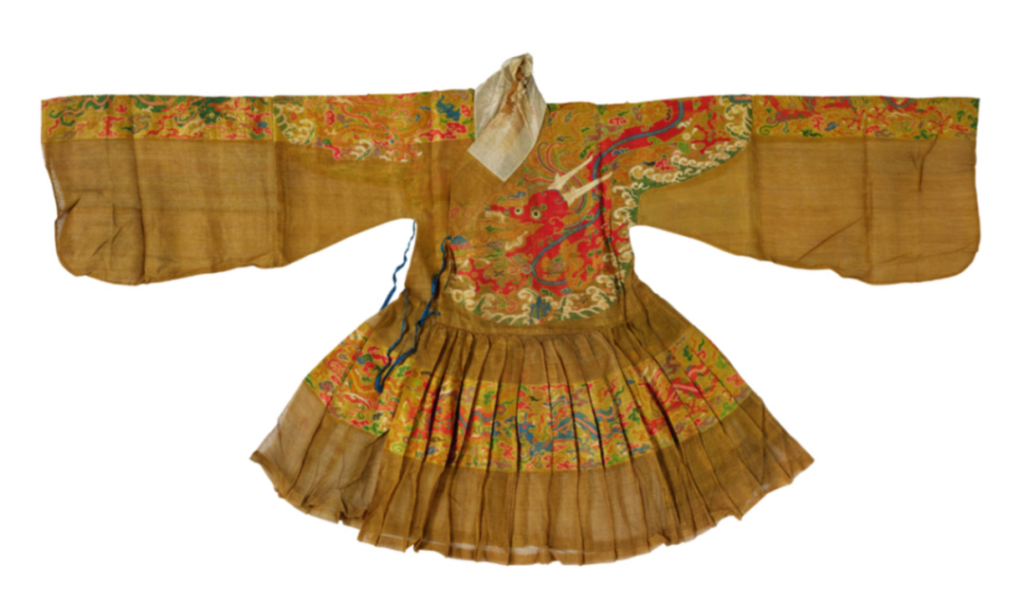
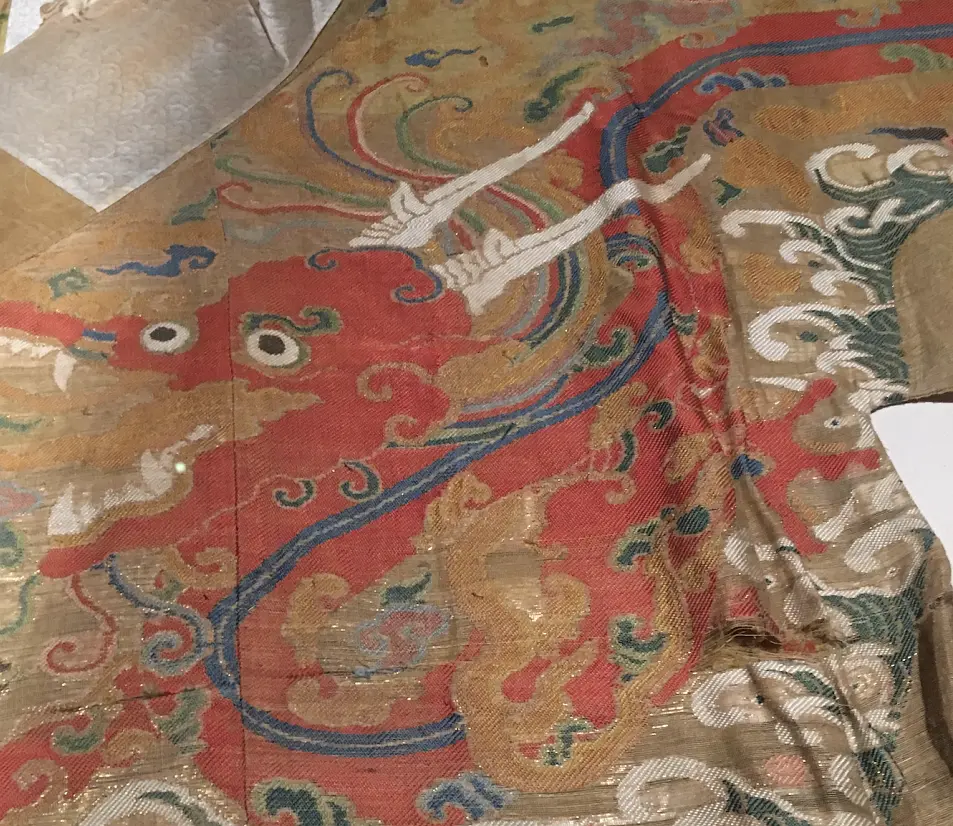
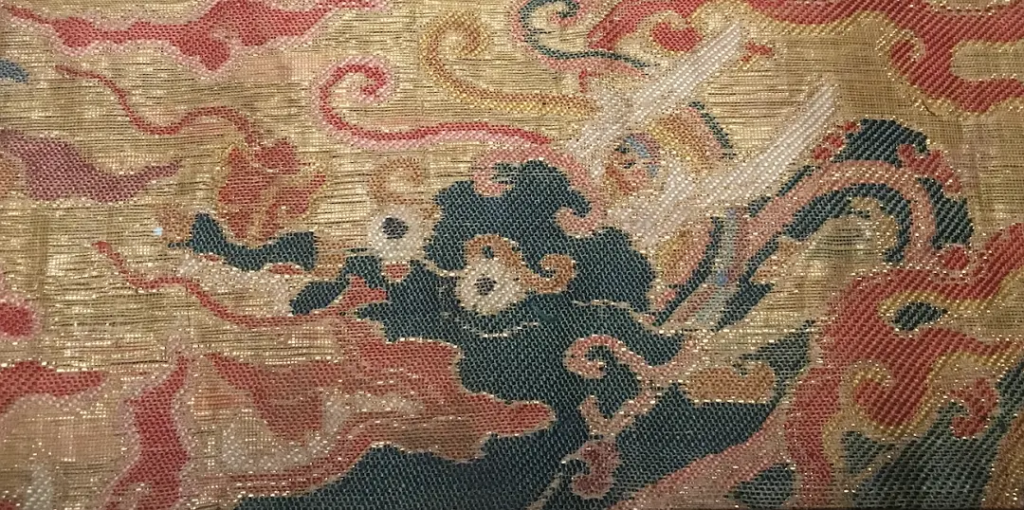
The most famous surviving Feiyufu of all is an incense-color hemp Tieli. It is the only extant male Feiyufu in the world, and it is kept at Shandong Museum. The robe has a straight collar, a large right-crossed lapel, and wide sleeves gathered at the cuff; the front and back panels are cut and joined above and below the waist, and below the waist the fabric falls in pleats like a hundred-fold skirt. The shoulder yoke is woven with gold-wrapped threads and silk yarns in red, white, black, green, blue, yellow and pink, using a cut-weft technique to form an over-shoulder flying fish above a sea-and-mountain wave-hem pattern, while the sleeve bands and knee bands carry cloud-and-flying-fish motifs. Shandong Museum's display notes describe the finished effect: crossed right lapel, wide sleeves bound at the waist, a generous hem, a large pleat at the waist in the Yesa manner, a white-silk collar trim, and over-shoulder flying fish amid clouds and waves in tones of incense — "flying fish and drifting clouds circling leisurely in a color at once warm and refined."
"Incense color" (香色), also called qiuxiang, is a yellow that leans green — a classical Chinese color with more than a thousand years of documented use, warmer than plain yellow and more elegant than plain green. The owner of this robe was no Jinyiwei officer. He was the Duke Yansheng (衍圣公), the hereditary title conferred by Northern Song emperors on the direct descendants of Confucius, head of the Kong family of Qufu, often called "China's first family." Because the title passed in unbroken succession through the Yuan, Ming and Qing dynasties, the family's Ming wardrobe survived the "change of dress" upheavals of the Ming-Qing transition and reached the present day.
Motif and Fabric: Second Only to the Mang
The flying-fish motif is the key to the whole category. According to the research of the "Museums Speak" (博物馆说) series of the China Cultural Centre in Singapore, the flying-fish image began as a dragon-headed, fish-bodied creature, grew dragon-like through the Song and Yuan, and became a high-rank court motif in the Ming. On clothing it ranked second only to the mang (蟒), the python-like dragon: the creature has a dragon head, two legs with four claws, two wings, a pair of ventral fins and no hind legs, and its tail curls outward to both sides. The ranked motifs of Ming bestowed robes ran mang, feiyu, douniu, qilin and luanfeng in descending order — the flying fish sat at number two.
On the fabric side, the imperial weaving bureaus produced flying-fish material as part of the Zhuanghua (妆花) branch of Yunjin brocade. The register lists types such as blue gold-woven Zhuanghua feiyu over-shoulder leno (肩罗), blue gold-woven Zhuanghua feiyu silk, crimson Zhuanghua feiyu bu-leno (补罗), crimson gold-woven feiyu bu-leno, crimson gold-woven feiyu full-sleeve leno (通袖罗) and crimson gold-woven feiyu bu-gauze (补纱) — the motif was woven in Zhuanghua leno, gauze and silk, deliberately not formed into complete dragon figures, and garments made of such fabric were therefore called Feiyufu.
Who Could Wear It: A Bestowal System of Honor
Zhu Yuanzhang, the founding emperor of the Ming, treated dress regulation as a pillar of statecraft. From the first year of Hongwu through the seventh and eighth years of Jiajing, the court built a strict hierarchy of costume covering everyone from emperors, empresses and imperial clansmen to officials, commoners, monks and merchants, with the stated purpose of "distinguishing rank and clarifying hierarchy." Outside the regular uniform system stood a special privilege: the bestowal system, under which the emperor rewarded meritorious officials with robes bearing specific motifs that signaled exceptional achievement and honor.
Who actually qualified? The historical record says the Feiyufu was the bestowed robe worn by Jinyiwei officers and court eunuchs at the rites of the sun and moon, the imperial plowing ceremony and the livestock inspection — accompanied by the xiuchun saber — and that outside those occasions only an explicit imperial grant allowed its use. Research suggests that from the Zhengde era military officers of canjiang rank and above could receive it, and that under Jiajing and Longqing it was extended to ministers of the Six Ministries and to generals sent to command the frontiers. The Duke Yansheng's incense-color hemp Tieli is itself a gift from the emperor to the sage's descendant. The History of Ming, Treatise on Carriages and Dress (明史·舆服志) records a famous scene from the sixteenth year of Jiajing (1537): Zhang Zan (张瓒), the Minister of War, appeared at court in a mang robe, and the emperor rebuked him — "You are a second-rank minister; why do you wear the mang?" Zhang answered: "What I wear is the feiyufu I was granted. It is bright like the mang, but it is not the mang." The exchange shows just how easily the two patterns were confused.
The black and silver Feiyufu of the films? Dazhong Daily's research found that Feiyufu in surviving paintings is almost always red or yellow, with no black or silver examples, and that Jinyiwei ranks such as qianhu, baihu and zongqi were not distinguished by color at all. On the color question, the movies "stepped on a minefield."
Luoyang Station and the Caoxian Workshops
In today's Hanfu scene the Feiyufu is one of the most popular pieces in the men's wardrobe; "Feiyufu plus xiuchun saber" is half-jokingly called the top-tier Ming-style outfit for men. In January 2024 the Luoyang culture-and-tourism department organized post-2000 college volunteers to wear Feiyufu at Longmen High-Speed Rail Station and greet returning travelers with the cry "Luoyang, the divine capital, welcomes Her Highness home" — the moment trended on both Douyin and Weibo and pushed the "Feiyufu does not equal the Jinyiwei" discussion back into public view, after some media misreported the volunteers as "dressing up as Jinyiwei guards."
The production side upgraded too. Heze Radio and Television reported that the design team of Caoxian Xietang Yizhuang Hanfu Co. reworked the traditional Feiyufu's wide sleeves and skirt silhouette for modern daily wear while keeping the classic cut; the improved Ming-style Feiyufu and Yuanlingpao became bestsellers, with the armor and scale details handcrafted using heritage craft techniques. The first batch sold out quickly and pre-orders passed 500 pieces.
The most complete Feiyufu collections are the Kong-family holdings at Shandong Museum and the Confucius Museum. On September 29, 2020, the two museums jointly opened "Yiguan Dacheng — Ming Dynasty Costume Culture Exhibition", presenting more than 30 surviving Ming garments over a three-month run. The show was organized into three units — "Garments Clothe the Realm," "Splendid Brocades for Festive Times" and "Incense Mists into Long Hems" — covering officials' ceremonial dress, wedding dress and daily dress, with the Feiyufu, court robes, cloud-crane square-bu robes and cloud-toe shoes all on display. Deputy curator Yang Bo (杨波) noted that Ming dress inherited from the Zhou and Han, drew on the Tang and Song, and stood out for its diversity and fusion; the textile galleries ran constant temperature and humidity to protect the fragile silks. Dazhong Daily observed that the incense-color hemp Tieli survived in such splendor "thanks not only to the thousand-year stewardship of the sage's mansion, but to generation after generation of guardians of cultural relics."
The Feiyufu's appeal lies in the way one garment ties together cut, motif, institution and contemporary life. It was at once a miniature of the Ming dress hierarchy and, today, a carrier through which young people touch tradition and voice cultural identity. Between the incense-color hemp Tieli in the Kong family collection and the improved bestsellers of the Caoxian workshops runs a six-hundred-year relay of robes.
