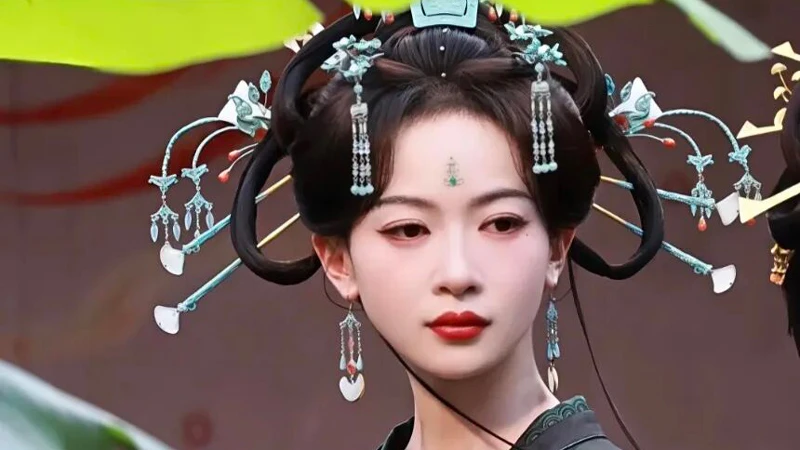
The recent costume drama Feng Bu Qi (凤不栖) has sparked considerable online discussion, not for its plot, but for the striking hairstyles worn by its lead, actress Wu Jinyan (吴谨言). Viewers were immediately drawn to the extraordinarily long hairpins piercing her towering coiffure. This immediately raised a wave of questions: did ancient people really wear such exaggeratedly long hair accessories in their daily lives? Or is this just a dramatic invention by the costume department for visual flair?
Many joked that the pins looked less like jewelry and more like convenient weapons that could be pulled out at a moment’s notice. This isn’t the first time historical dramas have faced criticism for seemingly “over-the-top” or “historically inaccurate” costume designs, often dismissed as pure fantasy. However, a deeper look into the history of ancient Chinese hairstyling reveals a surprising truth: these so-called “exaggerated” long hairpins were not only real but were a practical necessity, serving as the foundational “structural beams” for the elaborate hairstyles of noblewomen throughout history.
The Reality Was Longer Than You Think
Let’s start with a conclusion that might overturn modern perceptions: the long hairpins of antiquity were far more common and often much longer than we imagine. The practical hairpins used in daily life typically ranged from 20 to 30 centimeters. However, those designated for ceremonial or elaborate styling could extend up to 35 centimeters or more. Unlike modern hairpins, which are primarily decorative and delicate, the core value of these ancient long pins was not simply aesthetic; it was structural. They functioned as the essential “load-bearing supports” for complex hairstyles.
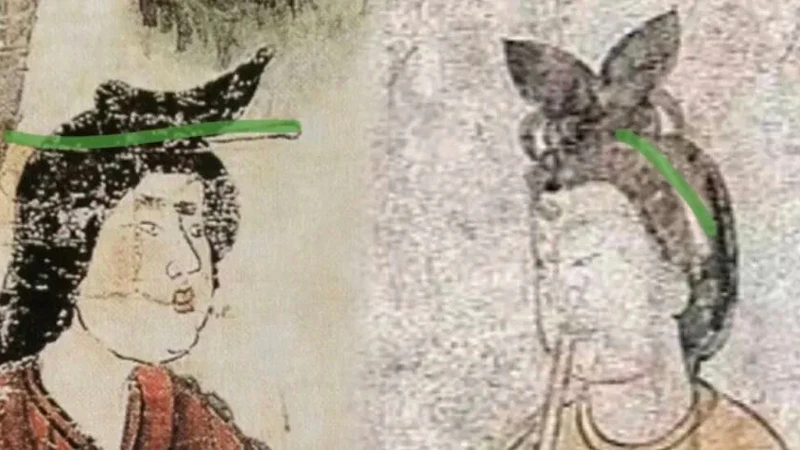
This need for support arose from the creation of grand, towering coiffures, voluminous sideburns, and intricate ring-shaped buns, often supplemented with wigs made of human or horsehair. Natural hair alone could not hold these massive structures in place. The long hairpins acted as a “reinforcing framework,” inserted both vertically and horizontally to “lock” the wearer’s real hair together with the added hairpieces. This interlocking system was crucial for ensuring the elaborate and beautiful styles remained intact and stable throughout a long day. A short, modern hairpin simply lacked the length and grip to provide this kind of foundational support, highlighting a fundamental divergence in the primary purpose of the accessory between ancient and modern times.
From Han Rituals to Tang Grandeur
The history of these long hairpins is long, with their use standardized as early as the Han Dynasty (206 BCE – 220 CE). Interestingly, they weren’t called “long hairpins” back then but were known as Zhi (擿). Hard evidence of this practice was unearthed at the Mawangdui (马王堆) Han tombs, where the well-preserved remains of Lady Xin Zhui (辛追夫人) were found. Her hairstyle showcased three Zhipins made of different materials—tortoiseshell, horn, and bamboo—with the longest measuring 24 centimeters. This length is roughly one and a half times that of a standard pencil, a size that seems improbable to modern viewers but was the standard for Han dynasty nobility.
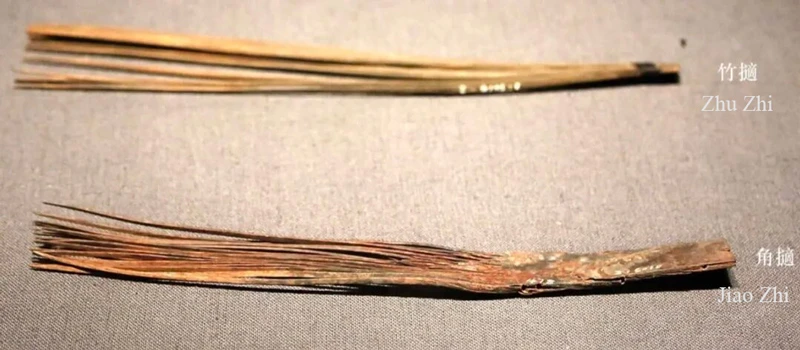
These long pins weren’t just a fashion choice; they were mandated by state rituals. The Book of Later Han (后汉书), in its treatise on ceremonial dress, explicitly states: “For the temple robes of the Grand Empress Dowager and the Empress Dowager… the hairpins shall be made of tortoiseshell, measuring one Chi… The hairpins with fish whiskers shall also measure one Chi.” A Han dynasty Chi (尺) is equivalent to roughly 23-24 centimeters. This regulation proves that wearing a one-Chi hairpin was not optional but a strict requirement for imperial women attending major ceremonies like ancestral sacrifices. This underscores that the long hairpin was a direct symbol of high social status, formal etiquette, and hierarchical order.
During the Tang Dynasty (618-907 CE), aesthetic preferences shifted dramatically towards opulence and grandeur. Hairstyles like the towering “Goose Bun” and the increased use of wigs meant that coiffures became far taller and heavier than in previous eras. Consequently, the difficulty of securing these elaborate styles skyrocketed. The archaeological record reflects this, with a significant increase in the number of excavated long hairpins and combs exceeding 30 centimeters.
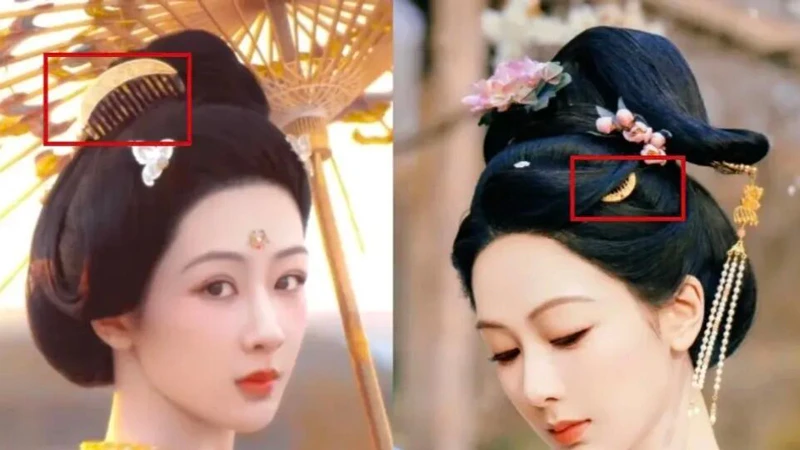
These extra-long pins were indispensable, as they could be driven deep into the core of the massive bun, firmly anchoring the entire structure and preventing it from collapsing or tilting. To further reinforce these hairstyles, people in the Tang and Song dynasties developed the “inserted comb” technique, using thick-backed, fine-toothed combs as “wedges” to secure the seams between real and artificial hair, working in tandem with the long pins as an ancient “anti-shedding device.”
The “Cross Insert” Technique and A Defensive Edge
By the Song Dynasty (960-1279 CE), the use of long hairpins became even more systematic, evolving beyond simple horizontal insertion. This period saw the classic “Cross Insertion Technique” (十字簪戴法). In addition to the traditional horizontal pin for securing the main bun, it became fashionable to insert a vertical hairpin with a spherical head into the center. This cross-pattern, with one pin horizontally and one vertically, created an incredibly stable interlocking structure. Scholars of folklore and costume history suggest this method originated from the ceremonial headdresses worn by Song women, which were later simplified and adapted for everyday use, showcasing a perfect blend of practicality and aesthetics.
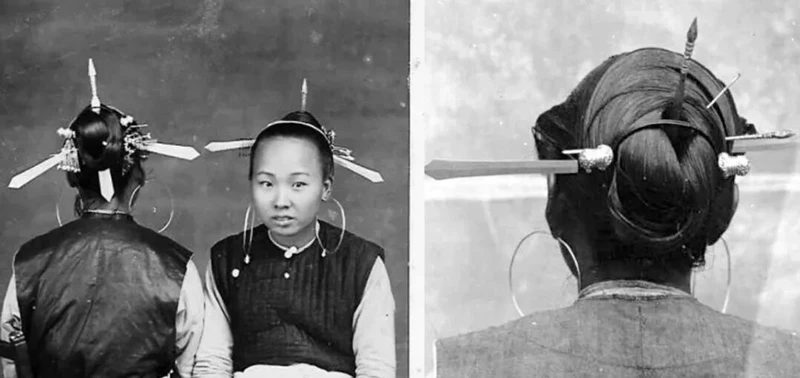
Perhaps the most fascinating aspect of ancient long hairpins is their dual function, blending beauty with a practical, and even defensive, edge. This was not mere internet speculation but a reality preserved in modern folklore. The clearest example is the traditional headwear “Three Hairpins” from Fuzhou, Fujian province, also known colloquially as “Three Knives”. This set consists of three knife-shaped long hairpins arranged in a cross pattern: one in the center back and one on each side, with their tips facing outward. The most popular origin story links them to the Ming Dynasty, when coastal women were said to have modified miniature knives into hairpins for self-defense against Japanese pirates, ready to be used as weapons in an emergency.
While scholarly debate continues over its exact origins—with some tracing its roots back to a similar military-themed accessory from the Jin Dynasty mentioned in the Book of Song (宋书), or to the traditions of the She (畲) ethnic group—the “Three Knives” serves as a living fossil of this ancient tradition. It powerfully illustrates that the long hairpin was more than just an ornament; it was a piece of cultural history that fused aesthetic beauty with strength and self-reliance. The long hairpin, therefore, is not a Hollywood-style invention. It was the essential structural core of an elaborate and historically significant hairstyle, reflecting the ceremonial culture, practical aesthetics, and the quiet strength of the women who wore them for centuries.