
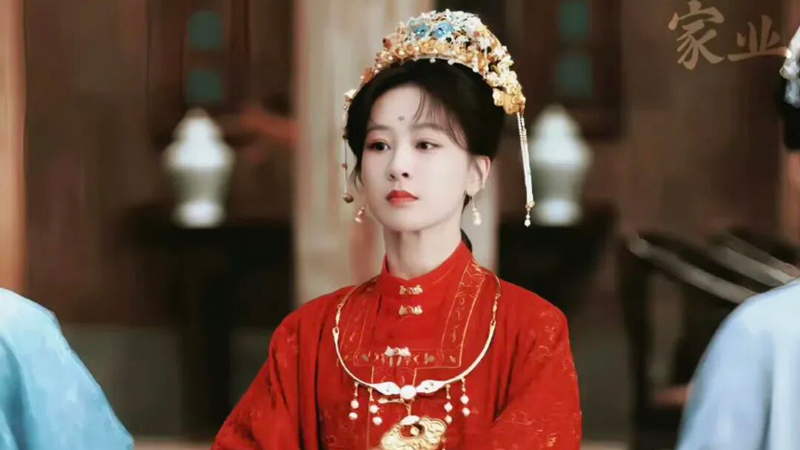
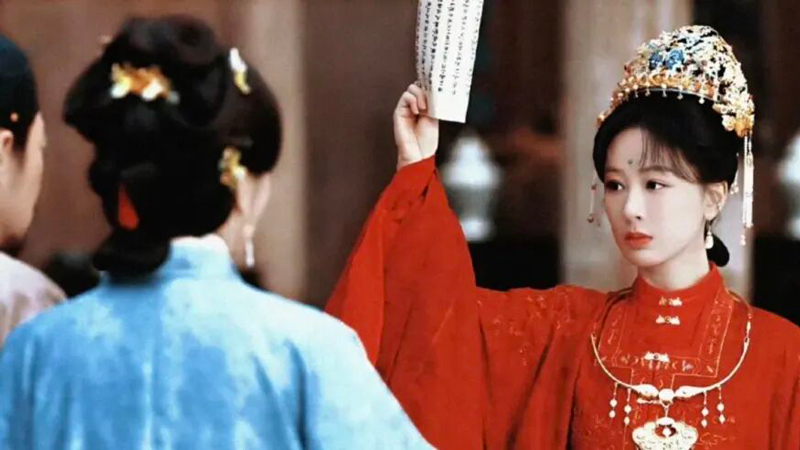
Has Yang Zi (杨紫) worn a Ming or Qing dynasty crown in the new drama The Mo (家业)? Her wedding look recently sparked heated debates online. While the show is set in the Ming period, the crown on her head leans heavily toward Qing dynasty style. To the untrained eye, the two dynasties’ phoenix crowns look nearly identical. But a few key differences—visible from across a busy street—tell them apart. This article breaks down those clues without drowning you in museum jargon.
1. Shape & Structure

The most obvious difference is how the crown covers the head. A Ming dynasty phoenix crown wraps fully around the wearer’s hair. It has a clear base and inner lining, forming one solid, tall piece. You see the whole structure from front to back, like a helmet made of gold and feathers. Those four complete Ming crowns kept in Beijing’s museums all share this all-enveloping shape. They sit high and proud, covering the entire top of the head.
Now look at a Qing dynasty crown—especially from the mid-to-late period. Some are fully wrapped, but many are half-wrapped. The half style leaves part of the hair or an inner cap exposed. Even the fully wrapped Qing versions, such as certain Dian Zi (钿子) that borrowed phoenix elements, appear flatter and lower. They don’t tower like Ming crowns. Qing crowns also tend to be smaller overall. Most surviving Qing examples are made with hollowed-out filigree, though a fabric lining was often added inside for comfort.
So when you see Yang Zi’s crown in the The Mo trailer, notice how it sits. Does it wrap completely? Or does it look slightly compressed and lower on her head? That lower, more compact fit points straight to the Qing aesthetic.
2. Decoration Rules
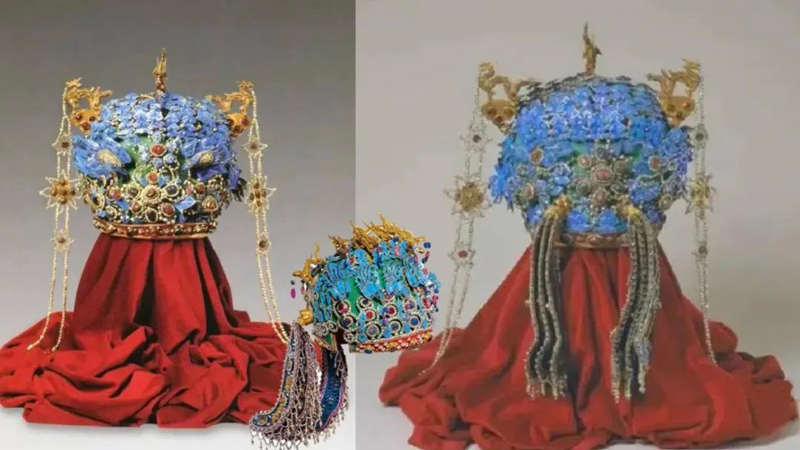
Ming dynasty crowns followed strict rank rules. A noblewoman’s crown had to have a set number of dragons and phoenixes—six dragons with three phoenixes, nine with nine, or twelve with nine. The dragons were made of piled gold wire, the phoenixes using kingfisher feather inlay. Accessories like beaded tassels and side flaps also had fixed placements. Nothing was random. Everything followed a visual law.
The Qing dynasty threw those rules out the window. On a Qing phoenix crown, dragons, phoenixes, flowers, and auspicious symbols pile together without clear hierarchy. You feel the crowding. Jingles hang from odd angles. Extra pearls cluster without purpose. This is not chaos from lack of skill—it was a deliberate shift in taste. The Ming loved symmetrical order. The Qing loved ornate accumulation. One looks like a formal garden; the other like a treasure chest dumped on a table.
Look again at Yang Zi’s crown. Does it have a balanced, almost mathematical arrangement of dragons and phoenixes? Or do the decorations feel layered and busy, as if more is always better? Her crown leans toward the busy side—that’s the Qing influence.
3. The Beaded Curtain Trick
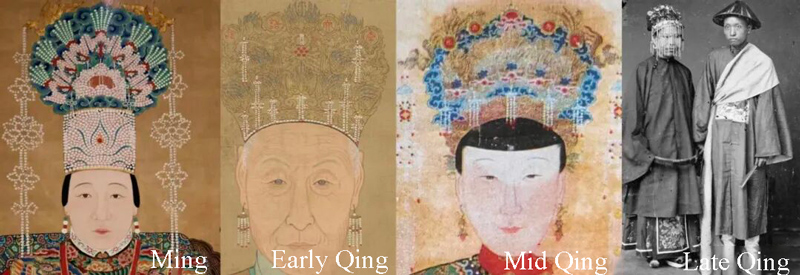
Both dynasties used long pearl strings hanging from the crown’s front or sides. But how they used those strings is a dead giveaway. In the Ming period, these strings—made of pearls and agate—were relatively short and subtle. They did not block the eyes. The look was borrowed from Song dynasty fashion, where pearl decorations were a delicate highlight, not a barrier.
In the mid-to-late Qing, those strings grew dramatically longer and thicker. By the late Qing, they became the exaggerated curtains you see in many period dramas—strings that literally cover the eyes. Early Qing versions were still moderate, not obstructing vision. But fashion escalated. Some noblewomen even customized the curtain length, making it a personal statement. However, the general rule holds: if the beads reach the nose or mouth, it’s almost certainly Qing.
Yang Zi’s crown in The Mo features noticeable long bead strings. They don’t hide her entire face, but they are far from the restrained Ming style. That’s another Qing signature.
4. The Diansi vs. Di Ji Confusion
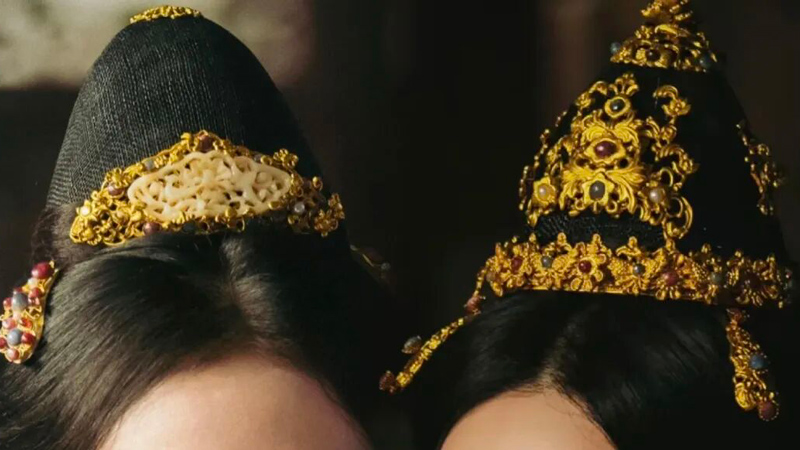
Here’s where even costume designers blur lines. The Qing dynasty had a separate hair cap called Dian Zi, which evolved from early Qing “head wraps.” It comes in half and full versions. A Dian Zi sits flat on the head, more like a modern hat than a towering crown. It is decorated with detachable hairpins. Many TV dramas use Dian Zi instead of real phoenix crowns because it’s easier to style.
But here’s the problem: in late Qing and early Republic times, people started mixing Dian Zi elements with phoenix crown elements. They added fake phoenixes, extra bead curtains, and random jewels onto a Dian Zi base. The result is a hybrid that looks like a crown but feels like a cap. This “stacked” style confuses most viewers. Yang Zi’s crown has hints of that hybrid look—not purely a crown, not purely a Dian Zi.
The Ming dynasty also had a one-piece hair cap called Di Ji (䯼髻). But it was fully wrapped and made almost entirely of gold ornaments. A Ming noblewoman could put on her Di Ji and walk out the door—no further styling needed. That Di Ji never got mixed up with a phoenix crown. The Qing, in contrast, loved mixing categories. So if a crown feels like it’s trying to be two things at once, it’s probably Qing.
5. Rarity & Social Access
Finally, consider who could own one. Ming dynasty phoenix crowns were strictly controlled. Only women of certain rank—empresses, imperial consorts, and high-level noblewives—could wear them. Breaking the rule was a crime. That is why only four complete Ming phoenix crowns exist today, all locked in Beijing’s museums. Each one is a national treasure.
The Qing dynasty flipped this system. By the mid-to-late Qing, any family with enough money could commission a phoenix crown. They became a status symbol for merchants and wealthy commoners, not just nobility. Official wives of high rank even received imperial-made crowns carved with “By Imperial Decree”. But ordinary rich people copied the style freely. As a result, thousands of Qing-style phoenix crowns survive today. They are common in antique markets and private collections.
Yang Zi’s crown in The Mo resembles the ceremonial crowns worn by Han Chinese noblewomen of the Qing dynasty—inheriting basic Ming shapes but loaded with Qing decorative flair. It is a sign of status, but a flexible status. That flexibility is pure Qing. So next time you watch a period drama, count the bead strings, check the crown’s height, and see if you can spot the dynasty before the subs tell you.

