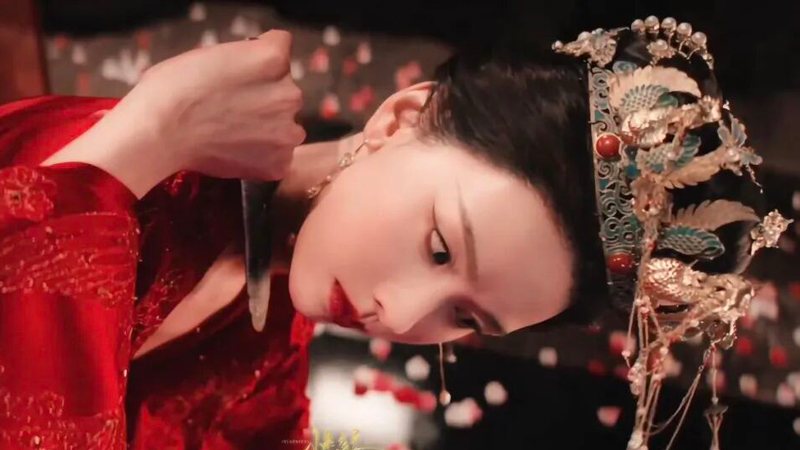
Has a simple costume detail ever sparked a heated debate about two great dynasties? Recently, actress Chen Duling (陈都灵) appeared in a promotional still from the upcoming drama Veil of Shadows (月鳞绮纪) wearing a magnificent phoenix crown. Fans immediately praised its antique elegance. But then came the question: is that headpiece from the Ming Dynasty (明朝) or the Qing Dynasty (清朝)? The answer is not as straightforward as you might think. While the two eras produced similar-looking crowns, their rules, shapes, and social meanings could not be more different. Let us break down what makes a Ming Feng Guan (凤冠, phoenix crown) different from a Qing one – and why Chen’s latest look leans heavily toward the later period.
Spot the Difference
The most obvious visual clue is coverage. A Ming phoenix crown is a full-wrap structure. It covers the entire top of the head like a helmet of jewels and feathers. In contrast, a Qing crown – especially from the mid-Qing onward – is often half-wrap, leaving the back or sides of the hair exposed. That said, some Qing examples are also full-wrap, particularly when they borrow elements from the Dian Zi (钿子, a hat-like hair foundation). But those tend to sit flat on the head, not tall like a Ming crown. Chen’s piece sits high and prominent, yet its side structure shows clear mid-to-late Qing characteristics.
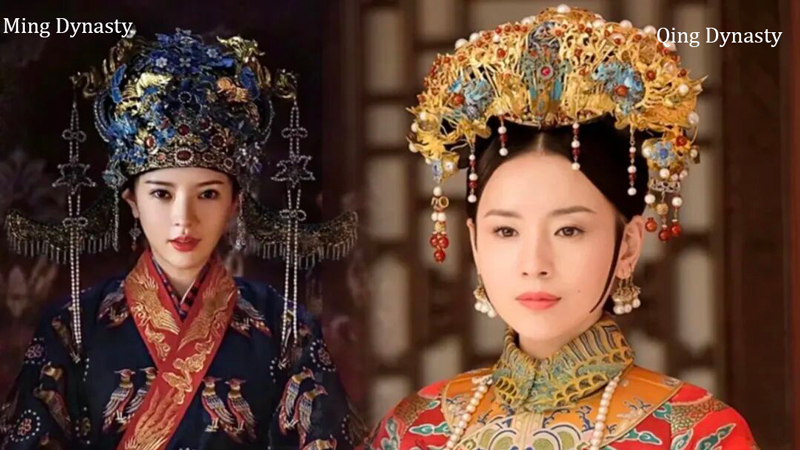
Next, look at the arrangement of decorations. Ming crowns followed strict imperial rules. Depending on the wearer’s rank, she might have a “six-dragon three-phoenix” or “nine-dragon nine-phoenix” layout. Dragons were made of piled gold wire, while phoenixes used kingfisher feather inlay. Everything – the dangling tassels, the side wing ornaments – followed a fixed pattern. Qing crowns have no such discipline. Elements pile up freely. You might see a phoenix next to a flower next to a butterfly, all competing for attention. This eclectic “more is more” approach is a hallmark of mid-to-late Qing design.
Then there are the bead curtains. Ming crowns could have tassels or side hanging ornaments called Bo Bin (博鬓, ornamental side wings), but they never blocked the face. Their bead strings were short, made of pearls and agate. Qing crowns, especially after the mid-period, feature long, exaggerated bead curtains hanging down the front or sides. Some are so long they cover the eyes – a style that became extreme in the late Qing. Chen’s crown has noticeable front bead drapes, but they do not yet obscure her vision. That places it firmly in the mid-Qing aesthetic, before the trend turned theatrical.
The Flexible Headpiece
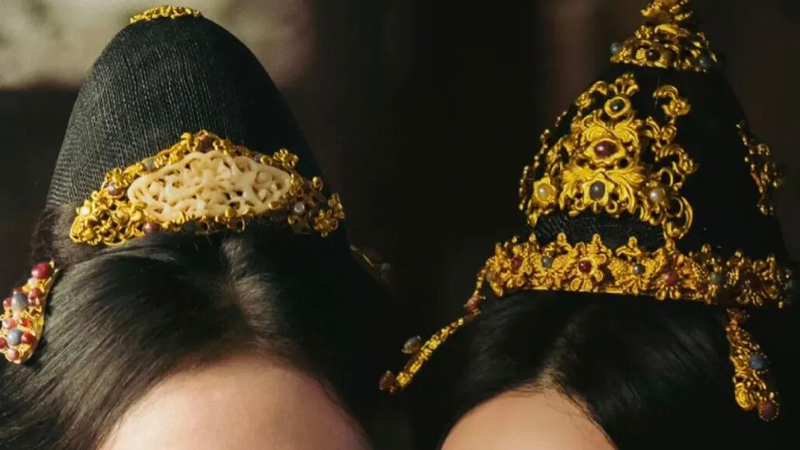
Here is where things get tricky. The Qing Dynasty had a separate headgear called the Dian Zi. It evolved from early Qing “head wraps” and became wildly popular from the mid-Qing onward. Think of it as a pre-decorated hair hat with a solid base. Depending on whether it covered the whole head or just the front, it was called a “full Dian Zi” or “half Dian Zi.” Actresses in period dramas love the Dian Zi because it is easy to pin on and style quickly. But here is the catch: Dian Zi and phoenix crowns were often mixed together. Costume designers would add phoenix ornaments and bead curtains to a Dian Zi base. That hybrid is very hard to date. Chen’s headpiece shows exactly that kind of blending – a tall shape but with Dian Zi-like side elements.
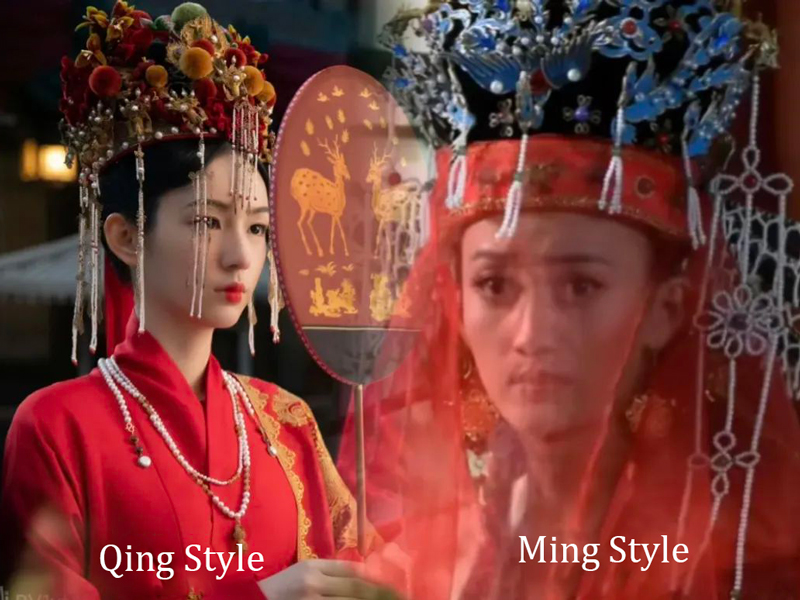
The Ming Dynasty had its own version of a one-piece hair hat. It was called a Di Ji (䯼髻, a wire-mesh hair cap). Unlike the Dian Zi, the Di Ji was always full-wrap. It was usually made of gold mesh and decorated with a full set of hairpins and ornaments. A noblewoman could put it on and be fully dressed in seconds. The Di Ji was extremely expensive – gold, pearls, kingfisher feathers – and its shape was rigid and tall. Qing Dian Zi, by contrast, could be flat or half-dome, and they used a wider range of materials, including silver, artificial flowers, and even cloth. Chen’s crown is too tall and ornate to be a pure Dian Zi, but its front bead arrangement is pure Qing.
By the late Qing and early Republican era, women began using modular headpieces. These were called “detachable tassel Dian Zi” – essentially a set of comb-like hairpins that could be mixed and matched. Women would “play” with the pieces, creating new combinations every day. This DIY spirit was unthinkable in the Ming Dynasty, where your crown strictly announced your rank. So when you see a phoenix crown in a drama today, ask yourself: does it look like it follows a rulebook, or does it look like someone had fun piling on beautiful things? Chen’s crown leans toward the latter – which makes it quintessentially Qing.
Rarity and Access
One historical fact puts everything in perspective. Ming phoenix crowns were strictly regulated. Only women of noble rank – empresses, imperial consorts, and high-level officials’ wives – could wear them. Breaking that rule was a crime. As a result, very few complete Ming crowns survive today. Only four intact examples exist, and all of them are kept in museums in Beijing. They are national treasures. Qing phoenix crowns, on the other hand, became widely available. By the mid-Qing, any reasonably wealthy family could commission a phoenix crown for a bride. That is why so many Qing-era crowns have come down to us through private collections and antique markets.
This democratization changed the crown’s meaning. In the Ming, the phoenix crown was a symbol of state authority. In the Qing, it became a symbol of personal prosperity. You did not need an imperial edict; you just needed silver. That is why Qing crowns show so much regional variation and personal taste. Some are delicate and restrained. Others are loud and overloaded. The lack of a central design bureau meant every craftsman could add his own flair. Chen’s crown has that handmade, slightly irregular feel – the hallmark of a piece made for a wealthy commoner, not an empress.
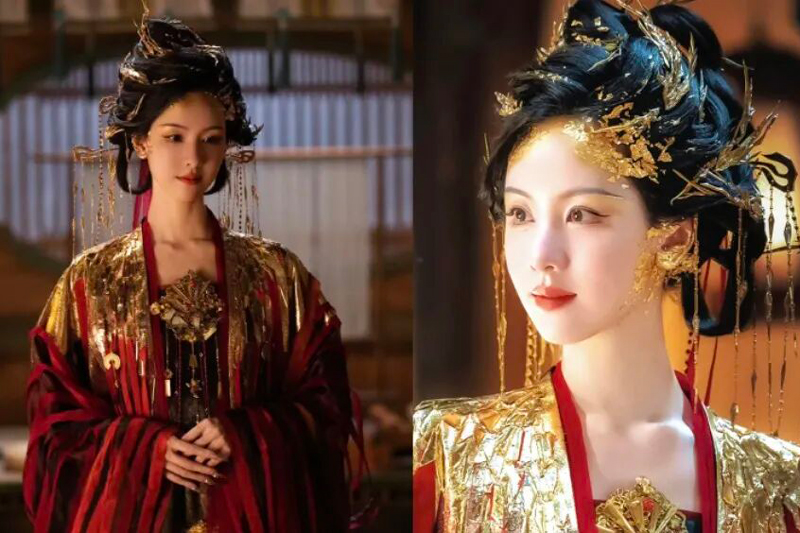
Some fans have pointed out that Chen’s look resembles her previous role as the “Mirror Demon” from another drama. That character also wore heavy head ornaments, multiple bead curtains, and a tall, face-framing hairstyle. But there is a key difference. The Mirror Demon’s style was pure fantasy. Her new phoenix crown is historically grounded – specifically, in the mid-to-late Qing transition period. It borrows the height of a Ming crown, the bead curtains of a mid-Qing crown, and the flexible base of a Dian Zi. That hybrid is exactly what a real Qing-era bride from a well-off merchant family might have worn. So when a netizen asked, “Ming or Qing?” the honest answer is: neither and both. But if we must choose, it is Qing – with a wink to the Ming.