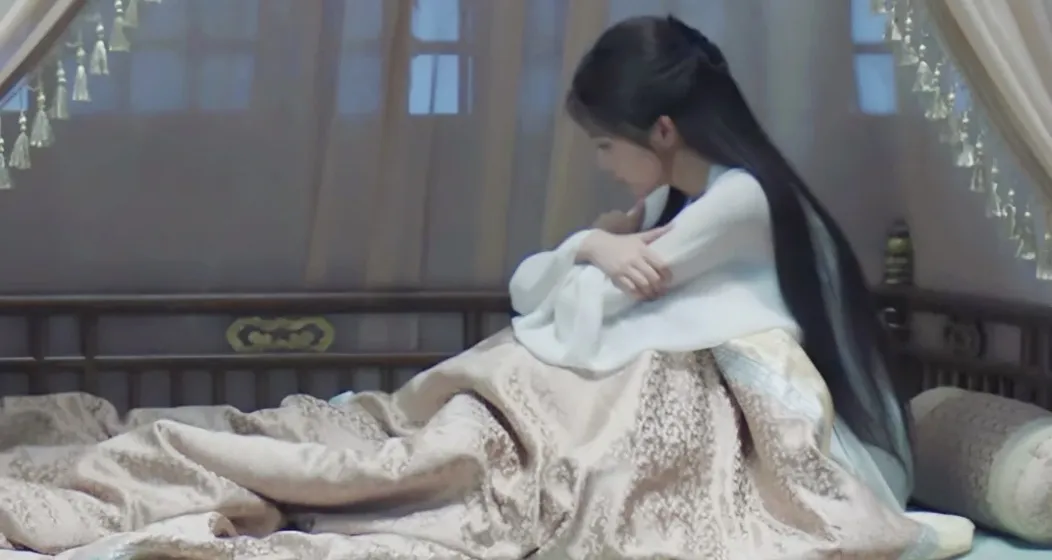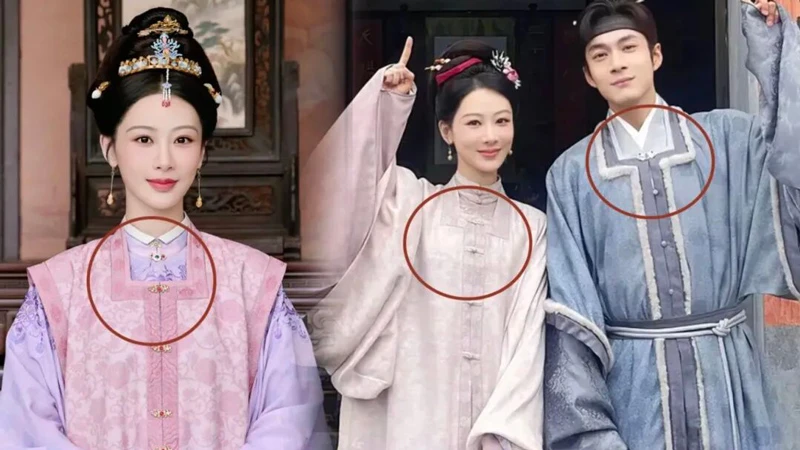
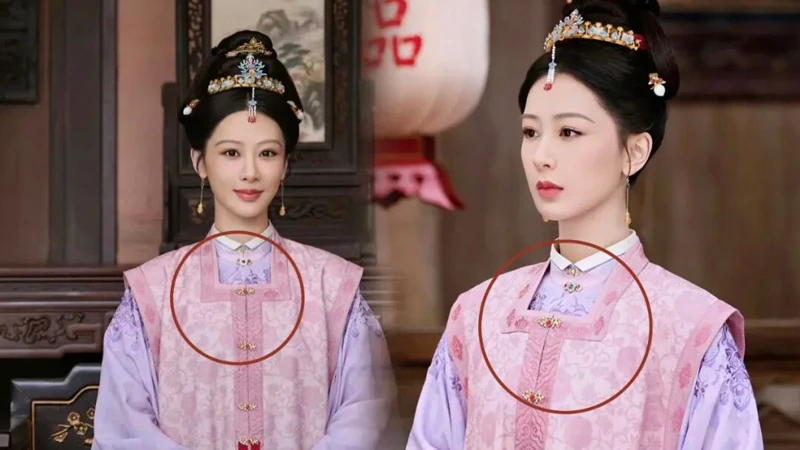
In the historical drama The Mo (家业), actress Yang Zi (杨紫) appears in a costume that has sparked online curiosity: her collar is perfectly square. Modern fashion rarely uses such a shape, so why did a woman in the Ming Dynasty (1368–1644) wear one five hundred years ago? The answer reveals a forgotten chapter of Chinese clothing design—one that favored geometry, layering, and hidden messages stitched into silk. This article uncovers the square collar’s journey from ancient tombs to royal wardrobes, and why it might just be the most unexpected trend of the Ming era.
A Forgotten Geometry
Long before the Ming, during the Shang (商) and Zhou (周) dynasties (c. 1600–256 BCE), tailors experimented with rectangular collars like the Ju Ling (矩领) and Fang Ling (方领). However, archaeological evidence remains thin, and these shapes never gained wide popularity. The dominant style for millennia was the Jiao Ling (交领)—a crossed collar that wrapped left over right. It was simple, practical, and anchored traditional Hanfu for centuries.
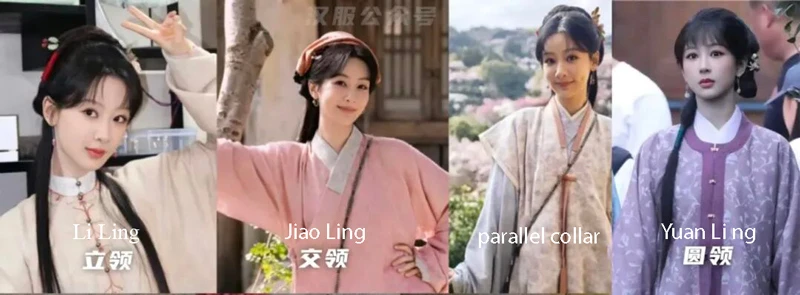
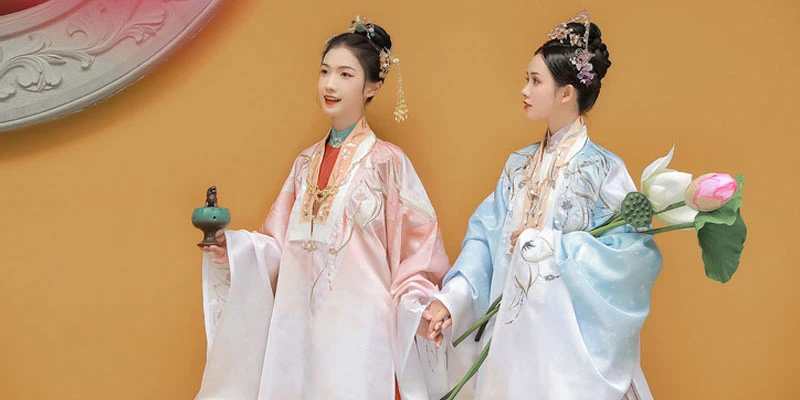
By the Ming era, collar options exploded. Women could choose from Li Ling (立领, standing collar), Yuan Ling (圆领, round collar), Fang Ling (square collar), and the classic Jiao Ling. Among these, the square collar remained relatively rare, but it appeared frequently in Ming paintings and portraits. He often wore it as an outer layer, revealing the inner collar beneath—a deliberate design choice that created visual depth.
In The Mo, Yang Zi’s character pairs her square collar with a standing collar underneath. Her male counterpart, played by Han Dongjun (韩东君), instead uses a crossed collar inside. This difference is not random; it follows historical records where the square collar acted as a frame, allowing the inner garment’s neckline to become a decorative border. The effect is subtle but striking—like a window within a window.
Unearthed Elegance
Real evidence comes from the tomb of Ding Ling (定陵), the final resting place of the Wanli (万历) Emperor and his empresses. Excavated in the 1950s, the site yielded dozens of silk garments featuring square collars. Two notable examples are a flower-patterned padded jacket featuring the hundred-children motif, and another inscribed with “boundless good fortune”. These pieces were mostly short-sleeved or half-sleeved, highlighting the square collar as a warm-weather or over-garment choice.
It also appeared on long-sleeved coats, sleeveless Bi Jia (比甲, a type of vest), and Ban Bi (半臂, half-arm jackets). By varying the length of the garment—from waist to ankle—Ming designers created a versatile wardrobe. The square collar almost always served as an outer layer, often fastened with fabric or metal buttons down the front. This allowed the wearer to show off two or three layers of collar edges at once.
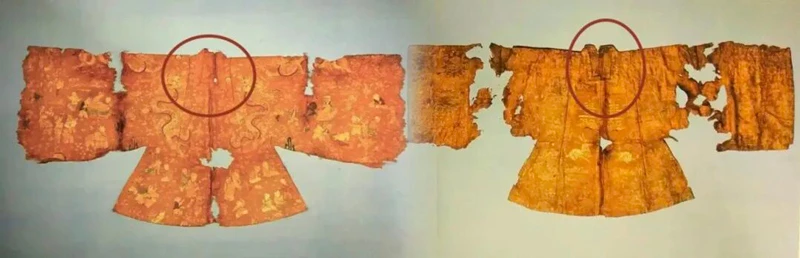
One of the most surprising finds is the Fang Ling Shen Yi (方领深衣), a square-collared deep robe. The Ming scholar Jiao Hong (焦竑) wrote in his Jiao Shi Bi Cheng (焦氏笔乘) that the ancient ritual garment “Qu Ge Ru Ju” (曲袷如矩) actually described a square collar like a carpenter’s L-square. He argued that later generations had misunderstood it as a diagonal collar, but the correct Ming interpretation was a crisp right-angled neckline. This shows how the square collar was not a novelty but a revival of classical ideals.
Wider Echoes
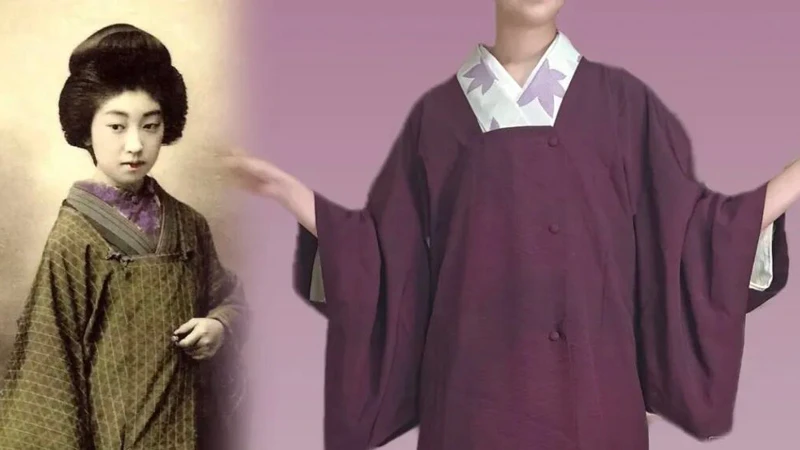
The influence of the Ming square collar did not stop at China’s borders. In Korea and Japan, traditional garments absorbed similar design elements. The Japanese traditional haori coat features a square or near-square collar that traces its lineage to Ming fashion through centuries of cultural exchange. Even today, visitors to Kyoto can see this silhouette in formal wear—a quiet reminder of shared East Asian textile history.
Why did the square collar work so well? It perfectly suited the Chinese love for layered dressing. Each layer revealed a different collar—the inner standing collar, the middle crossed collar, then the outer square collar. In a flat two-dimensional cut of fabric, this technique created a three-dimensional sense of depth. When she moved, the layers shifted subtly, drawing the eye to the craftsmanship. The same principle applies to the full-length skirt combinations: the upper jacket paired with pleated skirts, horse-face skirts, or paneled skirts.
Today, square collars are almost absent from fast fashion. Yet five centuries ago, Ming women wore them as everyday elegance. Their existence challenges our assumption that historical clothing was always conservative or repetitive. Instead, it was experimental, playful, and deeply thoughtful about geometry. The next time you see a drama like The Mo, look closely at the collar. That square shape is not a costume mistake—it is a window into a forgotten world of design intelligence.
How Ancient Chinese Clothing Used Buttons for Style and Function