The Yangzhou leg of a provincial morning tea competition closed on November 22 after two days of cooking, selling and parading along the city’s northern moat, with six rounds of Hanfu processions running around a single red bridge. The event was the opening stop of the second edition of a Jiangsu circuit that tours counties and cities under the banner of a hundred counties and a thousand flavours, and it bundled a chef contest, a breakfast market and a costume parade into one walking route between Yechun Garden, the moat, Wenhui Pavilion and Fengle Upper Street.
Four Tracks, One Banquet
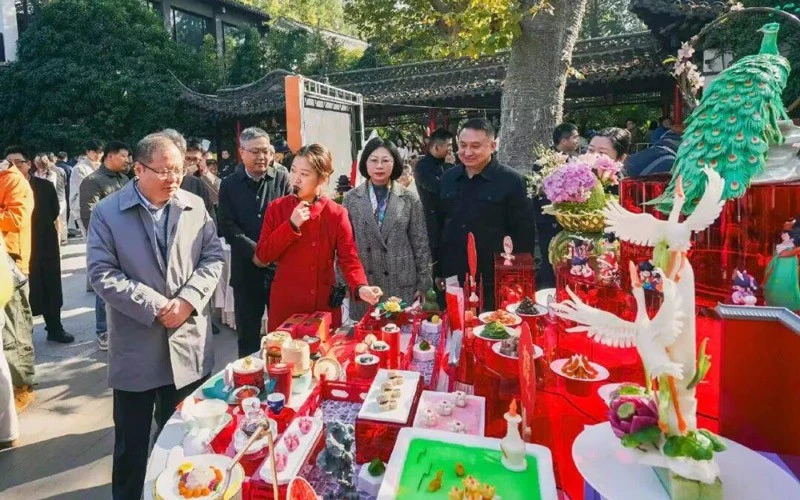
Five cities sent teams: Yangzhou, Taizhou, Zhenjiang, Yancheng and Nantong. The contest opened on the morning of November 21 at the opera stage square in Yechun Garden, organised by the Jiangsu provincial department of commerce, the provincial broadcasting group and the Yangzhou municipal government, and judged across four tracks that map onto how the meal is actually eaten: a bowl of soup, a basket of dim sum, a single creative dish and a full banquet table.
Yangzhou fielded a team led by Ni Qiuxiang, a city food ambassador, with younger cooks alongside her, and its entry was a Red Chamber breakfast banquet built from the food references in the novel. Results came on November 22. The team took the award for best banquet presentation, swept the gold in the dim sum track, and scored in the creative category with a sparkling tea served against a crisp five-dice bun. Presentation, basic technique and invention are the three things a breakfast kitchen finds hardest to hold at once, and the three prizes landed one on each.
Two Days of Markets, Sold Out by Noon
The market at Wenhui Pavilion square ran from 9:30 to 16:30 on both days, with a themed stall per city. Queues at the Yangzhou large-oil flatbread stall never cleared. Taizhou sold through more than ten crates of its stuffed buns, paper-thin shaomai and soup dumplings in half a day. Zhenjiang pushed pork terrine, pot-cover noodles and vinegar. Yancheng’s lotus-root balls and hand-made egg pancakes had vendors on site from eight in the morning, and one secret sauce ran out. Nantong’s crab roe buns from Changqing Ge sold out on opening, with vegetable buns and Rugao hearth flatbread short on supply through the weekend.
A second market ran from Wenhui Pavilion to Fengle Upper Street with more than fifty local firms, heritage brands and craft vendors across three zones, and the everyday goods section is where clothing appeared: a firm from Xiannv town showed Chinese dress in mulberry silk and Xiangyunsha, drawing a crowd on material and cut rather than on price. That a fabric once kept behind museum glass now sells next to salt and iron woks is the change these markets have made over two years. Yancheng salt moved ten crates in two days, a record for the city’s markets, and one vendor sold twenty Guyazhou iron woks in a day.
Six Rounds Around the Red Bridge
What turned a food fair into somewhere to spend an afternoon was the garden programme along the moat. With the red bridge as its centre, the two days carried six rounds of Hanfu processions, Kunqu sung across the water from boats, a resident band, breakfast buses, craft stalls, pitch-pot games and costumed characters. Organisers framed it as a reconstruction of the scene recorded in Yangzhou Huafang Lu, a Qing account of the city’s teahouses, painted boats and street entertainment in the Qianlong era.
Putting a Hanfu parade into a breakfast setting is less of a stretch than it sounds. Yangzhou breakfast peaks early, and a garden beside water is the natural stage; a visitor who has finished a pot of green tea and a basket of buns walks the moat afterwards and meets the procession rather than buying a ticket for it. Compared with a theatre show, walking past lowers the cost of watching and lets the clothing be part of the street for an hour.
The craft programming followed the same logic of making things touchable. A masterclass in dim sum had heritage cooks teaching visitors to crimp a bun and shred dried tofu by hand, breaking the kitchen’s sequence into moves a beginner can copy. A double-decker Yechun food bus also debuted, with coffee, tea and a lounge inside.
Distribution was wired to spending. The main venue hosted an open studio carried live on the provincial broadcaster’s app, which drew more than two million views, and the event ran coupons with a local bank alongside a map listing of popular small restaurants. For the Hanfu trade the useful part is the template rather than the footfall: a restaurant, a garden and a stretch of water can host a procession and a styling trade without waiting for a dedicated culture festival. Yangzhou has already scheduled the next round around the December shopping day, New Year and the January holiday.