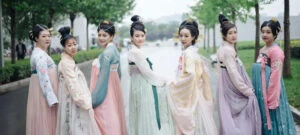
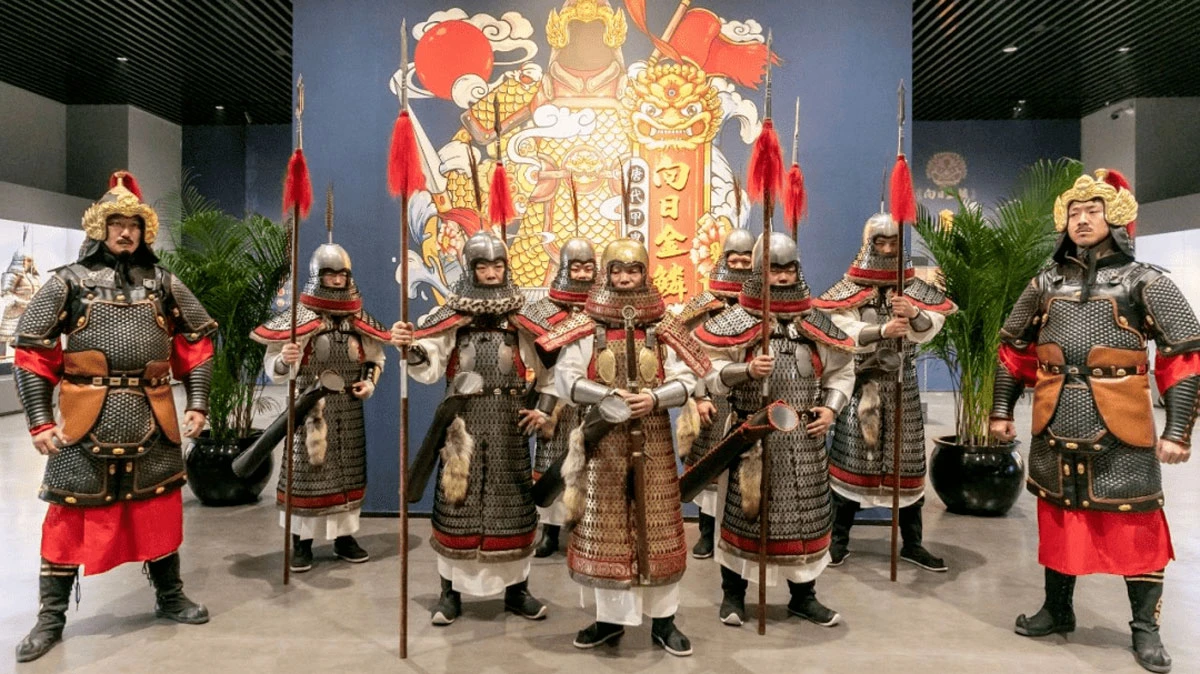
Over the November 11 shopping festival in 2026, apparel sold roughly the same number of units as the year before at a higher average price, a pattern Chinese retail analysts describe as flat volume, rising price. A note issued by Wanlian Securities on November 15 put a number on the shift: the average order for mid-to-high-end Chinese apparel brands on Tmall reached 1,309 yuan, against 1,123 yuan previously, a gain of 16.6%. The 1,500 to 2,000 yuan band grew six times faster than the market as a whole, the count of domestic brands selling above 1,500 yuan rose 50%, and 43% of sales value came from newly launched products, 48.3% in womenswear.
Those figures come from third-party monitoring, the Lijin database and Xingtu, relayed through a brokerage note. They describe one channel and one shelf position. They are not a Hanfu price index, and the difference matters before anyone quotes them.
What the Average Order Actually Measures
Behind the 16.6% sits a sample of mid-to-high-end Chinese apparel brands selling on Tmall, a filtered slice of a much larger market. Treating it as the price level of the Hanfu category, or of the neo-Chinese category, would be a category error. The denominators in circulation differ so widely that they cannot be added together: the broader Guochao apparel market passed 250 billion yuan in 2025, neo-Chinese apparel is estimated near that figure with growth above 15% a year, and the Hanfu segment alone was put at 19.11 billion yuan in 2025 with 22.8 billion forecast for 2026, a rise of 30.2%.
Production-side numbers live in a different frame entirely. Caoxian in Shandong, which supplies about half the national Hanfu market, recorded 13 billion yuan in sales in 2025 from 2,822 firms, 15,627 online shops and 224 physical experience stores. None of these totals can be swapped for another. Each answers a different question about a different set of sellers.
A Market Split Down the Middle
Inside the category, two price bands run side by side and obey different logic. The core buyer, concentrated between 25 and 34 and skewing towards women in tier-one and tier-two cities, transacts mainly between 500 and 2,000 yuan. That range covers the cost of the materials and the labour the category depends on, and it is also the ceiling most buyers will accept for something they intend to wear to work. Below 500 yuan, silk blends, jacquard, embroidery and Pankou work are hard to pay for. Above 2,000 yuan, the product moves into custom and occasion wear, and the pool of buyers narrows sharply.
Online tells a second story. Chanmama’s monitoring of neo-Chinese womenswear put the mainstream band at 100 to 300 yuan, with most listings and most units below 300, while products above 300 grew faster in sales value. The two readings are not in conflict. One measures brands in flagship stores, the other measures traffic on a platform. Put together they describe a dumbbell: a low end driven by volume and live streaming, a high end propped up by fabric and craft, and a middle whose reason to buy is thinning.
Scenario shift is measurable too. Commuting-oriented neo-Chinese apparel grew 47% in 2025, the fastest of any sub-segment, and more than 60% of demand is now described as coming from daily use rather than festivals. Average order value on Taobao for the category moved from roughly 400 yuan in 2024 to roughly 600 yuan in 2026. A garment bought for the office can carry a higher price than one bought for a single holiday photograph, because it gets worn more often.
Fabric Cost Sets the Floor
Material explains why the floor sits where it does. Entry-level full-silk Song brocade runs 140 to 280 yuan a metre; mid and high-end jacquard and heavy satin run 300 to 600; collector-grade material goes from 800 to well past 2,000. Xiangyunsha retails at roughly 320 to 380 yuan a metre. A single shirt in 22-momme Xiangyunsha therefore starts near 500 yuan in fabric alone, before a cutting table or a sewer is involved.
That arithmetic does two things. It makes a 1,309 yuan order plausible for a well-made garment rather than evidence of inflation, and it makes the same figure implausible for anything using hand-worked Kesi or Su embroidery across a large panel, where the hours alone exceed the price. A price band statistic cannot distinguish between a garment that is expensive because of its cloth and one that is expensive because of its marketing, and both sit inside the same average.
Brands Without a Price Leader
Concentration is the structural fact behind the pricing. The top five brands hold around 28% of the neo-Chinese apparel market, and no single brand has passed 5%. Measured across the wider field, the top ten hold about 15%. Domestic brands account for 89% of sales, leaving imports confined to the very top of the handmade and custom tier. The result is a two-storey structure: a high floor of craft and design brands with limited volume, a ground floor of scaled manufacturing that competes on speed, and a contested middle where several labels are trying to hold position.
Supply chains hand the same element library to everyone, and that is the weak point. Standing collars, Pankou closures and jacquard are available to anyone with a supply chain, so a small team can put a neo-Chinese item on sale within weeks. Differentiation then rests on photography, copy and the person presenting it in a livestream, and comparison inside a livestream compresses the margin window on every single item. Zhu Keli, founding director of the Guoyan New Economy Research Institute, has argued that the long-term competitiveness of Guochao apparel has to be built on design and cultural substance rather than on stacked symbols.
Policy is pushing the same direction. A seven-ministry implementation plan issued in November 2025 lists Guochao apparel among ten consumption categories intended to reach a hundred billion yuan each by 2027, and asks for traditional culture to be built into product design and original brands rather than applied as decoration. Whether that arrives as better cloth or as better storytelling will decide which half of the dumbbell grows.
Reading the next price-band headline takes three questions before the number lands: which sample, which channel, and whether the category is the one you think it is. A 16.6% gain across a Tmall basket of mid-to-high-end brands says something real about where Chinese apparel is being priced. It says nothing directly about what a Hanfu shop in Caoxian charges, or what a chinese dress costs in a mall in Chengdu.