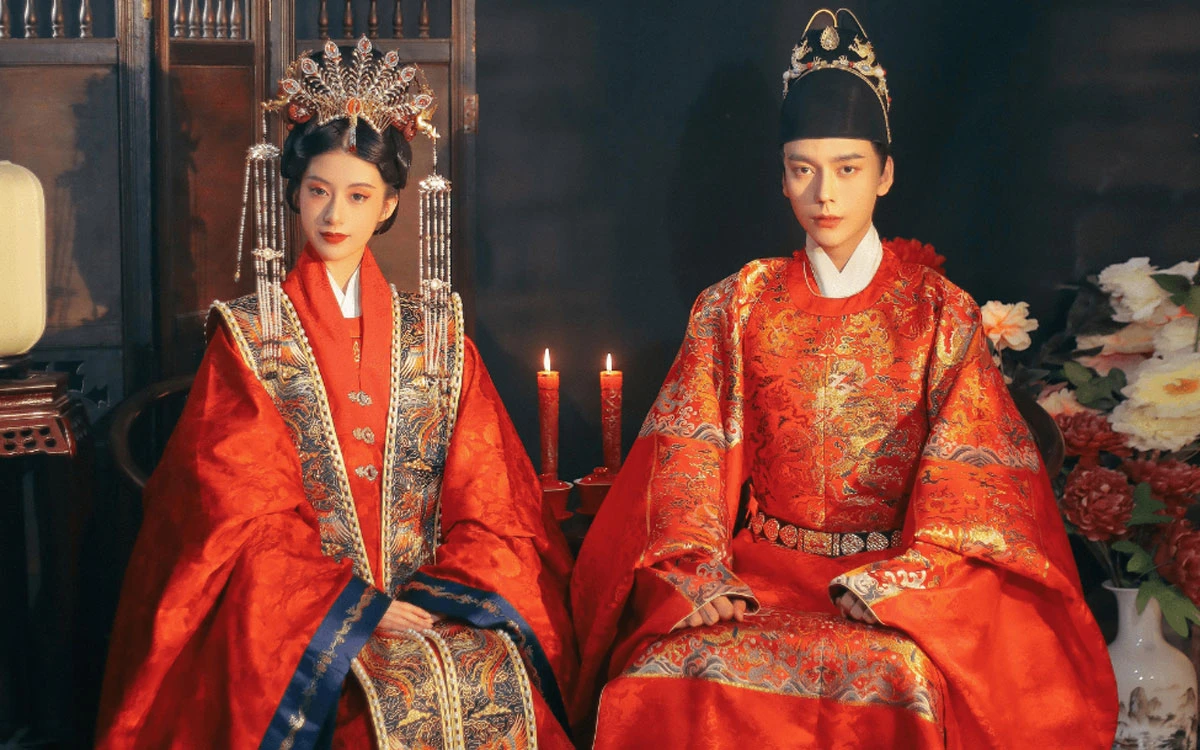
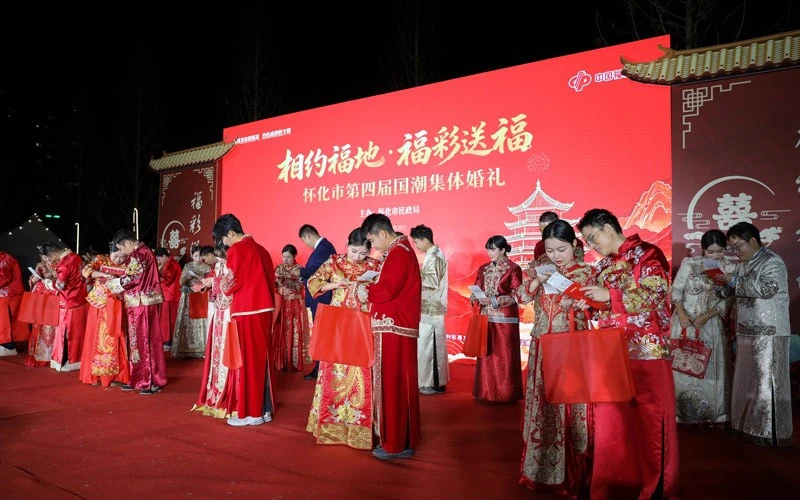
Sixteen couples walked a red carpet in Huaihua, Hunan, on November 20 and stopped in front of a low table to sign. The signing happened twice: once in the morning, on a stone lane inside Jingping, an old village in Zhongfang County, and once at dusk, when the same pact came back to them as a scroll handed over by a guest at the Huaihua Super Rice Paddy Courtyard. The fourth Guochao collective wedding in the city ran from daylight to dark, and the paper travelled the whole way.
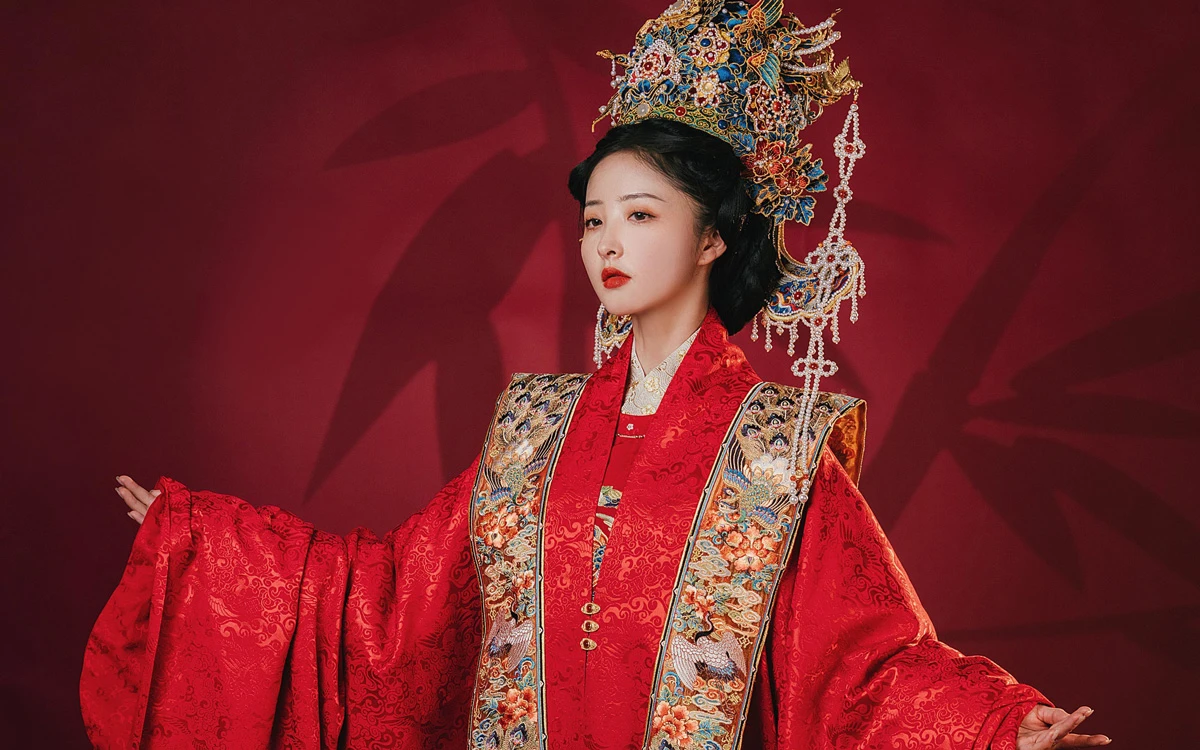
Huaihua’s civil affairs bureau organised it. Among the sixteen were schoolteachers, veterans, laboratory researchers and hospital staff, all of them in chinese traditional dress. No convoy of cars, no banquet spread across a hall.
A Pact Signed in the Old Village
Morning began as a check-in route branded around Huaihua’s own sites. The couples filed into Jingping, where flagstones run between old walls, and phones came out. The pact was signed on site, which turned the village itself into the witness.
From there the route went to the railway culture exhibition beside the new Huaihua Museum, where the group climbed into a green-skinned carriage set on a rebuilt platform, with track and gantry crane around it. The choice points at a second identity for the city. The Xiangqian and Jiaoliu lines meet at Huaihua, and a town became the rail hub of southwestern Hunan. That history was built into an exhibition and then written into a wedding itinerary.
Su Jin, a bride from Yueyang, held her husband Sun Guangze’s hand and said she had known about the Zhijiang surrender memorial and the Hongjiang old commercial town, but not that Jingping was this beautiful, or that the railway show held so many stories. She said she would walk visiting friends through the same route.
Why the Gourd Is Cut in Half
At dusk the ceremony began in front of relatives and neighbours. The hejin rite carried the weight of it. A bottle gourd is split down the middle, the two halves are bound back together with red cord, and the couple each hold one half and drink. The meaning is stated plainly: two become one, sweet and bitter shared.
In the Book of Rites, the chapter on marriage sets the two acts side by side, sharing one animal and then drinking from one vessel. Sharing the animal meant eating from the same offering; drinking from the gourd meant the cup was no longer two cups.
Guests handed over the scrolls. The organisers added a scratch card from the welfare lottery, a gift box named for a reunion. Wu Zhengyang, a teacher and one of the grooms, said the couple had agreed long before to skip comparisons and skip waste, that a collective wedding kept the ceremony and removed the labour, and that the money saved would go towards travel.
Zhao Yueming, a veteran and another groom, put the group’s position in one line: they would carry the word for civilised marriage customs and pass the simple, romantic idea on to the people around them.
Turning a Wedding into a Route
Making the wedding double as a tourism experience, and the couples into promoters of the city, was a deliberate design. An official from the civil affairs bureau said the hope was that more people would see Huaihua through the event, and that the name Blessed Land Huaihua would travel with the couples’ footsteps.
This was the fourth consecutive edition, and the format has settled into a local brand for marriage reform: against inflated bride prices, for simpler ceremonies, for family conduct, and, as a side effect, for visitor spending. The same official framed collective weddings as a vehicle for that reform, with the aim of making moderation part of how a new household starts.
Two objects did most of the work, and they answer two different needs. The pact is proof. A traditional one records both names, birth dates, the officiant and the matchmaker, is drawn in duplicate and exchanged, which turns a spoken promise into something that can be kept and shown. This time the signing and the handing over were separated, so the place of signing carried meaning of its own.
Gourd and cup make up the vessel half. It is bitter, so the wine drawn from it tastes of bitterness, a reminder issued at the start rather than later. Binding the two halves with red cord performs the reunion in front of everyone watching. Most weddings now substitute crossed arms and a shared cup; the vessel changed, the mechanics did not. Two people hold two halves and drink at the same moment, and the sixteen couples on the courtyard did exactly that.