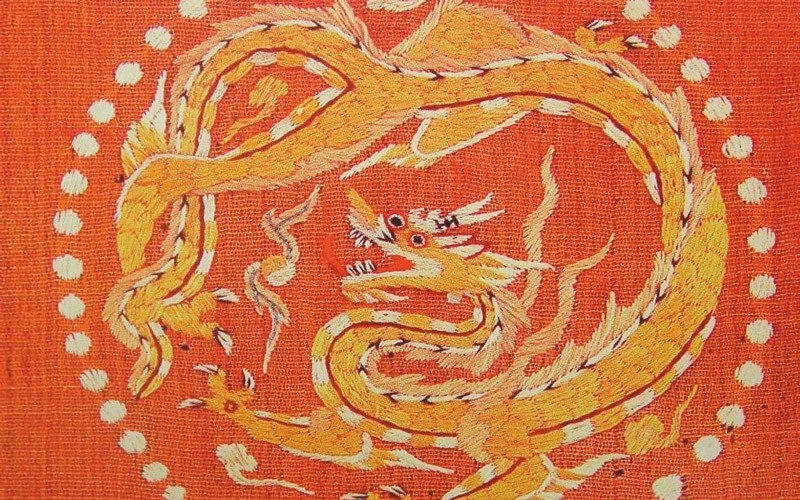
In 1974, diggers at Yemaotai near Faku County in Liaoning opened the seventh tomb in a Liao-dynasty cemetery and found a woman lying under a quilt of woven gold. The quilt carried a dragon, waves and mountains in Kesi silk tapestry. What surrounded it turned out to be a wardrobe: seven categories of silk, more than ninety varieties and specifications, and a set of techniques that pushed back the date historians had been willing to give Liao weavers.
Getting it out took a week. The coffin stood inside a wooden tent, itself set on a brick platform thirty centimetres high and surfaced with planks, with roughly twenty centimetres of clearance between tent wall and coffin. After a thousand years the fibres would not survive being peeled on site, so the team built plywood pallets, lifted the whole assembly, sealed it and moved it to the Liaoning Provincial Museum. Feng Yongqian and his colleagues then spent seven days separating the layers.
What Came Out of the Seventh Tomb
Catalogued fabric runs across plain silk, gauze, Luo (罗), damask, brocade, looped-pile fabric and tapestry. The garments survived as fragments: long robes, skirts and trousers, a four-layer crown, embroidered gloves with five separate fingers, knee-high tapestry boots with soft soles, a tall-wing hat of the kind associated with Liao dress, and the quilt itself. Few surviving assemblages of traditional Chinese clothing from the tenth and eleventh centuries are this complete.
Embroidery covered the smaller pieces. A yellow Luo robe carries paired birds; a sachet shows bird-and-leaf motifs worked in wrapped gold and silver; a crabapple-yellow Luo pouch has children at play across it; there is a powder puff in embroidered silk. Feng, who worked on the excavation, said the raw silk in some of the pieces weighed no more than six grams, and read that fineness as evidence of how far Liao spinning had advanced.
Location explains the density. Yemaotai sits in the cemetery of the Xiao clan, the consort family behind the Liao throne, inside the Shangjing circuit. This was not a frontier grave with one good coat in it. It was a household that could order at the top of the market.
A Silk That Needed a Twisting Loom
Luo is the piece technicians keep returning to. In the four-warp-twist version, warp threads are twisted around one another in pairs, leaving a regular field of pepper-eye holes. Producing it is not a matter of loosening a plain weave: the loom needs a twisting-warp device, so that ground warps and twisting warps trade places in sequence. The holes come out evenly spaced, and the twist points hold better than in a simple leno. Liu Ning, deputy director of the Liaoning Provincial Museum, treated that as proof that Liao workshops already ran draw looms fitted with twisting gear and a full patterning setup.
Colour came from clamp-resist dyeing, which was common practice at the time. A smoke-coloured belt in four-warp-twist Luo was printed by cutting a pattern block, then brushing on gold mud pigment, which leaves a metallic sheen rather than a flat colour. A crimson version used two-colour overprinting, white as the ground with indigo framing the motif, and the dye has not lifted in a thousand years.
Gold Woven Into the Picture
Kesi works on the Tongjing Duanwei tapestry technique, continuous warp and discontinuous weft, so the image is woven rather than embroidered on. The Yemaotai pieces are mostly gold-weft: the mountain-and-dragon quilt, a kerchief, cloud-and-water boots, the tall-wing hat. The gold was applied as Pianjin (片金), a flat strip of metal rather than a wrapped thread, and its use inside kesi appears in no other surviving kesi from any dynasty. That structure is gone; the tomb is the only place it can be read.
Written sources line up with the objects. Hong Hao, writing between 1088 and 1155, noted that Uyghurs settled in Yan were long established in the trade, skilled at twisting gold thread and weaving heavy brocade, heavy damask, twisted silk and patterned Luo, and that five-colour thread robes were called kesi, with the same gold thread twisted into flowering-tree patterns. Zhuang Chuo, a contemporary, described the Dingzhou version by its effect: held up against the light it looked carved, which is why the craft was also written with the character for carving.
Production was organised, not incidental. Liao’s southern capital, on the site of modern Beijing, sat close to the Northern Song and inherited a deep textile base; the court set up an embroidery office and a dye office there. Xingzhong Prefecture, present-day Chaoyang, held a silk-and-brocade workshop and a sericulture base, sending raw silk north to workshops at Zuzhou for finishing. The Ling River basin was one of the Liao textile centres, and Yemaotai’s goods most likely came out of it.
Boots, Gloves and the Cut of a Cold Country
Read as sewing rather than as display, the finds describe a working wardrobe. The gloves are five-fingered, which means separate finger construction and embroidery carried across the back of the hand, not a mitten. The boots reach the knee, are soft-soled and woven in tapestry along the shaft, a shape built for riding and for cold. Robes, skirts and trousers surviving as separate fragments point to layered assembly instead of one heavy gown, and the four-layer crown implies a stacked structure rather than a single cap.
One caution applies to the whole group. Li Meng, a professor of costume and art design at Donghua University, argues that Khitan dress and Liao court dress are not the same object. The Liao state ran a dual system, with a northern code for Khitan officials at ritual and a Han-style code for officials of the southern administration, and the empire contained Han, Xi, Bohai, Jurchen, Tangut and Uyghur populations whose dress differed again. A single Liao silhouette does not exist, and the Yemaotai textiles belong to one household inside that system.
In a museum case, the useful distinction is structural. Kesi is a woven image, built row by row with a stepped edge wherever the colour changes, and embroidery sits on top of a ground that was already finished. Once that difference is visible, a tenth-century quilt stops looking like decoration and starts looking like a loom, a dye vat and a pair of hands, which is what it took to make one.