Over three days in mid-November, foreign leaders and their spouses at the APEC summit week in Shenzhen did things that never reached the podium. One practised a breathing exercise in a hotel elevator lobby. One ate congee on a Nanshan side street at midnight. One filmed lion dancers on her phone. The episodes ran from November 17 to 19, between the hotels, the meeting venue and the streets of Nanshan District.
People’s Daily gathered them into a single observation on page 20 of its November 26 edition, under the headline “In Shenzhen, the World Reads Chinese Aesthetics”. Taste, sight and objects, the paper argued, cross a language barrier faster than a speech does.
Baduanjin in an Elevator Lobby
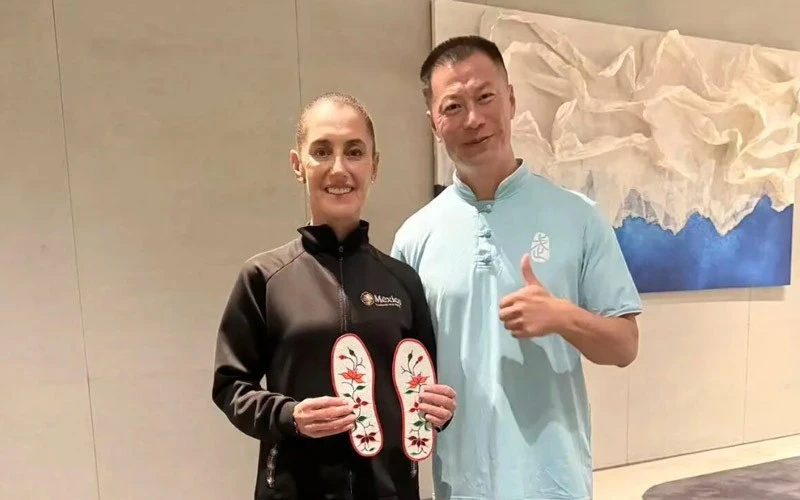
Mexico’s president, Claudia Sheinbaum, asked on arrival whether a local teacher could work with her on baduanjin, the eight-section exercise she already practises. Niu Aijun, a Shenzhen specialist in traditional sports, was called in. The two trained from a little after 7 p.m. until 8:30, in an elevator lobby pressed into service as a studio.
Niu said she moved fluently and held her attention, calling her someone who had put in the hours. He corrected several positions and explained the Chinese medical reasoning behind the sequence. She told him afterwards that the session had taught her more than the previous year of practice. Before leaving, Niu gave her a pair of insoles his mother had stitched by hand, embroidered with folk patterns.
The following evening, ahead of the welcome banquet, she picked up a white stringless guitar in the leaders’ lounge and played “Jasmine Flower”, working the pick with one hand and the touch pad with the other while LEDs along the neck showed her where to go. Less than a day separated the two performances: one skill stored in the body, one delivered by light.
Lion Dance, Yingge and a Cup of Tea
On the morning of November 19 the plaza at Shenzhen Bay Cultural Plaza filled with drumming. Children in lion costumes and a Chaoshan Yingge dance formation received the leaders and their spouses. Video from the scene shows Kim Hye-kyung, wife of South Korea’s president, tracking the lions with her eyes, waving at the young performers and trading high-fives, phone raised the whole time. She called the smallest dancers adorable.
Inside the Lingnan heritage exhibition that morning she stopped for tea and recalled the tea served to her in Beijing in January, saying the cup in Shenzhen was just as fragrant, according to the South Korean presidential office. Lion dance, Yue embroidery, Canton enamel and gambiered Canton gauze were all on display, the gauze being the dyed silk long used for traditional Chinese clothing along the Pearl River Delta. Zhu Jianjun, curator and director of the Shenzhen Art Museum, described Lingnan craft as evidence of exchange and said the show aimed at a contemporary translation that local visitors and foreign ones could read the same way.
Ngo Phuong Ly, wife of Vietnam’s president, spent the same morning at Nanshan Museum, at an exhibition of embroidered cloth bags and sachet making. Bags and sachets share one property that glass cases cannot offer: they can be picked up, opened and smelled.
A 588-Yuan Bowl of Congee
Late on November 18, Thailand’s prime minister Anutin Charnvirakul and his wife Thananon sat down at a Chaoshan congee shop on Houhai Avenue in Nanshan. Leaving, he was asked in Cantonese whether the food was good. “Very good, quite good,” he answered in the same language, while his wife offered “That’s great” in English.
A reporter who returned on November 20 saw the same set on the menu: signature shrimp and crab congee, a braised three-item platter, pan-fried oyster omelette and three more dishes, 588 yuan for the table. The party of more than twenty filled three tables. Chaoshan congee starts from raw rice in cold water, boiled hard until the grains split, with seafood going in last. Cantonese slow-cooked congee, which melts the grain, is a different bowl. Local diners know the difference without being told; a first-time guest does not.
Threading the Stops Together
Formal occasions carried the other half of the message through objects. Zhan Peiming, founder and chief craftsman of a Longgang porcelain firm, spent decades photographing the city and its ecology, then drew on 50,000 frames for the Wutong Mountain, mangrove and bougainvillea motifs that went onto the porcelain used at the APEC state banquet, marrying Chaozhou painted-porcelain technique to Shenzhen design.
Those pieces sit on a route rather than in a case. Porcelain and embroidery inside the venue, lion dance and Yingge on the plaza, congee and a 300-year-old Hakka village outside it: Gankeng, restored on the principle of repairing the old as old, where bamboo hats and Hakka songs survive, a movable-type workshop still has wet ink, and a digital figure recites poetry at the Phoenix Valley academy. People’s Daily also noted an American on the street naming rice noodle rolls as his favourite dish, and foreign reporters in the press centre handling chopsticks like locals.
What the visitors said, they said in those places rather than at the lectern: more learned in an hour than in a year, the tea is fragrant, the food is good.