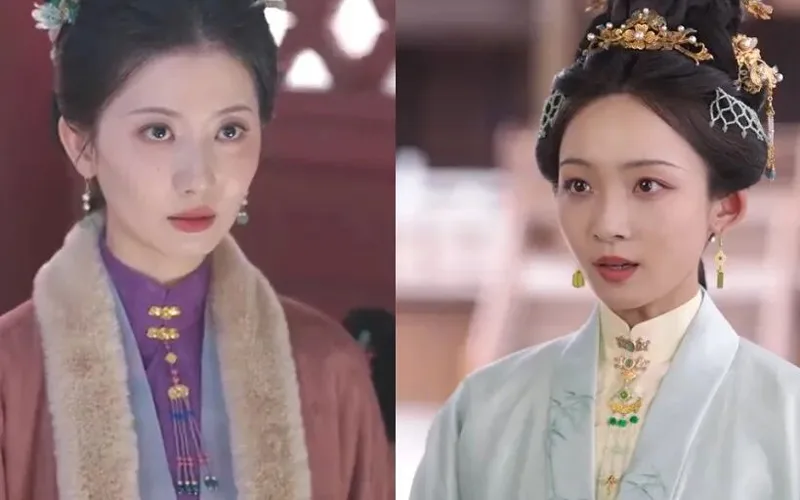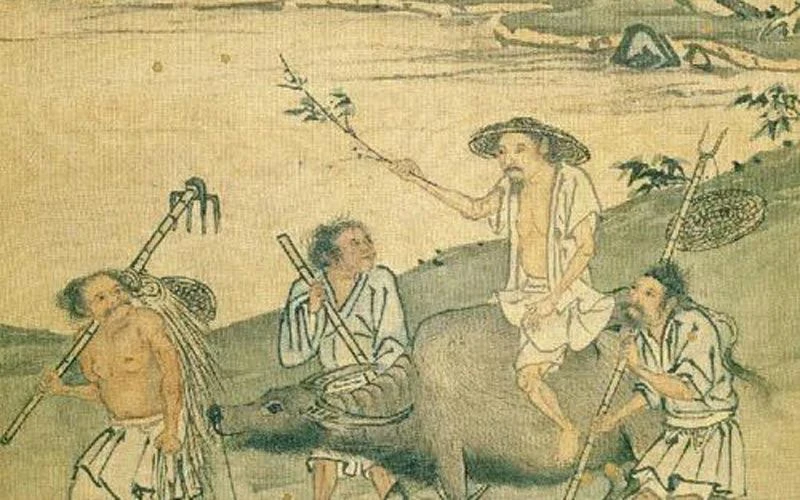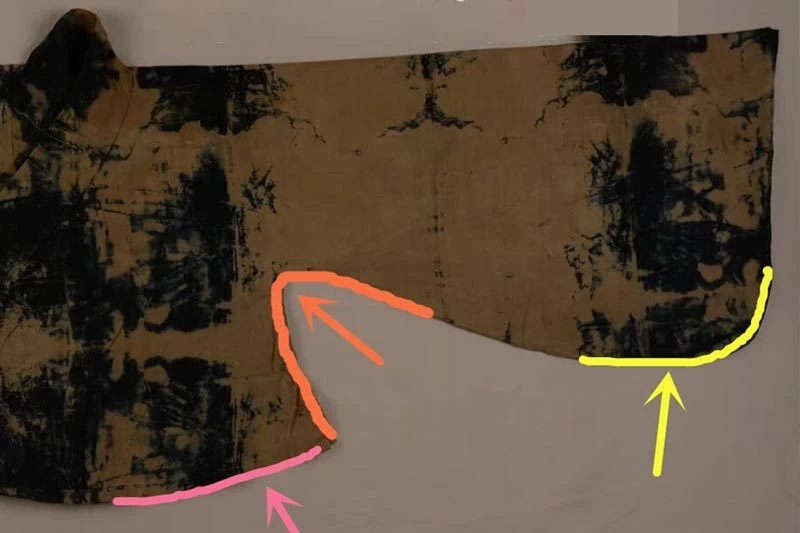
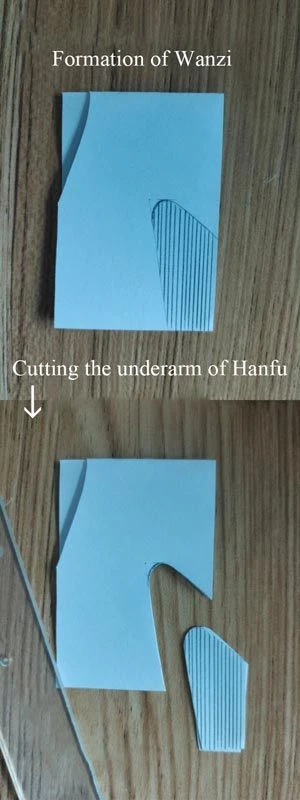
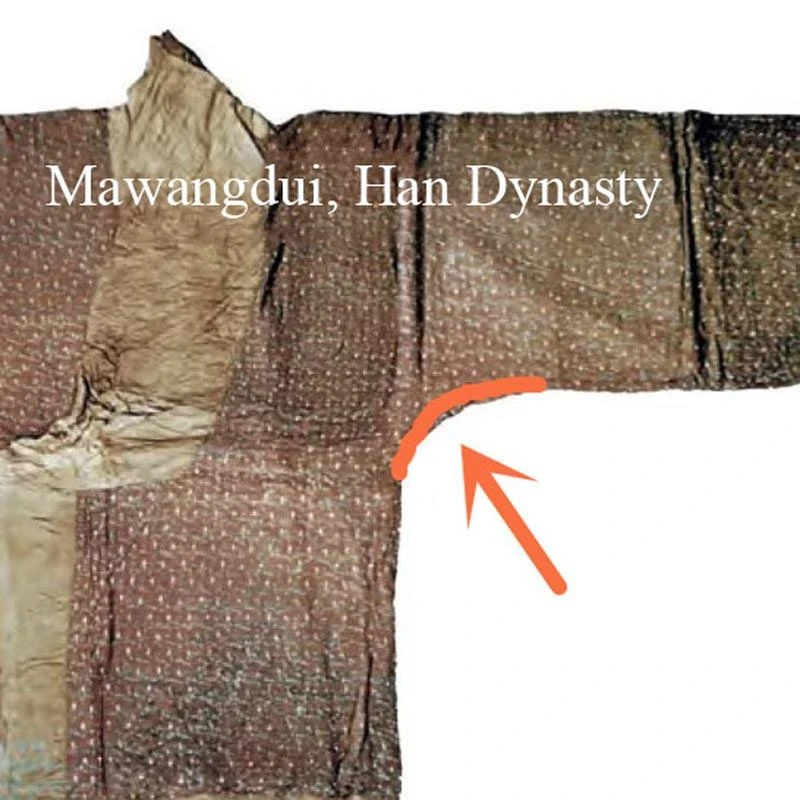
A Hanfu flat-lay can look like a puzzle of rectangles. A robe folds into a long strip; a skirt opens into two wide panels; sleeves sit as straight tubes. That first glance hides the real skill. The shape is not random, and the leftovers are not trash. At the armpit, where sleeve and body separate, a curved line creates a small offcut. Old tailors named it Wanzi (帵子). The word sounds tiny, almost forgettable. Yet it opens a door into cloth width, labor, and tight calculation. Once you notice that curve, the plain rectangles stop looking simple. They start looking engineered.
Named Scrap
Chinese dictionaries did not ignore this shop-floor word. The Song-era Guangyun (广韵) records that wanzi means cloth left after cutting. The Ming-era Zhengzitong (正字通) adds that silk shops used the term for trimmed remainders. Later, the Modern Chinese Dictionary (现代汉语词典) kept it as a dialect word. A scrap with an entry is more than scrap. It is a recognized part of the cutting system.
The name also carries shape. “Wan” suggests a bend. With the cloth radical, the word points to a curved piece of fabric. That detail matters. A straight leftover could be any strip. A curved leftover appears only when a cutter follows the body’s movement. The armpit curve lets an arm lift without tearing the seam. It also marks a mature separation between sleeve and torso. The small piece is the visible price of comfort.
The dictionary trail also changes how we picture old clothing work. These terms lived in markets, not only in courts. A silk shop clerk could say “wanzi” and be understood. A tailor could ask for the curved remainder without a drawing. The word passed between workers, then into print. That path shows a trade with shared standards. People who cut cloth had a vocabulary for the awkward pieces, not just the beautiful finished robes.
Look at early examples. A robe from the Mashan Chu Tomb (马山楚墓) folds from a long rectangle. A Song jacket, laid flat, uses direct lines. A Ming horse-face skirt separates into broad rectangles. Even the famous Dingling (定陵) cuttings show careful planning. These garments are not blocky because their makers lacked ideas. They are blocky because the loom set hard limits, and the cutter answered with geometry.
Cloth Logic
Woven cloth has a strict grid. Warp and weft cross at right angles, and the width is fixed. Skin does not behave that way. Neither does a moving shoulder. A cutter cannot stretch the loom. He or she can only place pattern pieces so that straight edges follow the grain. Rectangles nest against rectangles. Collars, ties, body panels, and sleeves all submit to the same grid. This is not a style game. It is material logic.
This grid also explains why so many historical garments look like folded maps. A coat body may be one wide piece folded at the shoulder. The front opens, the back stays whole, and ties close the gap. Each choice keeps the grain straight. Curves appear only where the body demands them. The cutter is not drawing a silhouette first and forcing cloth to obey. The cutter reads the cloth, then finds the body inside it.
In farm households, weaving cost time and muscle. Every inch carried human labor. So “zero waste” was not a slogan. It was a practical rule. A good cutter saved thread, saved cloth, and saved future repairs. The curved armpit offcut was often small enough to become a tie, a facing, or a patch. Sometimes the cutter planned the sleeve join so the leftover could return to the garment. Waste existed, but it was measured.
Cloth width changed over centuries. Wider fabric allowed more ease. The back center became a base line, side panels joined, and sleeve seams moved toward the upper arm. A larger sleeve opening needed a deeper curve under the arm. Hem curves and changing sleeve shapes widened the meaning of wanzi beyond the armpit. The word stayed, even as the pattern grew. Language followed the cutter’s knife.
Costly Curves
That curve looks modest, but it decides how a garment lives. Cut too little, and the arm fights the seam. Cut too much, and cloth is lost without gain. The cutter balances movement, grain, and width. A straight tube is easy. A curved armhole is a negotiation. The sleeve must hang, the body must drape, and the seam must not twist. In this sense, wanzi is a record of problem solving.
Modern buyers often read “straight cut” as old-fashioned. The opposite is closer. Straight edges respect the loom. Overlap, ties, and seams turn flat cloth into room for a body. A coat can close in several ways; a skirt can wrap; a sleeve can widen. The system gains variety without discarding the grid. Restraint produces range. That is the quiet cleverness inside a plain-looking garment.
So next time a Hanfu piece lies flat on the floor, look at the armpit. Find the bend. Imagine the cutter’s table, the fixed width, the heap of curved scraps, and the word that gave them a place. The small curve explains half the structure. It shows a craft that counted cloth before cutting and named the remainder before throwing it away. Scrap was never just scrap. It was a cost, a clue, and a design decision.