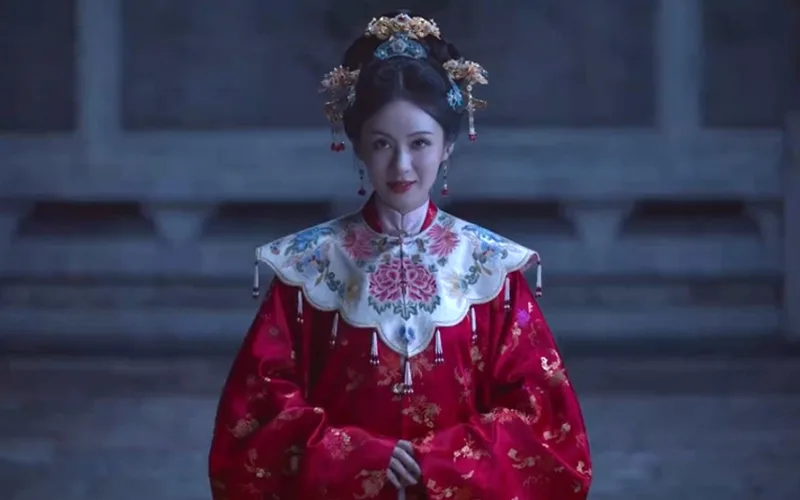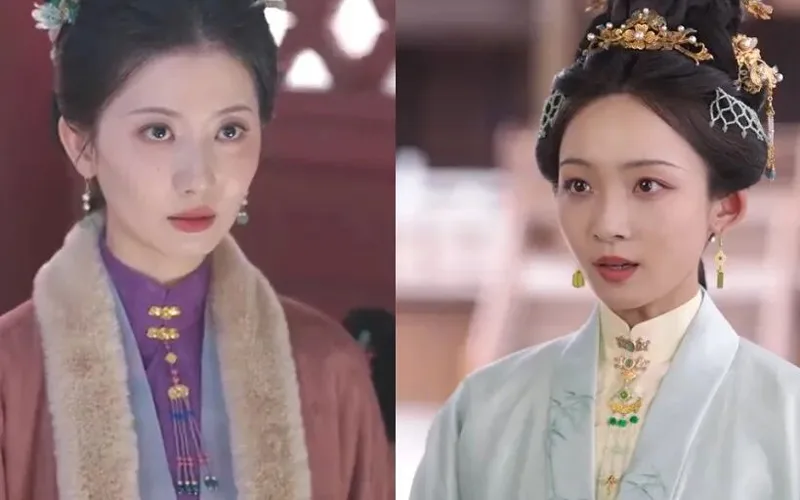
In Against the Current (兰香如故), a small ornament often swings below the collar button. Xu Lanxiang (许兰香), Zhao Xingtang (赵星棠), and other women in the household wear bead strings with jade plaques, gold pieces with tassels, short drops and long chains. The camera treats these objects as quiet details, yet they are not random jewelry. They are collar pendants, known as Zhuiling (坠领), a fashion tied to the Ming dynasty. The question is simple: why did women hang something right at the throat, and why does this drama repeat it so often?
From Seven Items
Earlier women wore necklaces, not collar pendants. In the Wei-Jin period, noblewomen liked grouped jade pendants; by the Tang dynasty, Yingluo (璎珞) arrived through western regions. Those pieces circled the neck. They did not depend on a button or a stand collar. During the Song and Yuan periods, women’s robes mostly used straight or crossed fronts, tied with cords. There was no fixed point at the collar to hold a hanging ornament.
The stand collar changed that. When a stiff upright collar rose around the neck, its frog button gave the pendant a secure anchor. A hook at the top of the pendant could catch the button, while the main body fell down the center of the chest. Mid- and late-Ming women, from court wives to ordinary households, wore these drops with stand-collar jackets. Extant portraits and excavated objects show flower-shaped plaques, bead chains, and small dangling figures. The shape varied, but the logic stayed the same: the collar became a frame, and the pendant became the focal point.
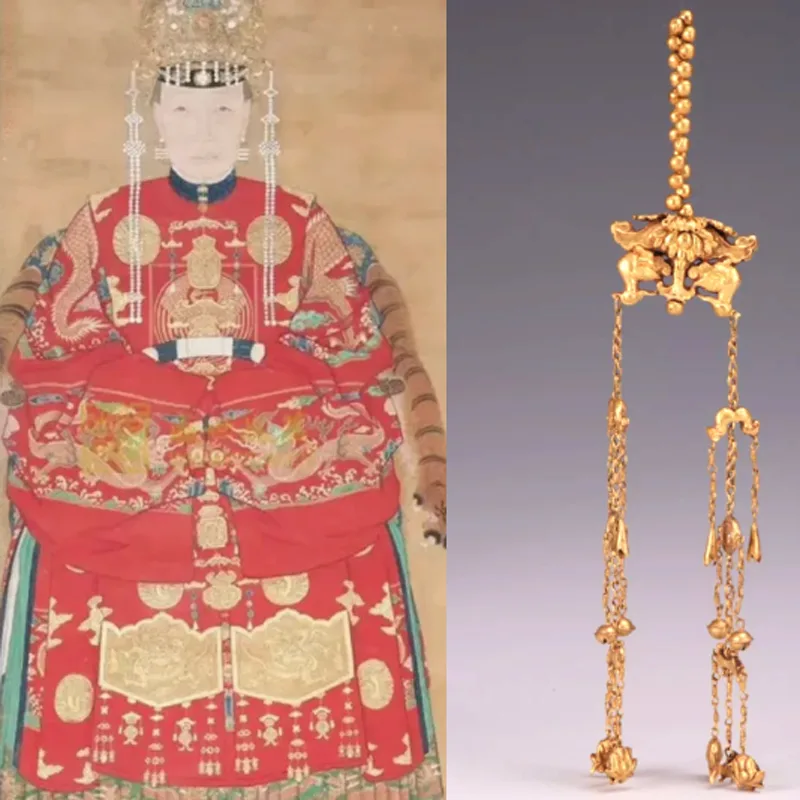
Kezuo Zhuoyu (客座赘语) notes that Zhuiling looked almost identical to Qishi (七事), the “seven items.” The difference was where they hung. Those seven objects began on nomadic belts, entered the central plains during the Wei-Jin era, and became standard gear for high-ranking military officers in the early Tang. Old Book of Tang (旧唐书) records knives, fire stones, needle cases and other tools. Later, ordinary people wore smaller scissors, pouches and bottles. By Ming times, the tools lost their practical edge and became decorative pendants.
Construction explains the look. A Zhuiling needed a ring or hook at the top, a flexible chain or cord, and a weighted end. Some drops stopped above the chest; others reached the stomach. The button did the holding, so the pendant could move with the body instead of sitting tight against the throat. This also separated it from a necklace. A necklace wraps around the neck; a Zhuiling hangs from one point and answers the robe’s front line. Once stand collars became common, that small button turned into a stage for metalwork, beads and jade.
Status in Silk
Why hang it there? First, weight. Ming stand collars were often made of soft silk. The edge could curl or sit unevenly. A pendant at the center pulled the front down and kept the collar neat. It also disciplined movement. A quick step or broad gesture made the drop swing and strike the body. To keep it calm, a woman slowed down and held her posture. The ornament worked like a small governor, turning clothing into behavior.
Second, sight. A bare stand collar creates a clean line, but it can also look empty and make the face seem long. A pendant fills that space, draws the eye downward, and lengthens the neck. The drama uses this effect with care. Different costumes receive different materials and lengths, so the ornament answers the color and cut of the robe. It is a costume decision, not a history lecture.
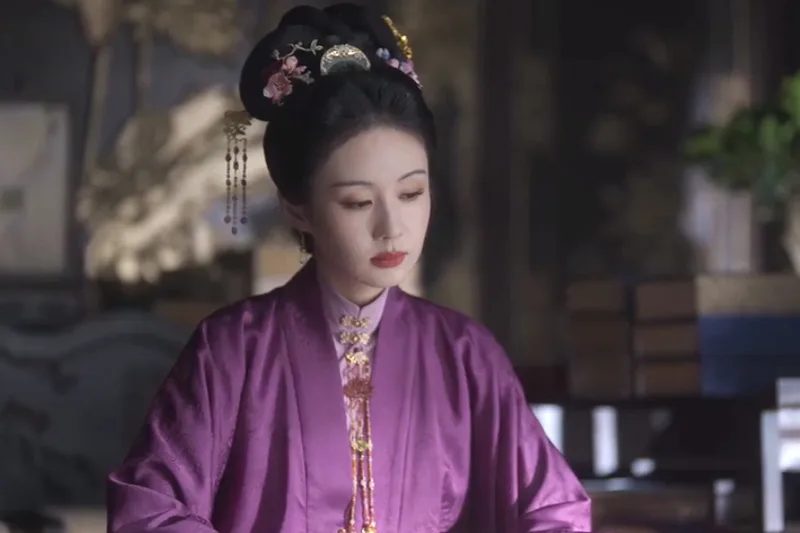
Third, rank. Expensive Zhuiling used gold, pearls, jadeite, and nephrite, with complex workmanship. In the drama, the pendant also marks position. Xu Lanxiang wears one after marriage; as a maid, she wears stand-collar clothes without it. The object thus does two jobs at once: it balances the upper body on screen and tells viewers who belongs where. The production makes the drops more polished than surviving relics, but the core idea remains Ming.
The show’s choice is clever because it never turns the pendant into a lecture. It appears at a collar, catches the light, and moves when someone walks. Viewers read status, mood and rank before they know the term. That is how costume detail works best: first as an image, then as information. The Zhuiling is not a loose decoration added for beauty. It grew from a button, a stand collar and a changed way of dressing. In silk, it holds the front line; in story, it holds attention.