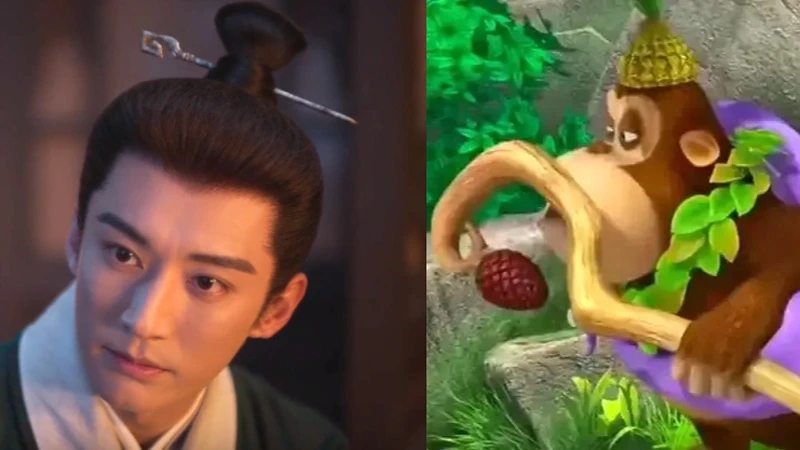
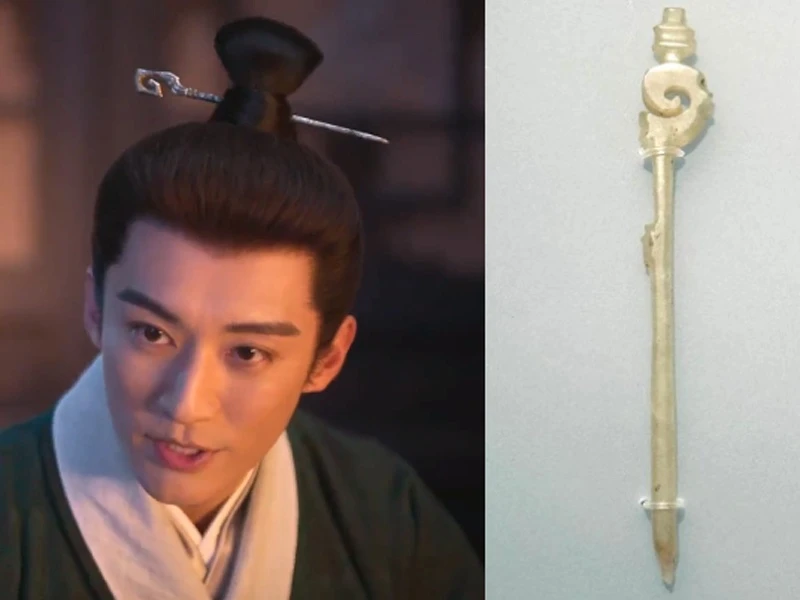
Viewers of Against the Current (兰香如故) noticed something odd on Lin Daye (林大爷): a hairpin whose top curls into a hook. Someone placed a screenshot beside Jiji King (吉吉国王), the cartoon monkey with a twisted scepter, and the resemblance is hard to miss. The joke travelled fast. Yet the pin is not a random prop. Its shape belongs to a long decorative language, and the costume team seems to have borrowed that language for a reason. Does a tiny hair ornament really carry plot weight? In this drama, yes.
Old Shape, New Joke
The pin’s head follows a hook-cloud motif, a pattern of curling lines that bend back at the ends. On a hairpin, this becomes a folded cloud hook. The design looks playful today, especially beside a cartoon scepter, but its roots are serious. Early makers used it on ritual objects and personal ornaments. A small curve, repeated and balanced, turned a plain pin into a recognizable silhouette.
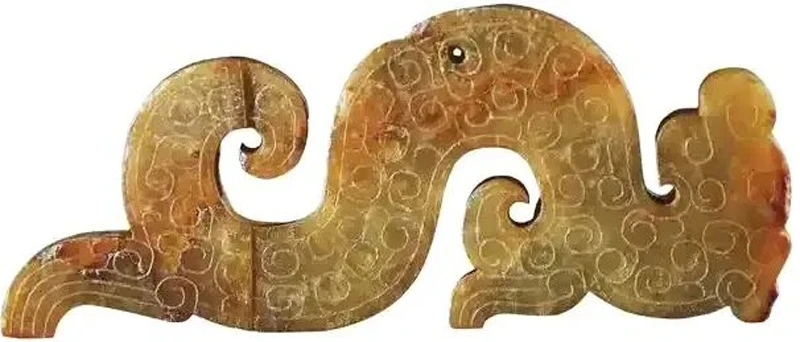
The motif is simple enough to work at small scale. A line curls into an S or C, then turns inward at both ends. Carvers could keep it flat, raise it, or repeat it. On a hairpin, the hook sits above the forehead or at the back of the head, so the shape must read from several angles. That constraint explains why the curl is bold rather than fussy.
In Against the Current, Xu Lanxiang (许兰香) shares private scenes with Lin. The pin appears often in those quiet talks. Its curl loops back on itself, never fully closing. That shape suits two people bound by an imperial order, carrying old grudges and fresh suspicion. They circle each other. They test words. Nothing cuts cleanly. The hairpin becomes a quiet visual echo of that knot.
The cartoon comparison is fair but limited. Jiji King’s scepter may come from a forked branch or a designer’s invention. The drama’s pin comes from a documented ornament tradition. Similar outline, different origins. The internet joke opened the door; the object itself invites a closer look.
History in Jade
Longshan (龙山) culture sites have yielded jade hairpins with curled cloud heads. Stone-working was not yet highly advanced, yet the curves are smooth. These early pieces do not show a full cloud system. They do show that someone cared about the outline of a pin, not just its function. A tool for holding hair had become a small display of skill.
During the Shang and Zhou periods, the hook-cloud pattern spread across jade and bronze. A Shang hairpin found in Henan (河南) shows symmetrical bends and clean lines. Later, during the Spring and Autumn and Warring States periods, and into the Han dynasty, elite wearers adopted elaborate versions. Some pins were carved all over with connected clouds; others kept a sculpted hook at the head. A linked hook-cloud jade pin from Liu Sheng’s (刘胜) tomb shows how fine the work could be.
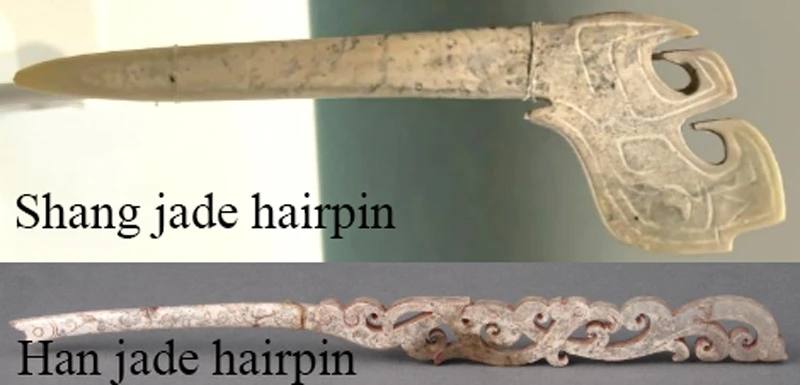
Material matters too. Many surviving examples are nephrite, a tough stone that rewards slow abrasion. Jadeite appears in later jewelry, but these early pins belong to an older stone-working story. The carver had to plan the curve before grinding, because a bad turn could ruin the piece. That technical pressure makes the smooth hook more impressive than its small size suggests.
After Wei Jin, taste shifted. Whole hook-cloud pins became rare. The pattern survived in other forms, paired with dragons, phoenixes, flowers, and later ornament. The hairpin did not vanish because the motif failed. It faded because fashion moved, while the curve remained useful as a building block. Nephrite pieces in museum cases still show that quiet persistence.
Why This Pin?
The costume team had practical choices. Lin wears lotus-shaped pins, bamboo-section pins, plain jade, and other styles. Changing them by scene fills out daily life. A wealthy young man from an established household would own a range of hair ornaments. The hook-cloud pin fits that logic. It is distinctive without shouting. It also gives the hair a clear top line in close shots.
Camera work matters. A hook at the crown catches side light and adds depth to a tied hairstyle. In a wide shot, the pin’s outline remains visible against dark hair. In a close-up, the curl gives the eye a small anchor. The prop is not decorative noise. It helps the frame read quickly, especially in tense conversations where faces and hands carry the scene.
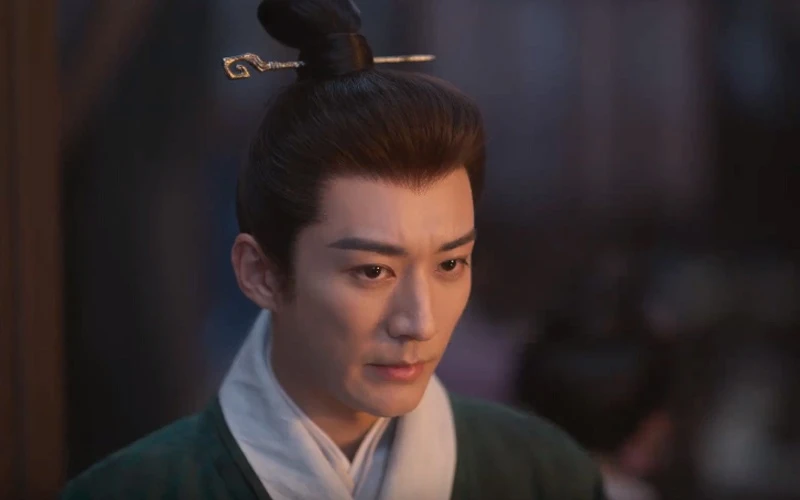
For viewers, the pin also creates a small puzzle. It looks familiar, almost comic, yet it comes from a formal tradition. That tension keeps attention on a detail that might otherwise pass by. A prop can do this without a line of dialogue. It asks the eye to compare, question, and remember. The best costume details work that way: first as pleasure, then as information.
So the resemblance to a cartoon scepter is a happy accident. The drama’s pin draws on hook-cloud forms; the cartoon prop likely follows a branch or pure invention. One is a costume choice with historical backing, the other a visual gag. Put side by side, they spark a laugh. Look closer, and the pin opens a door into craft, character, and the small decisions that make a scene feel lived in.