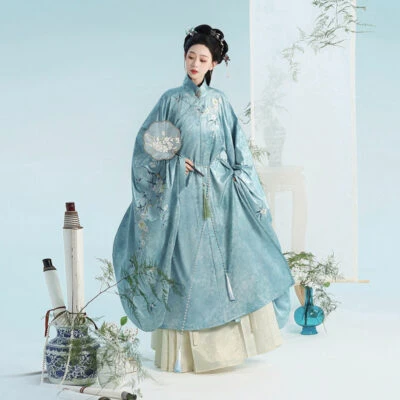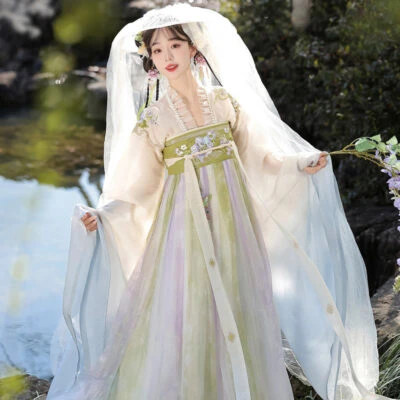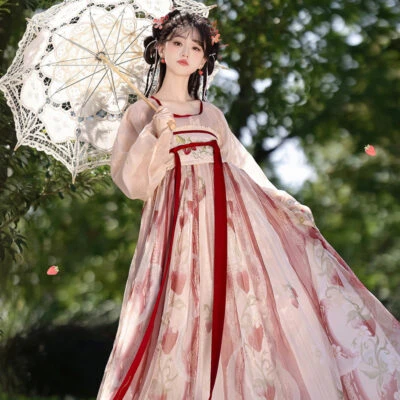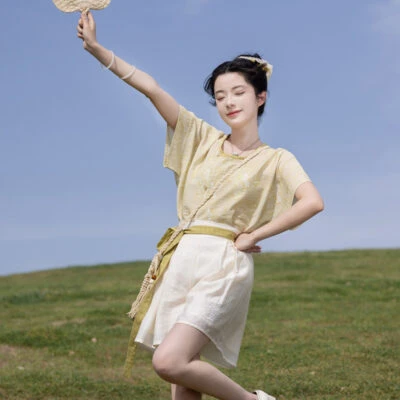
Search online for Hanfu and a stubborn rumor surfaces fast: “Hanfu has no pants.” Other versions claim Hanfu only had open-crotch trousers, or that ancient Chinese learned pants from nomadic peoples. These lines sound confident. They have circulated for years. They are also false. But refuting a rumor takes more than shouting “wrong.” It takes evidence, structure, and a clear framework. That is why this series starts with the most basic question: where do pants actually sit within the Hanfu system? Once that position is clear, every later piece of proof—origins, artifacts, texts, craft details—has a place to land. This first article lays the groundwork. Specifics come later.
A Real System
Many people treat Hanfu as a loose pile: any dynasty, any style, all tossed together. That misunderstanding feeds most rumors. Strictly speaking, Hanfu is a complete garment system with internal logic and clear boundaries. Scholars often call it Huaxia Yiguan (华夏衣冠). It is not a random collection of historical outfits. A system has structure, categories, and technical standards. Its parts connect and support one another.
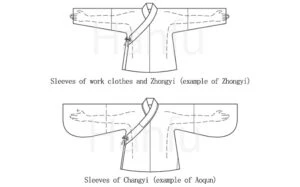
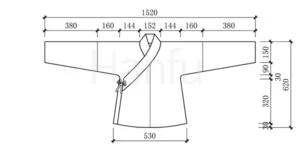
The core of this system is a cutting method called Han tailoring. It works with the limits of silk, hemp, and ramie. Because fabric widths were fixed, Han tailoring pursued zero-waste layout—every inch counted. The structure relies on flat pieces, wrapping, overlapping, and tying rather than tight seams. Local three-dimensional additions, such as crotch panels and sleeve extensions, provide room to move. In short, Han tailoring wraps flat cloth around a three-dimensional body with remarkable precision.
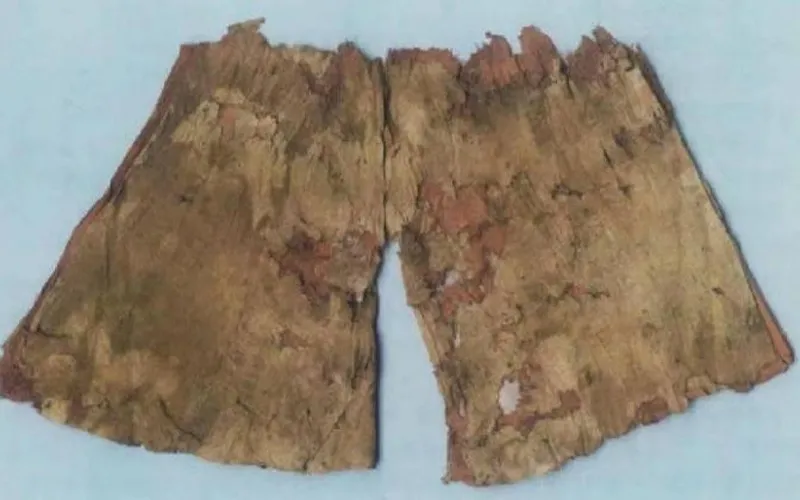
This idea is not modern. The Qin dynasty bamboo text Zhiyi (制衣) proves it. In 2010, Peking University acquired a batch of Qin bamboo slips from overseas. Among them, 27 slips form a garment-making text by an author named Huang Ji (黄寄). The text divides into six sections: skirt, upper garment, robe, short jacket, front-layer garment, and pants. The classification follows cutting structure, not dynasty or style. Pants appear as a formal category with two prototypes. Two thousand years ago, pants already had a defined place.
Not an Accessory
In the Hanfu system, lower garments fall into two parallel categories: skirts and pants. They are not superior and subordinate. The Zhiyi layout confirms this: skirt and pants each receive their own section, terminology, and prototype summary. Pants were not an afterthought. They were formal members of the lower-garment team.
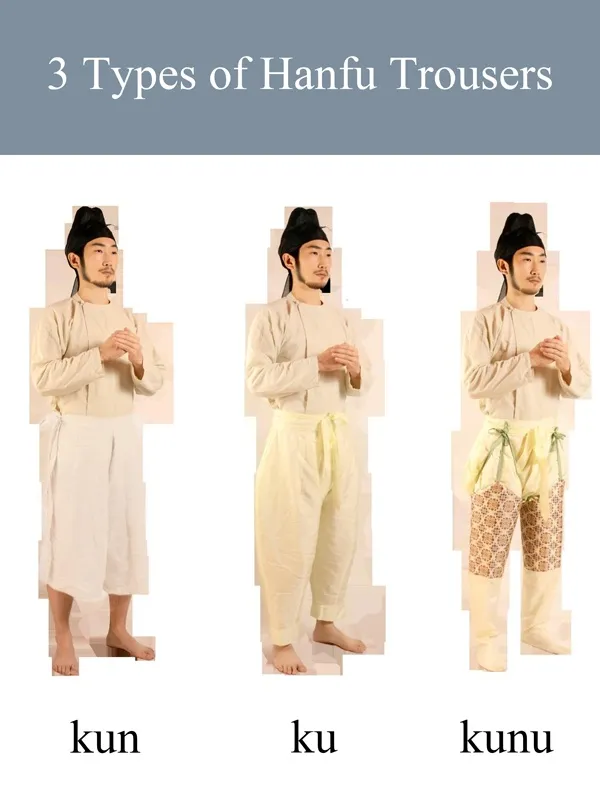
From inner to outer, pants come in three layers. The innermost is kun (裈), a fitted undergarment with a crotch. Its history runs deep: Neolithic pottery wheels show depictions, Longshan culture jade figures wear them, and Tang dynasty silk examples survive. The middle layer is ku (袴), an outer or base-layer trouser with a waist, crotch, and legs. A hemp ku from the late Western Zhou tomb of Guo Zhong (虢仲) dates back about 2,700 years. The outermost layer is the over-trouser, called kunu (袴奴) in the Tang dynasty—two legs, no waist, no crotch, worn over long trousers for protection and decoration.
This layering follows the wrapping tradition of Hanfu: no zippers, no buttons—just ties and overlaps. Trouser waists cross left over right and tie shut. Crotch panels add mobility. Pants handle base coverage, warmth, protection, and modesty. Remove them, and the whole outfit fails.
Hidden in Layers
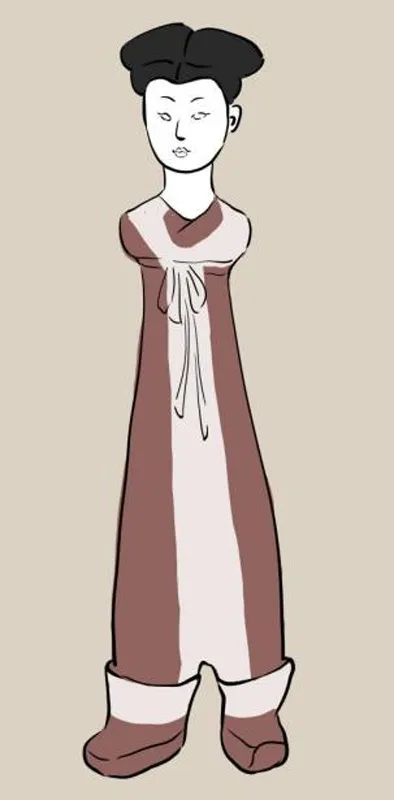
A common question: if pants mattered so much, why do ancient paintings and murals almost never show them? The answer is simple. Pants sat on the inside. Hanfu dressing habits required trousers beneath skirts and robes. Sui dynasty female figurines wear long skirts over long pants. Tang women wore skirts over trousers, with crotch-covering kun underneath. The layering was as strict as modern dress codes—just more concealed.
Picture a Tang official in Chang’an (长安) at dawn. He rises, puts on close-fitting kun, then cross-crotch ku, then a robe or skirt, and finally a leather belt. On his day off at the public bathhouse, he peels these layers off one by one. This inside-out, layer-by-layer method shaped daily life for centuries.
Paintings show the finished exterior. Pants stayed underneath. Three factors explain their low visibility. First, visual media depict the outer layer by default. Second, inner garments sit closer to the body, decay faster, and survive less often in tombs. Third, formal dress codes emphasized the outer silhouette, not hidden support layers. A painted pottery horse-groom figure from a 1931 Luoyang (洛阳) excavation shows the truth: layered cross-crotch ku beneath outer robes, built for movement and privacy. Pants were deep, not absent.
Technical Proof
Did Hanfu pants have their own craft standards? Yes—and detailed ones. The Zhiyi pants section lists waistband, legs, ties, and the critical element: the crotch panel, called Renzi (人子). The text specifies panel material length, width, and placement—five inches, one at front-left, one at back-right. Even the position of the waist opening is left open: front, back, left, or right, chosen by function.
The crotch panel is the key variable. Two sewing methods appear: front-back panels produce a looser silhouette; left-right panels produce a slimmer one. This single element separates skirts from pants. Add a panel between the front and back faces of a horse-face skirt, and you get horse-face pants. Remove it, and you have a skirt again.
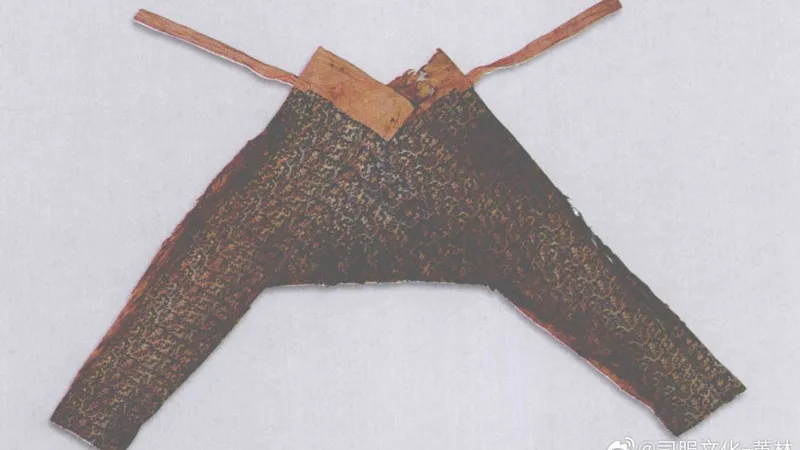
Han tailoring pants also skip darts. Shape comes from tying, not stitching. Waistbands overlap and tie for adjustable fit. Cutting follows zero-waste principles. A Han dynasty brocade woman’s trouser from Niya (尼雅) shows the method: two rectangular legs plus one square crotch panel folded diagonally, joined to a waistband and two ties. No scrap left. Modern reconstructions based on the Zhiyi produce wearable pants today. The structure still works.
So the most fundamental rumor collapses. Pants existed in Hanfu. They stood parallel to skirts. They had their own prototypes, terminology, and craft standards. They were layered deep, which is why they stayed out of sight. Later articles will tackle origins, artifacts, textual records, and practical applications. But first, the position is secure: pants belonged.