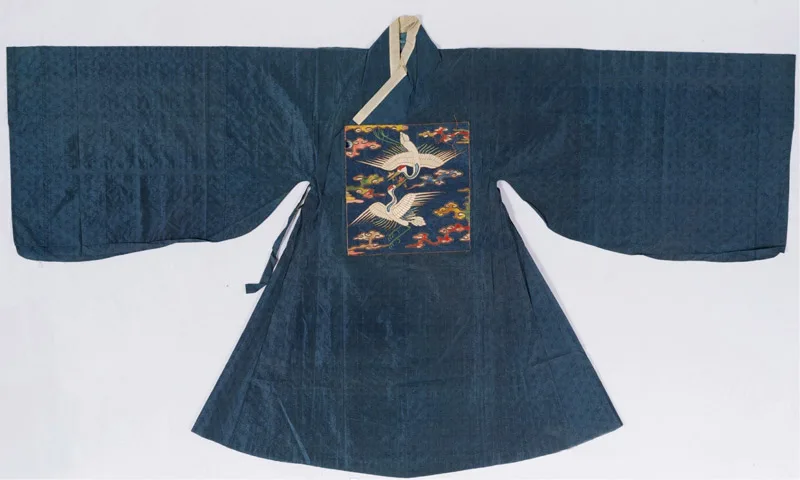
A mandarin square is a rectangular patch of woven or embroidered silk, made on its own and then sewn to the centre of an official’s chest and back. That last detail is the one most often lost. The bird or beast is not printed onto the robe and not worked directly into the garment’s ground cloth. It exists first as a separate piece, complete with its own finished edges, lining and stitching, and only afterwards becomes part of a coat.
Read from the front, a badge is a rank marker. Read from the back, it is a textile with a construction history. Ming officials wore both readings at once, which is why the badge sits at the intersection of two systems that are usually studied apart: an administrative code that compressed nine grades into nine birds and nine beasts, and a weaving and embroidery trade that had to produce each of those images to a standard.
What a Mandarin Square Is and Where It Sat
A mandarin square is a square or near-square badge, roughly 40 cm on a side in surviving Ming examples, attached to the front and back of an official’s everyday robe. It sat on the centre line of each side, aligned with the garment’s main seam, so that the two badges faced forward and backward rather than sideways.
Dimensions are not decorative. Because the badge was cut and finished as a separate rectangle, its edges had to be caught down by hand along four sides. Turn a surviving example over and the evidence is a hem, a lining and a row of stitches, not a printed surface. This is the single most useful test for anyone handling a reproduction: a printed badge has no reverse side to inspect. The construction, not the motif, decides whether a garment is built the way a Ming coat was built.
For the wider Ming wardrobe that surrounded the badge, including the cut of the robes it was sewn onto, the guide to Ming Hanfu types and dress codes covers the garment vocabulary; this page deals with the rank system and the object itself.
The 1391 Statute: Nine Birds and Nine Beasts
In 1391, the twenty-fourth year of the Hongwu reign, the court regulated the everyday dress of officials. The Ming History records that the garment was a round-collar robe with wide sleeves, that a square badge was fixed to the chest and to the back, and that the purpose was to separate high from low and noble from common. Civil officials received birds. Military officials received beasts. The bird or animal changed with grade, and the grade could therefore be read at a glance across a courtyard.
Aligned against the text of the Ming History and the Collected Statutes, the roster runs as follows.
| Grade | Civil official (bird) | Military official (beast) |
|---|---|---|
| Dukes, marquises, imperial sons-in-law, earls | Qilin and baize, outside the nine grades | |
| First | White crane | Lion |
| Second | Golden pheasant | Lion |
| Third | Peacock | Tiger, leopard |
| Fourth | Wild goose | Tiger, leopard |
| Fifth | Silver pheasant | Bear |
| Sixth | Egret | Panther |
| Seventh | Xichi (鸂鶒) | Panther |
| Eighth | Oriole | Rhinoceros |
| Ninth | Quail | Sea horse |
| Unclassified posts | Lianque (练鹊) | None |
| Censors and investigating officials | Xiezhi (獬豸) | None |
Two points in that table are routinely misread. Military grades share one beast between each pair: first and second both use the lion, third and fourth the tiger and leopard, eighth and ninth the rhinoceros and sea horse. Civil grades do not share; each grade has its own bird. The qilin and baize sit outside the sequence altogether, belonging to the ducal and marquis layer rather than to any numbered grade.
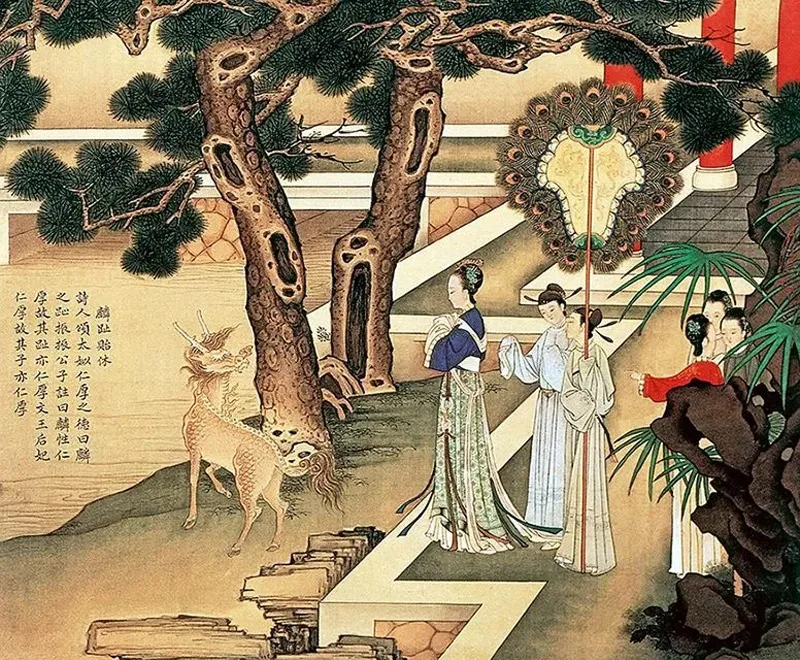
A discrepancy is worth flagging because it circulates widely. Several popular tables list the qilin as the badge of the first military grade and the lion as the second. The Ming History does not: it gives the lion to both first and second military grades and assigns the qilin to dukes, marquises, imperial sons-in-law and earls. The qilin, the python, the flying fish and the Dou Niu also belong to a separate system of granted robes, which is governed by different rules from the nine-grade everyday badge. When a table and the statute disagree, the statute is the safer witness.
Its textile catalogue, published by the Confucius Museum, adds the two badges most often dropped from summaries: the lianque for unclassified posts, and the xiezhi for censors and investigating officials attached to the Censorate and the provincial surveillance commissions. The xiezhi is a single-horned beast said to lower its horn at the guilty. On a robe whose wearer’s job was impeachment, that is not a decorative choice; it is a statement of function. The Collected Statutes repeated the whole structure in 1393, and for the next two centuries an official’s bird was the same answer from the Hongwu reign to the Chongzhen reign.
Birds and beasts divide along their own logic. Birds stood for literary accomplishment, order and clean administration; beasts for force and courage. Rank also ran in the direction Ming contemporaries believed it should. The crane sits at the top and the quail at the bottom, and the quail holds the ninth grade precisely because it is the least conspicuous and least aggressive of the nine. For the robe itself, the Ming dynasty Hanfu overview sets out the cut and layers that carried these badges.
Woven, Embroidered, Then Sewn On
Technical threshold sits in the verb: attached. Surviving objects show at least three different routes to the same result, and they are not interchangeable.
The Shandong Museum holds a Ming padded robe in blue with a gilt-woven qilin badge. Gilt weaving means the gold thread was carried into the cloth as it was woven, so that motif and ground grew together rather than being added afterwards. The choice of qilin is also instructive: the same beast served the ducal rank and appeared frequently in the granted-robe system, so one animal could carry different meanings in different contexts.
Another object, in the Confucius Museum, is a blue woven-flower gauze robe with an applied embroidered crane badge. This object is the clearest evidence that a badge could carry two processes at once. The gauze ground was first woven with a floral pattern, and the crane was then embroidered over that pattern and attached. Weaving and embroidery are stacked here, not substituted for one another.
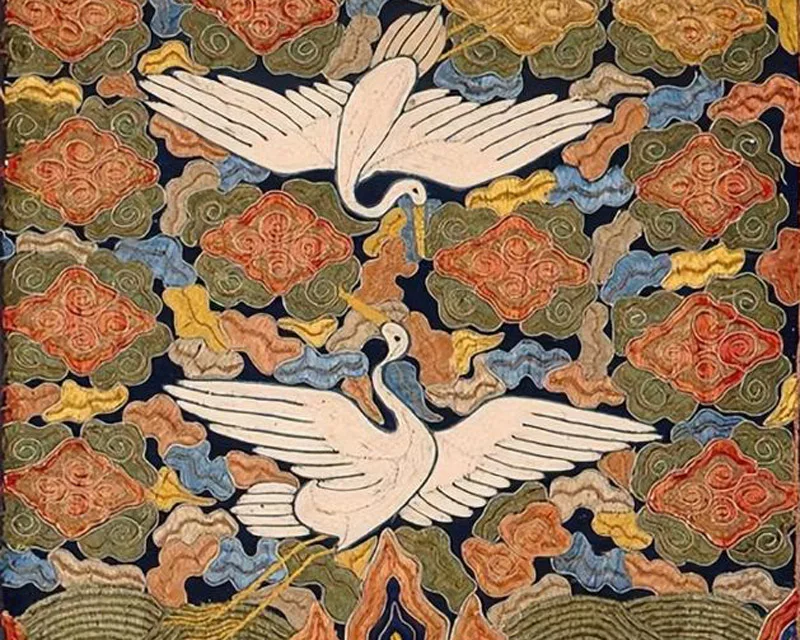
Overseas collections provide an independent cross-check. The Victoria and Albert Museum records object O14485 as a Chinese badge of the sixteenth century, in silk, silk thread and gold thread, worked in embroidery. The museum holds 72 Chinese badges of this kind; silk dominates the material list, embroidery dominates the technique list, and woven brocade, satin weave and gauze also appear. That distribution is itself an argument: the badge was never the product of a single craft.
Set the three together and the pattern holds. Ming badges were gilt-woven, woven in gauze and then embroidered, or embroidered outright, and in every case the piece was finished before it met the robe. The ground colour followed the garment, which is why Ming observers described the effect as bright without being frivolous: the badge did not shout against its own coat.
Changfu, Gongfu and the Rank on the Chest
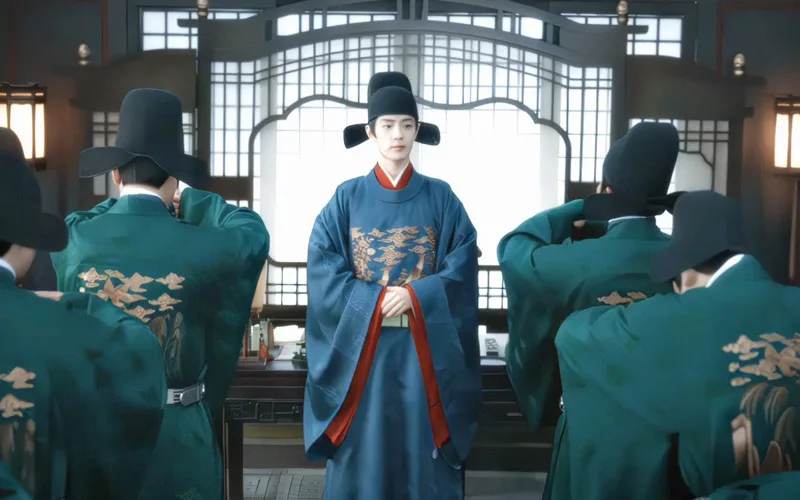
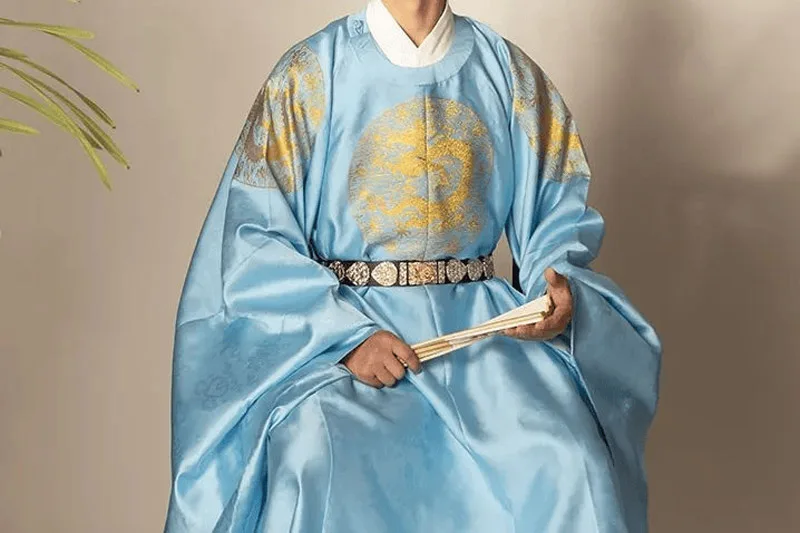
Three terms get used as if they were synonyms, and they are not. Changfu (常服), the everyday dress, is the set that carried the badge: round-collar robe, black gauze cap, leather belt, one badge front and one back. The 1391 statute regulated this set. Gongfu (公服), the public or formal dress, is a different assembly: a cap with stiff extended flaps, wide sleeves, and a robe colour fixed by grade, scarlet for the first four grades, blue for the fifth to seventh, green for the eighth and ninth. Colour did the ranking there; no badge was worn. Bufu (补服) is a later catch-all for “the robe with a badge on it”, and the Qing called the equivalent robe a badge surcoat.
One piece deserves a separate note, and that is the black gauze cap, because it explains a common mistake. From the first grade to the ninth, the cap was the same. It carried no rank signal at all. Everything that distinguished one official from another sat on the chest, in the badge and in the robe colour. The idiom about keeping one’s black gauze cap, still used for holding on to a post, comes from exactly this arrangement: the hat was identical, and losing the post meant losing the badge.
For restorations and costume checks, the seam matters more than the picture. A badge sits at the centre of the chest and back, its sides caught down by hand, its vertical axis aligned with the robe’s centre seam. A printed panel, or a motif woven straight into the body cloth, will fail all three tests. The round-collar robe that the everyday set was built on is treated in the study of the Mandarin collar and the Tang Yuanlingpao, which follows the collar form rather than the rank system.
The Qing Kept the Frame, Changed the Look
Under the Qing the bird-and-beast framework survived and almost everything else about the object was rebuilt. A Ming badge and a Qing badge can be separated by eye once the six differences below are known, and the differences are consistent enough to serve as dating markers rather than curiosities.
- Size: Ming badges are commonly about 40 cm on a side; Qing badges shrink to roughly 30 cm.
- Structure: Ming badges are single pieces; Qing badges are usually split into left and right halves because the surcoat opens down the centre.
- Position: Ming badges sit higher on the chest; Qing badges sit lower.
- Count: Ming bird badges usually show a pair; Qing badges usually show one.
- Ground: Ming grounds follow the robe colour and stay bright; Qing grounds darken with the garment.
- Border and composition: Ming borders are plain and the field is full; Qing borders widen or take ornament, the composition grows busier, and a red sun disc is added at the top.
Read as a checklist, those six lines answer most dating questions in a collection or a costume archive: paired birds, one piece, 40 cm, no sun, plain border points to the Ming; single bird, split halves, 30 cm, sun disc, wide border points to the Qing. The continuity is institutional. Birds for civil officials, beasts for military officials, image fixed by grade: the Qing conceded nothing on that structure. What broke was the visual language. One piece split into two halves, a pair of birds gave way to a single one, the plain frame grew a border, and the sun disc appeared.
A trace also survives in the language. The phrase yiguan qinshou, “clothed beasts”, began as a description rather than an insult: it named the officials whose robes carried birds and beasts, and it was not a term one minded being called. The Confucius Museum’s survey traces the turn to the middle and late Ming, when the gap between the virtues embroidered on a robe and the conduct of the man wearing it became too wide to ignore. The Ming play Jinlian Ji, by Chen Ruyuan, already carries the line “everyone curses me as a clothed beast”, and the verb in it signals that the meaning had begun to slide. By the Qing the phrase had settled into the insult it remains today.
That slide is the best argument for still looking at badges now. For Hanfu restoration, costume-drama research and textile collecting, a badge is one of the few parts of a garment that can be checked hard rather than admired loosely. Four questions settle most of it: is it a separate woven or embroidered square, does the creature match the grade, is there one or a pair, and is there a sun disc.
Common restoration errors all come from one confusion, treating three parallel dress systems as a single one: printing the badge instead of making it, putting a civil bird on a military robe, or fixing a badge to a round-collar robe that has been paired with the wrong cap. After the edict of 1391 the badge sat on Chinese officialdom’s chest for more than five centuries, turning an abstract grade into an image that could be woven, embroidered and read at a glance.