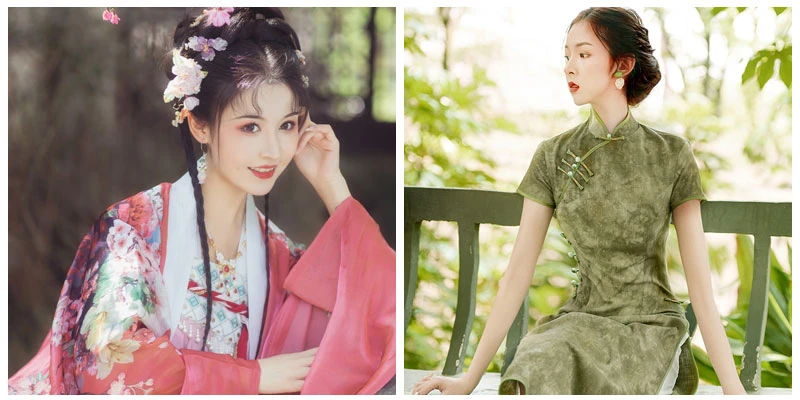
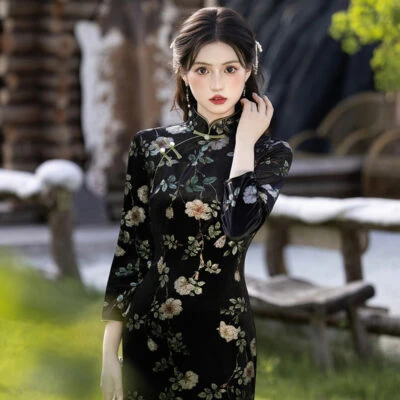
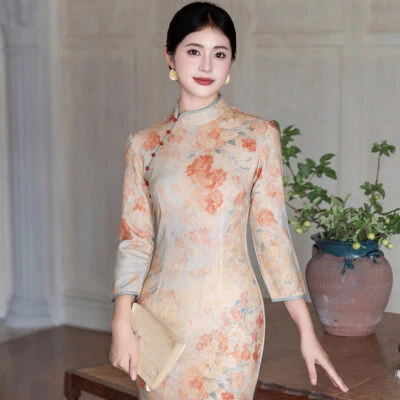
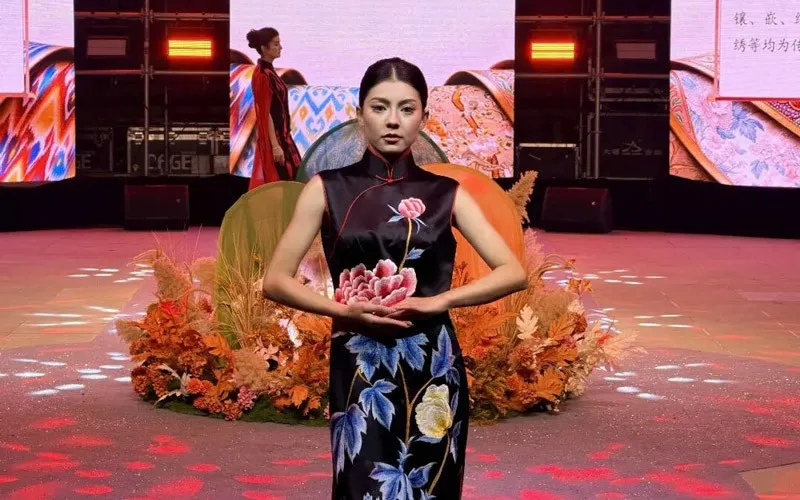
A Shenzhen-Kashgar intangible heritage showcase opened on the evening of 30 October 2026 at the Pantuo City ruins park in Kashgar, Xinjiang, and closed with two qipao on one walkway. One came from Shenzhen’s Yang-style qipao craft, the other from local Atlas silk. Six hand techniques on one side, Silk Road pattern on the other, the tight Jiangnan line and the looser Western Region drape alternating down the same aisle.
Before the runway, a fifth visit to Kashgar
Tang Guangyan (唐光艳), Shenzhen’s municipal inheritor of Yang-style qipao making, talked about time rather than about styles. She said the visit was her fifth to Kashgar, and that a qipao carries memory as well as beauty. Bringing the craft west, in her account, was a way of putting two intact craft systems side by side for comparison rather than moving one dress from one city to another.
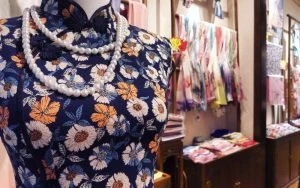
Her workshop’s handwork follows a fixed sequence. Appliqué trim runs decoration along an edge; inset piping slips a fine cord between the body and that trim; rolled binding wraps the raw edge; contrast banding presses a differently coloured strip between trim and binding; knotted frogs are coiled into shape one loop at a time; embroidery lands its stitches on the finished garment. Those six steps decide whether a silhouette holds, and they are the reason the trade still measures every customer.
Atlas silk, and the other costumes sharing the stage
Atlas silk works the opposite way round. Warp threads are tied into sections following the pattern, dyed, then woven, so every motif edge arrives with a soft bleed where the dye travelled. Nothing about the cloth wants a fitted waist. Drape and the jump between colours carry the garment, which is why cutting it as a qipao puts a Western Region pattern logic underneath a Jiangnan tailoring logic.
Other segments kept to dress. Paper-cutting inheritor Wu Haifeng sent models out in cut-paper headpieces, cloud collars and long skirts, the patterns opening across the hem as the wearers walked. She brought pieces designed for Xinjiang, using motifs she had seen on a research trip, and her students cut the characters for “Shenzhen and Kashgar are one family” along with window-flower patterns, some of them mounted on round fans. The paper-cut costume show has run more than twenty times in Shenzhen; this was its first outing in Xinjiang.
Zhang-family lanterns, each taking more than thirty processes, went down the runway with the models. A leather-carving show, a Tajik eagle dance and folk-song sets followed. Deng Xiyuan brought two konghou harps and told the audience the instrument has a history of more than 2,700 years; Meng Lulu, a regional-level inheritor of leather carving, said she had set up a workshop in Kashgar so that local young people could work there instead of leaving.
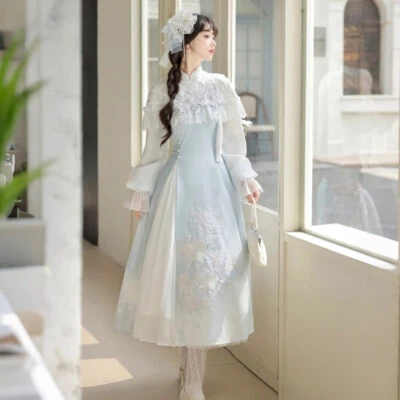
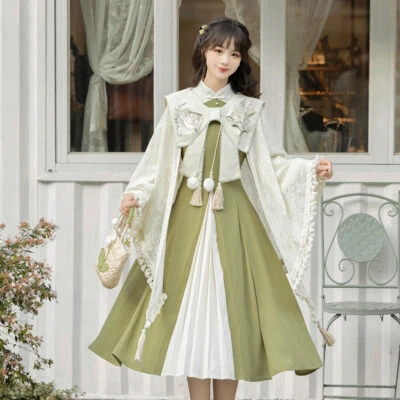
Organisers framed the evening as a pairing rather than a handover. The Shenzhen forward command post for Xinjiang support mounted the event with the Kashgar municipal party committee and government, the regional culture, radio, television and tourism bureau and the city publicity department co-organised, and the Shenzhen Federation of Literary and Art Circles lent support. Qipao belongs to a far later lineage than Hanfu, standing nearer to qing dynasty clothing than to the Han-era wardrobe, yet both garments sit inside traditional chinese clothing as a broad umbrella, and the programme kept the two traditions apart instead of blending them into one runway theme.
What a qipao costs, and where the money goes
Expense sits in the hands, not the cloth. Four of the six techniques are edge work, which means the money goes into a single line: binding has to be even, piping straight, the rolled edge free of puckers, the banding strong enough to hold its colour. Once those four are done, roughly seven tenths of the silhouette is settled. Knotted frogs and embroidery are the additions, and embroidery splits into two economics, since stitching on a finished garment cannot be undone while stitching before cutting can still be laid out.
Atlas silk carries a different cost curve. The money is in the tying that happens before any dye: finer ties restrain the bleed at each motif edge, coarser ties let the colour run bolder, and the density of the knots decides whether a bolt reads as restrained or as hot. Setting the two together puts two crafts that cannot be reworked onto one garment, which is why the pairing was more interesting in the workshop than on the catwalk.
Outside the theatre, the two cities set out their stalls. Shenzhen brought leather carving, Zhang-family lanterns and Yang-style qipao; Kashgar brought embroidered caps, earthenware, wood carving, brass, folk instruments and medicinal teas. A hands-on zone ran lacquer fan painting, tie-dye, paper-cutting and cotton sculpture. Hu Haiping, a Shenzhen leather-carving inheritor, described his city’s work as drawing on Lingnan culture and international fashion, which makes it comparatively fine and practical next to the denser pattern work arriving from the west of the region.