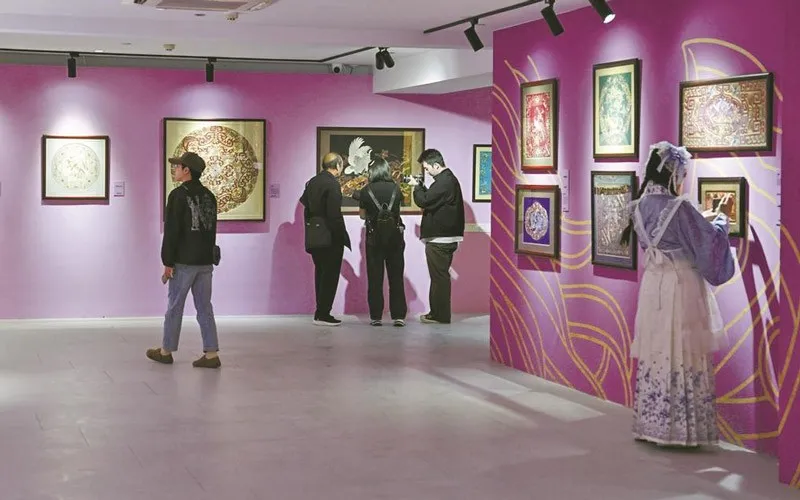
A 500-square-metre hall in Ningbo’s Nantang heritage quarter opened a survey of gold and silver coloured embroidery on 28 October, and put a flower-arrangement show in the next room. Both run to 15 November, closed Mondays, free to enter.
| Dates | 28 October to 15 November 2026, closed Mondays |
| Venue | Nantang heritage hall, Ningbo, 500 square metres |
| Organisers | Ningbo Cultural Centre and the city’s intangible heritage protection centre |
| Admission | Free |
| Lead work | Xu Jinlun’s Baihe Chaoyang, with Feifu, Peony and Twin Birds, and Lingfei Fengwu |
| Alongside | Autumn Colours, a traditional flower and bonsai show by Qin Houlei’s team |
| Linked events | A Beijing academic seminar and filmed oral histories of master and apprentices |
Gold and Silver Laid on Satin
The narrative starts with one object. Xu Jinlun, a national-level inheritor of the craft, made Baihe Chaoyang, cranes turning toward the sun, and the original now belongs to the China National Arts and Crafts Museum, which is also the national intangible heritage museum. That holding is what the Ningbo show leans on, and what justified the seminar in Beijing and the recording of master and apprentice interviews.
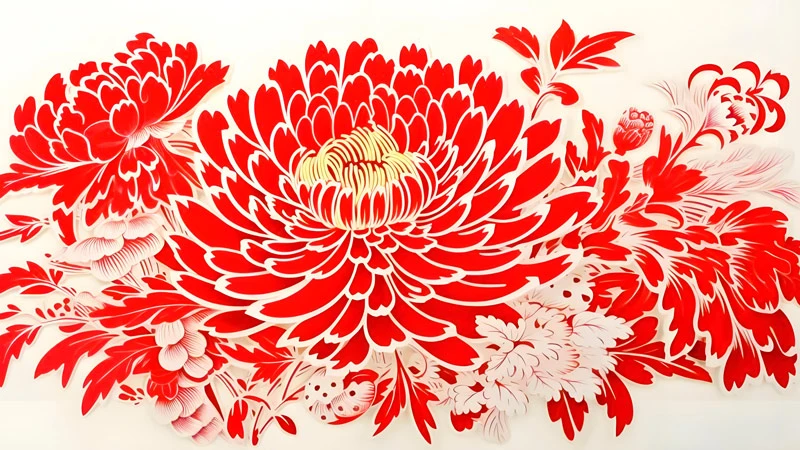
Coloured gold-silver embroidery, called antique embroidery in the trade, lays gold and silver thread over coloured satin. It began in the Tang period and peaked under the Ming and Qing, when the work moved onto ceremonial dress, altar cloth and gift panels. Two stitch families carry most of the surface: Panjin embroidery, in which metal thread is couched in parallel runs so the light travels along the motif, and a silver-padding stitch that raises the ground beneath the thread to give the metal a body it does not have on its own. Feifu, Peony and Twin Birds and Lingfei Fengwu hang beside the cranes, and the newer pieces take the same stitches into designs that were never made for a robe.
The Output Stays Small on Purpose
Ask why so few of these panels exist and the answer sits in the material. The thread is real gold and real silver, so cost rises with every square centimetre covered, and one misplaced pass can scrap a whole field of work that took weeks. Panjin and the padding stitch both depend on hand tension; no machine holds metal thread at the right slack across a curved satin ground. Expensive material, expensive error and no way to test-run a design at scale leave apprenticeship as the only transmission route.
That shapes what the craft can argue with. Su embroidery and Shu embroidery paint in silk and compete on stitch range and subject breadth. Here the visual weight is reflectance, and the direction of a gold line decides the temperament of the whole panel, so improvement tends to land in ground fabric, composition and use rather than in adding stitches. A panel can be rehung as a screen, reset into a bag or reduced to a collar, and each move changes the argument without touching the technique.
Flowers in the Next Room
Autumn Colours fills the adjacent space with work by the team of Qin Houlei, a provincial-level inheritor of traditional flower arrangement in Ningbo. Materials were chosen for the season and for the Siming hills, and the arrangements keep the Jiangnan habit of pale, open composition; the line the show borrows for its own logic comes from the Ming garden manual Yuan Ye, that a thing made by human hands should look as though heaven made it.
Reading the two rooms together is the point. Embroidery works by addition and precision, flower arrangement by subtraction and placement, and the same visitor crosses one discipline of control and arrives at its opposite within a few steps. The opening also ran a session titled for needlework and memory, where the family workshop’s history and decades at the frame were discussed next to the arrangement team’s approach, under three headings: holding the technique, changing it now, and reaching people who will never hold a needle.
What a provincial city gets from a pairing like this is not the fortnight of visitors. It is whether the objects, the recorded interviews and the seminar papers are still usable two years from now, when the hall has been reassigned and the loans have gone back. Ningbo has at least built the three parts that outlive a show.