Nanjing’s Yunjin museum reopens in a new building on Jiangdong Middle Road in Jianye District on 10 November, and the reason to go is a single length of cloth. The 17-metre bolt of Ming-dynasty dragon-robe fabric that has anchored the collection since the 1980s will be shown along a curved wall at eye level, the first time the whole piece has been visible at once.
A Facade That Shifts Colour the Way the Loom Does
The building wraps 1,600 years of weaving history into its own surface. Silver-white perforated aluminium panels are set out on a warp-and-weft grid taken from the wooden loom, so each panel catches the sun at a different angle as the day turns and the facade runs through a range of tones. That is the effect Yunjin weavers call colour that changes with the flower: one bolt, seen from another angle, reads as another colour.
The plan follows one line. It runs east to west, turns up where it meets the street and becomes the roof, which leaves a sunken entrance court for crowds, an eastern sunken plaza tied into the city’s underground walkway and a cafe below grade, and a west entrance court off the main road with the roof deck above it. The museum’s design concept is titled Brocade, Heavenly Pattern, and the building is meant to be read before the cases are.
Drawers Instead of a Fixed Route
Inside, the director Jian Mingwei has organised the displays into a sequence of six chapters with an immersive corridor between them, but the walls do not force a single path. Rows of drawers sit at the base of the display walls: pull the one that matches the period or the object you care about and the detail opens in front of you. A visitor in a hurry can walk the outline in twenty minutes; a visitor who wants the weave can keep opening drawers.
The opening hall carries a wall-sized digital version of the great flower loom, with the machine running up the screen and a bolt of brocade pouring down it. Scanning a code lets a visitor choose a motif, a colour and a ground, then throw one pick of the shuttle; that pick joins the scroll growing across the wall. Jian sums up the idea in eight characters: one pick makes a pattern, many picks make a bolt. On the real loom the same work takes two people and yields five to six centimetres a day.
A miniature set called A Dream of the Brocade City strings six scenes together to explain how a bolt was made and who wore it: the archway of the Jiangning Weaving Bureau, the Qinhuai river market and grain wharf, the bureau’s own offices, a five-storey pagoda, and a garden that served as the model for the Grand View Garden. A virtual-reality room lets visitors walk that garden, and an interactive table shows how a motif is picked out and tied into the pattern cards that drive the loom.
A Robe Length Measured in Loom Days
The core hall is where the 17-metre piece lands. It is not a finished robe but the full length of cloth woven for one: a thin crimson gauze ground carrying 17 dragons in real gold thread, peacock-feather thread and polychrome silk floss, the feather thread shifting through iridescent colour as the viewer moves. The Nanjing Yunjin Research Institute reconstructed it in the 1980s from documentary records and excavated textiles.
Behind the cloth, the museum has set a shadow-puppet layer: a wedding procession, an imperial tour, fishing and woodcutting and reading, and a lantern fair move as faint silhouettes through the gauze, so the robe length flickers while you look at it. Jian points out what changed with the move. In the old hall the piece lay flat and a visitor saw a metre or so of it; on the curved wall the whole length reads at once, down to the faint woven ground pattern.
Two further rooms carry the argument. One holds four Yunjin panels made for the Mengtian laboratory module, launched from Wenchang on 31 October 2022 and installed in the Chinese space station to mark the four seasons: deer and cranes in spring, golden carp in summer, a tiger in autumn, magpies in winter, framed in an octagonal garden window. Two sets were woven; one went up and one stayed, and the set on the ground is shown here for the first time, treated to survive temperatures above 1,000 degrees Celsius.
Alongside them sit dozens of rank badges, from the first-rank civil crane to the ninth-rank military seahorse, forming a full civil and military sequence. Ming badges were worn on Ming dynasty clothing and cut larger, Qing badges on Qing dynasty clothing and cut smaller, and a separate Ming category marked the festival rather than the rank: lanterns for the first full moon, swings for spring, mugwort and the five poisons for midsummer, magpies for the seventh night, the moon rabbit for mid-autumn, chrysanthemums for the ninth day. Jian calls the holding the most complete display of Ming and Qing civil and military badges in the country.
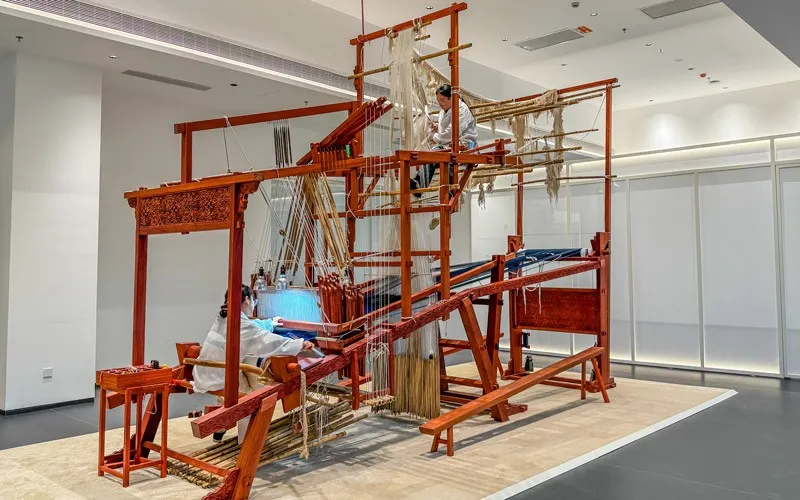
Cost is the last thing the building explains, and it explains it with parts. The great flower loom in the gallery is assembled from 1,924 components and needs a drawer of pattern cards above and a weaver below; at five to six centimetres a day, the 17 metres on the wall represent years of loom time rather than a season of work. That is what the phrase inch of brocade, inch of gold is counting.