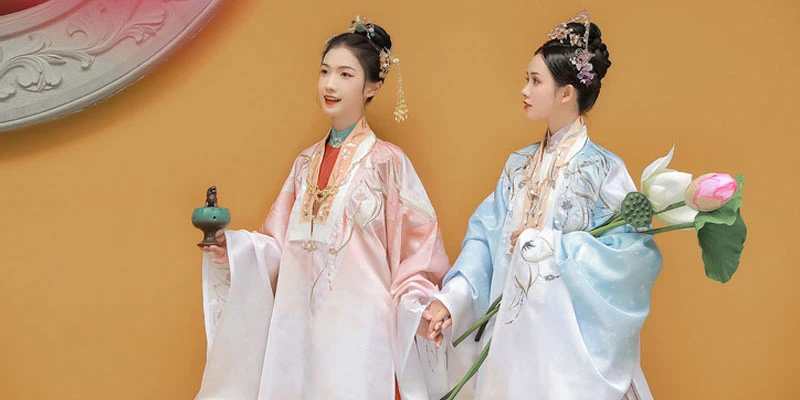
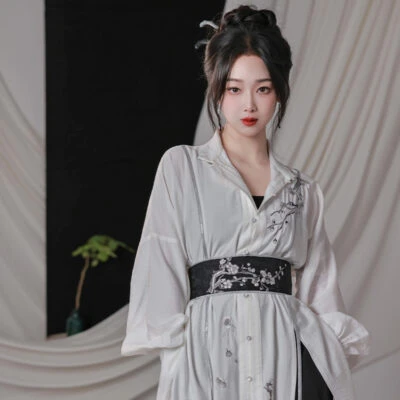
In the Song dynasty almost every wardrobe held a Beizi, and not only the wardrobes of the court. Empresses wore it, and so did women working in the fields, because the garment was never reserved to one rank. It is the defining outer layer of the period, and it is also the one most often flattened into a single sentence: the Song’s most popular jacket. That sentence hides the real subject. Across the two centuries of the Song the Beizi changed its sleeve, its hem, its width and its proportion, and each of those changes can be dated. The question worth asking is not what a Beizi is, but what happened to it, and how anyone can know.
What the Beizi Is
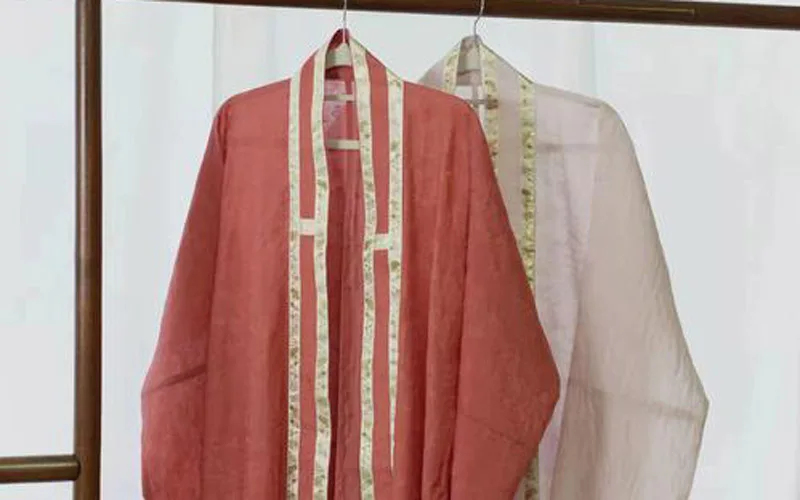
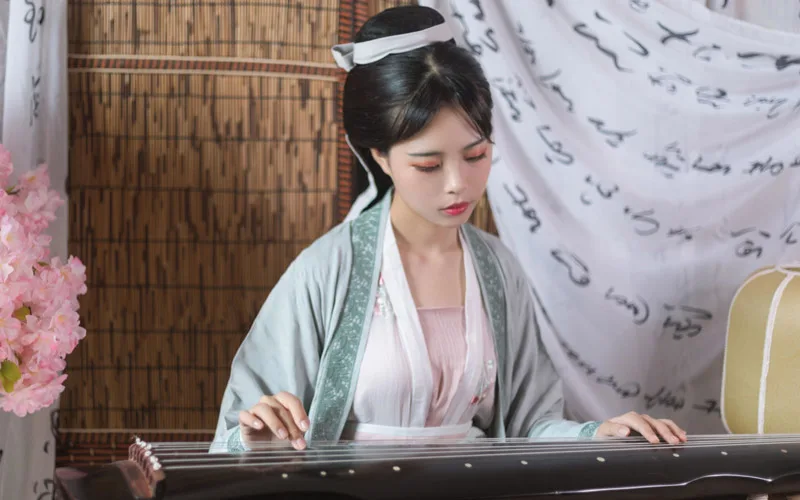
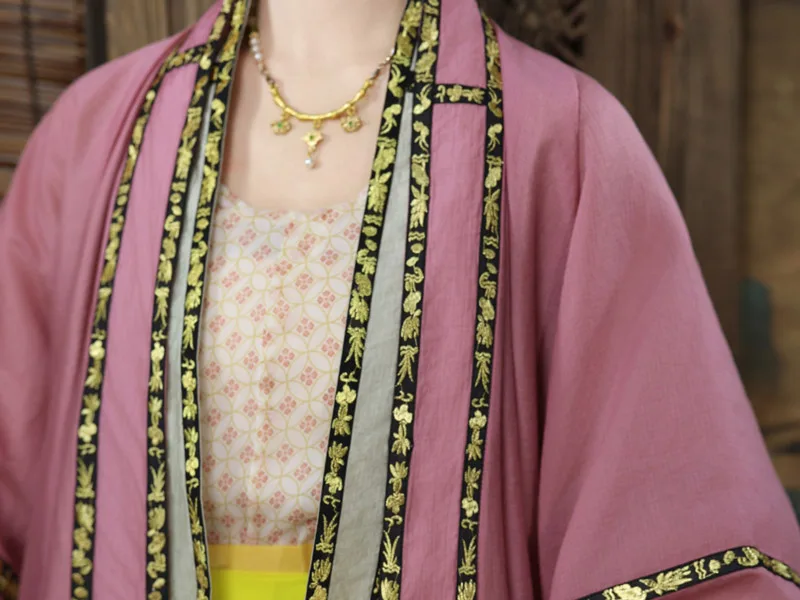
The Beizi is a straight-collared, front-opening outer garment worn by both men and women, and it is the most representative piece of Song dress. Its basic shape is a straight collar with two parallel front panels, clean in line and open at the centre. The front is almost never closed. Only one excavated example carries loops and ties, the piece from the Zhou family tomb in De’an, Jiangxi, and it stands as the exception rather than the rule. Both sides are slit long from the armpit, the sleeve mouth widens or narrows by period, and the edges are usually finished in a contrasting fabric. Length is flexible: some pieces hang below the knee, others fall level with the skirt hem, so one garment form served several ranks and several occasions.
Because the front panels do not fasten, the garment is held at the waist by a cloth belt, and the two bands sewn under the arms and at the back are left hanging. They are never knotted. Their purpose is imitation: they copy the crossed ties of the ancient inner garment, so the Beizi carries the sign of an older closure while working by a simpler one. The station’s history of the Beizi sets out the same form and the name theories behind it.
A painted stone figurine from the Fan Tongzhi tomb, held by the Henan Museum, shows how the garment sat on the body. The figure wears a narrow-sleeve parallel-front jacket underneath and a red wide-sleeve robe over it; the red outer robe is the Beizi. Its collar runs straight, its sleeves are long and either narrow or wide, its length sits at the knee, above it or at the ankle, its armpits are slit, and its bands hang loose under the arm and at the back. The front panels and the body are not sewn to each other and no loops are used. The garment was worn over a jacket, a short top or a skirt rather than on its own, so the colour and cut of the layer beneath showed through as the wearer moved.
Why the Side Slits Define It
Separation of the two lower panels at the armpit is the feature that decides what a Beizi is, and what it is not. In a closed robe the front and the back are joined down the side; in a Beizi they are not, and the join is replaced by a long slit. Everything else follows from that opening.
A slit running from the armpit to the hem changes how the garment behaves. It allows a full stride and free arms, which is why the form lasted among people who worked, and it also means the Beizi never reads as a dress. It reads as a layer placed over something else. The four panels fall separately, and even a floor-length version moves without restriction. This is also the cleanest way to tell an early Beizi from a long vest: the vest closes, the Beizi does not.
Length and sleeve width vary from piece to piece, but the slit does not. That is why the source material treats the slit as the defining line and the sleeve as the changing variable, a point the station’s form note also makes, with the construction detail worked through in the styling guide to the Song Beizi.
Half Sleeves, Then the Narrow Cut
The garment did not appear from nothing, and the documents that describe its beginning disagree with each other. The Gujin Shiwen Leiju states flatly that the Beizi began as a Banbi, the half-sleeve garment worn by warriors, and the Zhenghe Wuli Xinyi supports that reading when it records court guards who wore a half-sleeve Beizi over a brocade jacket. The Zhuzi Yulei gives a different account: the Beizi began as the dress of maidservants attending their mistress, named for the position they stood in, at her back.
Gao Cheng’s Shiwu Jiyuan, compiled in the middle of the Northern Song, adds two entries that matter more than either theory, because they record shape as well as origin. On the Banbi it says that in the Daye era of the Sui palace officers mostly wore the Banbi, that without its sleeves the garment became the long-sleeve form, and that Emperor Gaozu of Tang shortened the sleeve and called it Banbi, which by the compiler’s day was the Beizi.
The second entry is the Beizi itself. It says that the Second Emperor of Qin decreed a Beizi be added over the robe worn to court, that its sleeves were shorter than the robe’s and its body level with the robe’s, and that by the compiler’s own day it had grown as long as the skirt, with sleeves only slightly wider than the robe. The two entries therefore disagree about the dynasty and agree about the direction of travel: a short-sleeve over-garment that lengthened.
Earlier in the Song the garment matched the first description. Through the early and middle Northern Song the Beizi was mostly a half-sleeve over-garment laid over a jacket, its sleeve mouth a little wider than the jacket’s and its length level with the skirt. The mud-gold flower-and-bird gauze parallel-front woman’s garment from the underground palace of Changgan Temple in Nanjing fits that description closely.
A datable image fixes the same shape in time. A silk painting fragment recovered from the Ciyun Temple pagoda in Ganzhou, Jiangxi, painted in the seventh year of Dazhong Xiangfu, or 1014, shows a woman in a short jacket and a chest-high long skirt, with an outer over-garment that is the early Northern Song half-sleeve Beizi and matches the Changgan find closely. Paintings and brick reliefs are the third evidence path in this field, alongside textiles and documents: a textile gives fabric and cut, a contemporary image gives the whole outfit, and only the two together put the garment back into a worn set.
Through the middle and late Northern Song the taste turned toward a closer fit, and the Beizi followed. Long-sleeve Beizi appear while half-sleeve ones stay in use, and the sleeve length, sleeve width, hem and slit are all refined at once. The stone figurines from the Fan Tongzhi family tomb, buried in the Yuanfeng era, show women in long-sleeve Beizi with a front hem at the ankle and a back hem trailing the floor, sleeve mouths neatly narrowed. The Baisha Song tomb murals in Yuzhou, Henan, painted in the same decades, show women in the orderly even-hem version, so the two hems coexisted and no single standard governed the cut.
Not every region moved at the same speed. A tomb mural at Jiyuan, Henan, still shows the loose wide sleeve, and the wide-sleeve Beizi excavated from the Nangling Tiegui tomb in Anhui keeps the straight collar, the parallel front and the wide body of the early style; its sleeve span reaches 149 centimetres, against 109 centimetres on the Changgan piece. The sequence, in other words, is a drift rather than a replacement.
| Period | Sleeve | Silhouette | Evidence |
|---|---|---|---|
| Early to mid Northern Song | Half sleeve, mouth slightly wider than the jacket | Loose, length level with the skirt | Mud-gold flower-and-bird gauze parallel-front garment, Changgan Temple underground palace, Nanjing; figure in the Ciyun Temple pagoda silk painting, dated 1014 |
| Mid to late Northern Song | Long sleeve appears, half sleeve retained | Front hem at the ankle, back hem trailing, body closer to the figure | Female stone figurines, Fan Tongzhi family tomb, Yuanfeng era |
| Mid to late Northern Song, other regions | Wide sleeve kept | Loose body and wide sleeves retained | Jiyuan tomb mural; wide-sleeve Beizi, Nangling Tiegui tomb, Anhui, 149 cm sleeve span |
| Middle Southern Song | Cuff markedly narrowed | Narrow and close to the body, with a high long slit | Brick reliefs, Peng Gao couple’s tomb, the musicians’ red Beizi; the handscroll Music and Song |
| Late Southern Song | Fitted to the wrist | 112 to 131 cm long, falling below the knee | Four Beizi, Huang Sheng tomb, Fuzhou; comparable piece, Chayuanshan tomb, Fuzhou |
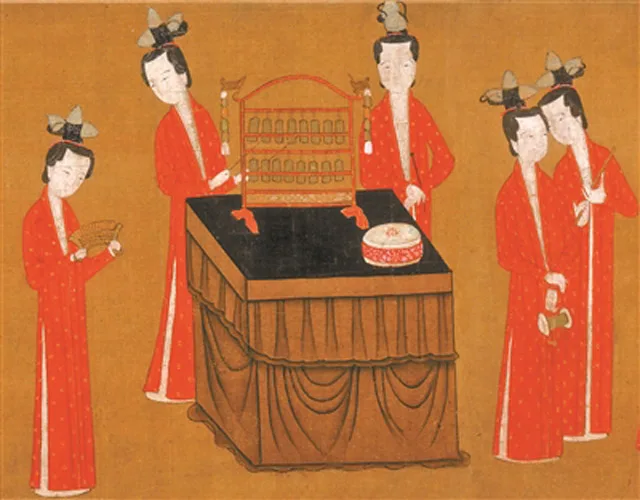
After the Southern Song was founded the aesthetic turned plainer and lighter, and the Beizi finished the change. The narrow fit became the mainstream dress of women at every level. Brick reliefs and paintings from the middle Southern Song record it precisely: in the Peng Gao couple’s tomb the musicians wear narrow red Beizi over long skirts, close to the body with high long slits, almost identical to the musicians in the handscroll Music and Song. The handscroll Five Hundred Arhats separates the classes inside one picture, with noble women in floor-length fitted Beizi and maidservants in jacket-and-trousers sets cut for work.
One tomb is the reason the late Southern Song picture survives in quantity. Huang Sheng was the daughter of a top-ranked scholar and a relative by marriage of the imperial house, and her tomb in Fuzhou held more than three hundred complete silk textiles, among them four Beizi in light gauze and silk, richly patterned, long enough at 112 to 131 centimetres to hang below the knee, with sleeves fitted to the wrist. A comparable piece from the Chayuanshan tomb in the same city confirms the trend toward lighter cloth and more varied lengths.
Gauze is worth a note of its own. The weave used a two-warp or four-warp twist that could carry a pattern inside the cloth, so the garment showed a texture that surfaced and faded with the light rather than a printed motif. That hidden pattern is the technical reason Song silk reads as soft rather than flat, and the construction behind it is set out in the station’s Beizi cutting and sewing patterns.
Beizi, Banbi, Pifeng and Bijia
A small family of open or sleeveless outer layers surrounds the Beizi, and the four are easy to confuse because they overlap in time. The Banbi is the short-sleeve ancestor the Song sources name as the Beizi’s starting point, a half-sleeve top worn as an outer layer in its own right; its construction is laid out in the station’s Banbi cutting and sewing patterns. The Pifeng is the later name for a heavier version, with the same parallel front but a warmer cloth and richer embroidery, treated in the Pifeng history and styling guide.
Bijia takes the opposite route. It keeps the open front and the side splits but removes the sleeves entirely, a vest rather than a jacket, and its line is traced in the Bijia guide. One step further out sits the skirt the Ming paired with all of them, whose flat front panel and pleats are described in the history and construction of the Mamianqun. What separates the four is not the collar but the arm: sleeveless, short sleeve, long sleeve, and long sleeve in a heavier cloth.
Questions People Ask About the Beizi
- What is the difference between a Beizi and a Banbi? The Banbi is a half-sleeve outer top. The Beizi began as a version of it and then lengthened, so the Song sources treat the Banbi as the earlier form and the Beizi as its long-sleeve descendant.
- Did men wear the Beizi? Yes. Men wore it as informal dress and under formal dress. In the Song the straight parallel collar was the women’s form, while men also carried a slanting cross collar or a round collar version.
- Why does the Beizi have slits under the arms? The two lower panels are not sewn to each other. That lets the garment move with the wearer and marks it as a layer placed over something else rather than a closed robe.
- Is the Beizi the same as a Pifeng? No. The Pifeng is the later, heavier outer coat with the same parallel front. It is a descendant in name and silhouette rather than the same garment.
- What is the Beizi made of? The dominant fabrics were gauze and silk, with lighter plain silk and damask as secondary weaves. The gauze was often a twisted-warp weave carrying a pattern inside the cloth.
- How long was a Beizi? Length varied by period and rank, from above the knee to the skirt hem to the ankle. The four Beizi from the Huang Sheng tomb measure 112 to 131 centimetres and hang below the knee.
- When did the Beizi stop being worn? It did not end with the Song. Through the Ming it continued as a wide-sleeve or narrow-sleeve garment, and it is one of the most worn silhouettes in the present Hanfu revival.
Reporting in this piece rests on two Chinese-language sources: a research feature on the stylistic changes of the Northern and Southern Song Beizi published by China Science Communication, which carries the document quotations and the excavation data, and the Henan Museum’s object note on the painted stone figurine from the Fan Tongzhi tomb. The dates given above for the Ciyun Temple pagoda painting and for the tomb finds follow those two sources.