
The term pifeng (披风) entered the vocabulary of Chinese dress in the Ming dynasty, but the coat itself had been familiar for centuries under an older name. A straight-collar, Duijin (对襟) garment fastened at the neck with ties and cut with two long sleeves and slits at both side seams, the pifeng served as the standard casual outer layer of the Ming and Qing periods. It could be worn outdoors as a windbreak or indoors as a room coat — a flexibility that separated it from the sleeveless doupeng cloak, which belonged almost exclusively to the outdoors. Wang Qi's illustrated encyclopedia Sancai Tuhui (三才图会), compiled during the Wanli era, states the lineage in a single line: "Beizi — that is today's pifeng." In other words, the Ming-Qing pifeng was the Song Beizi (褙子) under a new name.
Cut and Construction
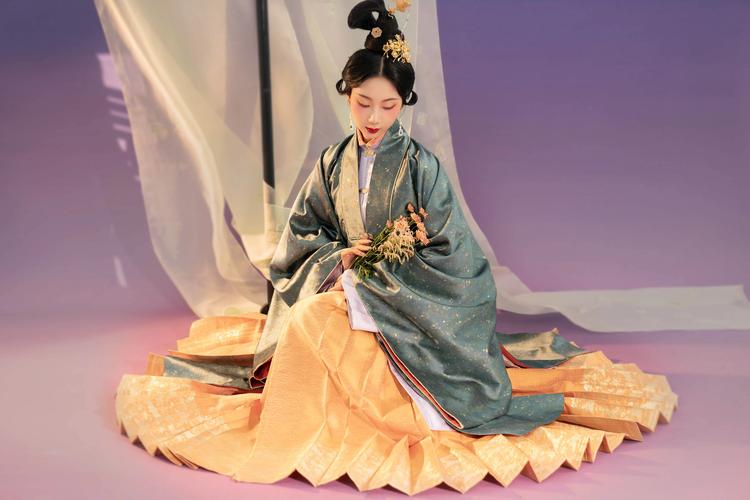
The Ming pifeng was a Duijin, straight-collar coat worn by both men and women. The collar measured about one chi — roughly 33 centimeters — the sleeves were wide with open cuffs, and the body was slit at both sides, with the front and back panels separate and unconnected. A pair of ties on the placket secured the closure, though some examples used flower-shaped jade buttons instead. The late-Ming scholar Zhu Shunshui recorded the tailoring in his Zhushi Shunshui Tanqi (朱氏舜水谈绮): the fabric and color matched those of the daopao (道袍), except that the pifeng was Duijin and carried no edging, with fastenings at the chest — jade pieces cut in floral shapes, or failing that, small ties. Gao Lian's Zunsheng Bajian (遵生八笺) goes further into literati whim, describing miniature bottle gourds grown in pots — "barely an inch tall" — of which the grower kept one perfect specimen to admire, then dried after frost and strung as pifeng buttons. Details like these give a vivid sense of the delight Ming scholars took in the minutiae of daily life.
The pifeng was already common in the Ming; the late-Ming gazetteer Yunjian Jumu Chao (云间据目抄) mentions the "pifeng casual outfit" (披风便服). After the Qing conquest, the policy of "nan cong nv bu cong" — men were required to adopt Manchu dress while women were not — allowed the pifeng to keep circulating among Han Chinese women. The novel Dream of the Red Chamber (红楼梦) returns to the garment repeatedly, and notably uses both pifeng and doupeng in the same text, confirming that Ming-Qing readers understood the two as distinct items. Gai Qi's illustrated edition of the novel (红楼梦图咏) renders the moment in chapter six when Wang Xifeng receives Granny Liu: "Xifeng wore her everyday Zhaojun cap of autumn marten, a beaded lezi headband, a peach-pink flowered satin jacket, a stone-blue Kesi (缂丝) gray-squirrel pifeng, a crimson crepe skirt lined with silver-squirrel fur, powdered and bejeweled, seated bolt upright, stirring the brazier ash with a pair of small brass tongs."
The Pifeng-Cloak Distinction
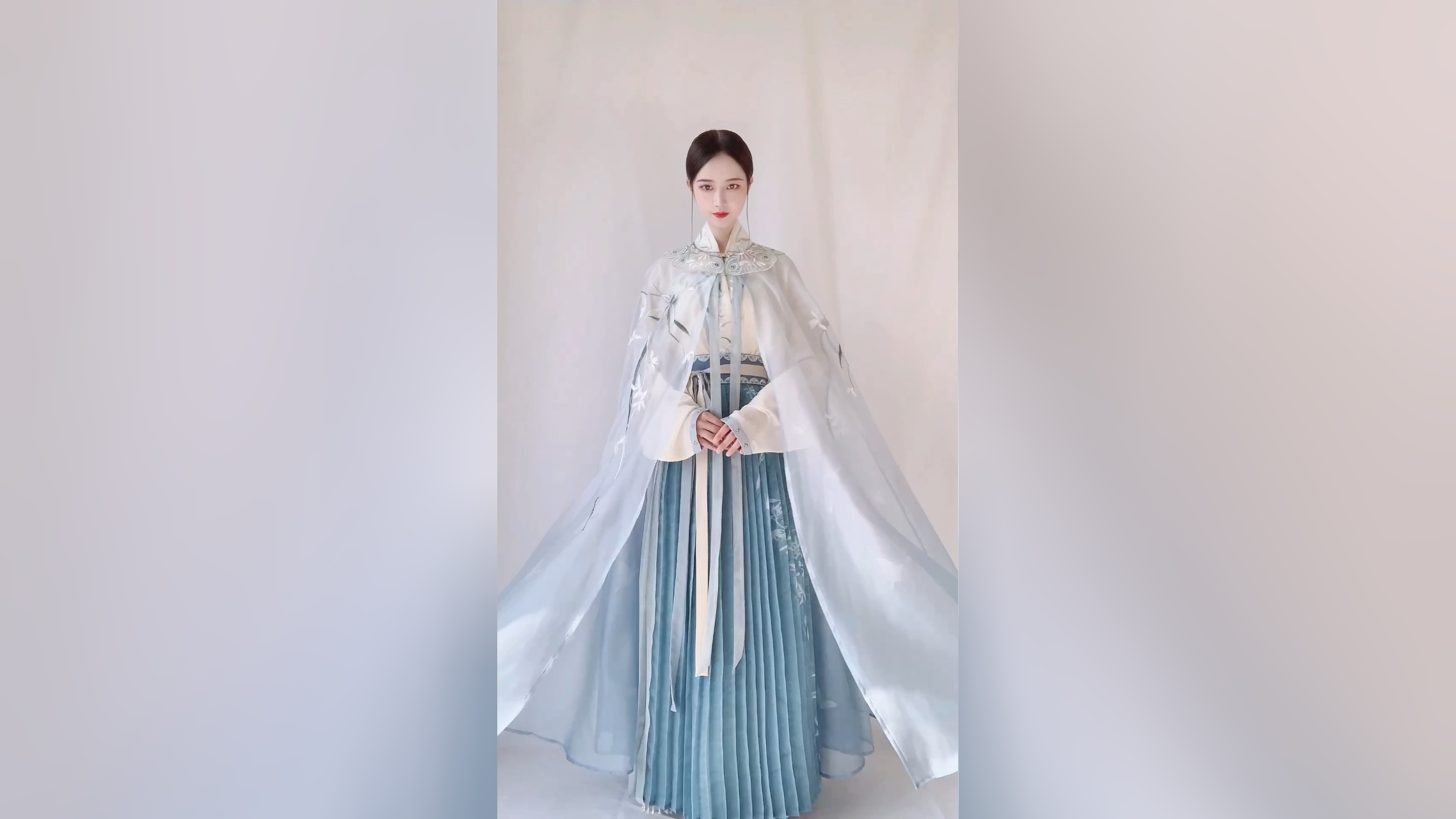
Pifeng and doupeng both kept out wind and cold, but their construction differed fundamentally: the pifeng had sleeves, a straight collar, and side slits, while the doupeng had none. A pifeng could be worn indoors or out; a doupeng was for the road. According to Sancai Tuhui and Zhu Shunshui, the Ming pifeng otherwise resembled the Song Beizi — straight-collar, Duijin, slit at the sides — but with noticeably wider sleeves. In the late Ming a standing-collar variant appeared, one commonly seen in Qing portraits. Nakagawa Tadahide's Qingsu Jiwen (清俗纪闻), a Japanese record of Qing customs, illustrates a standing-collar pifeng: nothing had changed but the collar. The straight-collar Duijin pifeng was unisex; the later standing-collar version was reserved for women.
Dressing a pifeng followed clear rules. Women wore it over a standing-collar long Ao jacket and a Mamianqun (马面裙); men paired it with a daopao as at-home leisure wear, a combination favored by late-Ming scholars. In autumn and winter, pifeng were made from assorted animal furs for warmth. Color and fabric carried status: Wang Xifeng's "stone-blue Kesi gray-squirrel pifeng" in Dream of the Red Chamber shows the aristocrat's version — a Kesi silk tapestry ground with a gray-squirrel lining, at once refined and warm.
The Qing pifeng kept the Ming cut but grew more ornate: dense floral motifs and circular tuans embroidered on the collar and cuffs. As a woman's outer coat it remained Duijin, wide-sleeved, and hemmed around the knee. Over time it acquired a ceremonial character, worn over a red skirt — the "pifeng and red skirt" combination endured well into the Republican era. The functional front ties gradually turned into a purely decorative "descendants' belt" (子孙带), a motif still visible on contemporary qungua bridal ensembles.
For generals, the pifeng carried symbolic weight: bright red or black wool made the commander identifiable to troops amid the chaos of battle and served to rally morale. The coat's thick fabric doubled as bedding at night and could be pressed into service as emergency bandages. The Ming straight-collar Duijin pifeng also entered the opera costume system as the pi (帔), a robe worn by emperors, generals, and ministers in Peking opera and other traditional forms.
Pifeng in Modern Hanfu
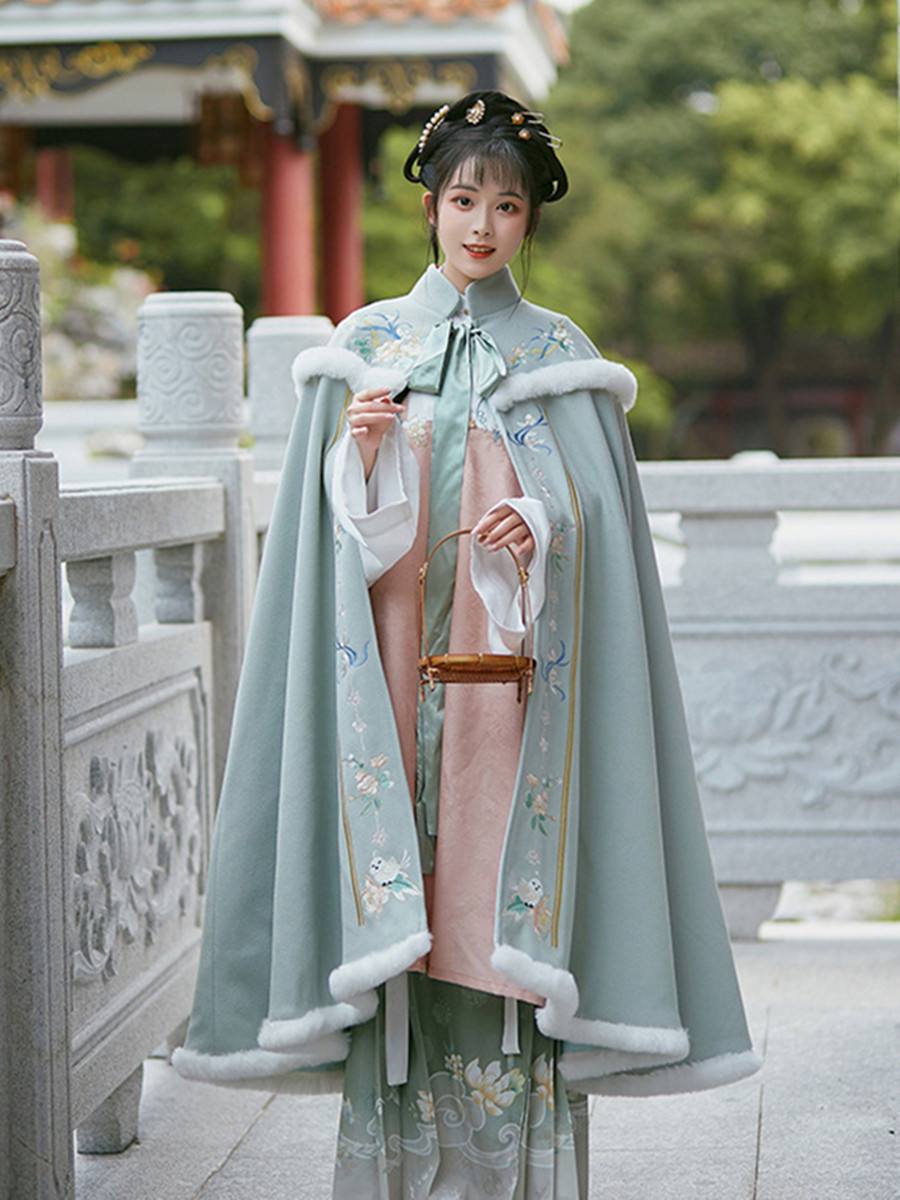
In the modern Hanfu revival, the pifeng ranks among the most important Ming-style forms and one of the most flexible. Pair it with a standing-collar long Ao and a Mamianqun for a formal, dignified Ming ensemble, or throw it over a T-shirt and jeans with canvas sneakers for a Hanyang Zhezhe (汉洋折衷) fusion that crosses eras. For serious occasions — formal Hanfu gatherings and traditional festivals — the full classic layering of pifeng, standing-collar long Ao, Mamianqun, and arched-sole embroidered shoes (弓鞋) remains the most imposing choice. Established Hanfu brands including Minghuatang (明华堂), Chonghui Hantang (重回汉唐), and Zhizao Si (织造司) all carry pifeng pieces in materials ranging from silk and cotton-linen to brocade, priced from a few hundred to several thousand yuan.
The Hechang, a Close Relative
The garment closest to the pifeng is the hechang (鹤氅), also called changyi (氅衣). Records of the hechang reach back to the Jin dynasty; Daoist clergy wore it, Song-dynasty literati favored it, and Ming scholars used it as a casual overcoat. Its construction paralleled the pifeng — Duijin, straight collar, wide sleeves, closed with a pair of long ties — but the body was usually light-colored with dark edging on the collar, cuffs, and placket, and the sides were generally not slit. Because hechang and pifeng looked so alike, the two names were sometimes used interchangeably.
Few outer garments of the Ming wardrobe carry that range. Descended from the Song Beizi, reshaped through two dynasties of daily wear, and reinterpreted by today's Hanfu community, the pifeng remains the most visible Ming-style coat in modern circles — and the one a new wearer is most likely to reach for first.
