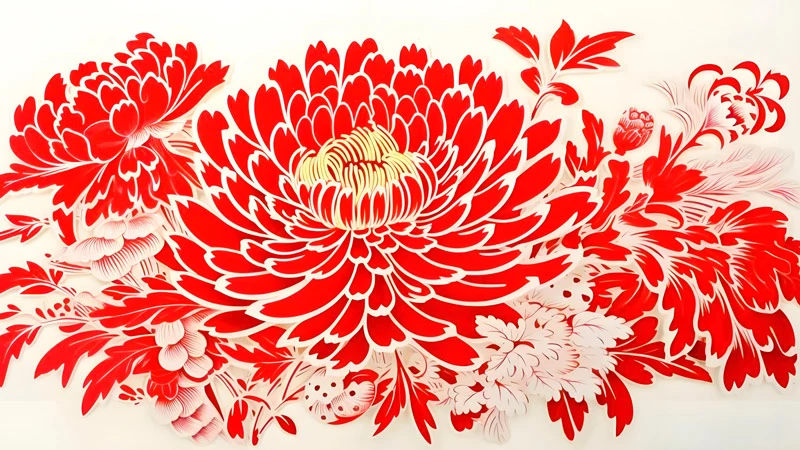
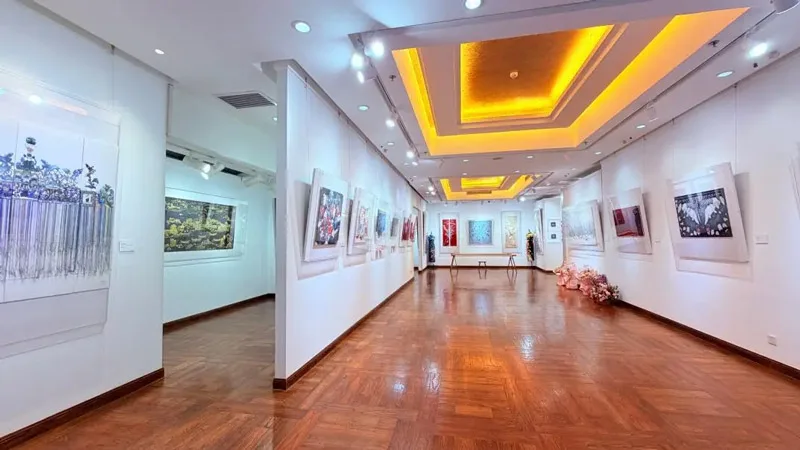
A needle tradition that has run for roughly 1,350 years in the black-soil country of Heilongjiang reached Hong Kong on October 13, when the Himalaya Gallery on the 26th floor of MassMutual Tower, 38 Gloucester Road, Wan Chai, opened a thematic exhibition of Manchu embroidery, the national-level intangible cultural heritage practised as Bohai Mohe embroidery. China News Service and Zijing reported the opening the same day. The show runs until November 12 and brings 46 original works together with about 500 cultural and creative products, all made from tussock silk from the northeast, a fibre whose soft sheen is part of the reason the pictures read as paintings rather than as cloth.
It is the first time the tradition has been presented on an international stage in Hong Kong. The line-up is led by Sun Yanling (孙艳玲), a fourth-generation representative inheritor of Manchu embroidery, a master of arts and crafts in Heilongjiang, and a council member of the China Intangible Cultural Heritage Protection Association. She came to Victoria Harbour with close to a hundred museum-grade pieces and new creative works, and the exhibition’s framing places the craft inside a grown-up version of the usual travelling show: half museum, half trade mission.
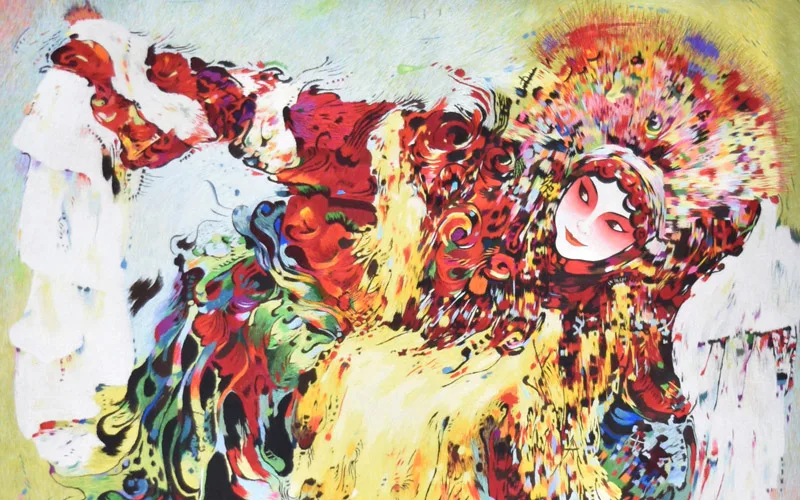
Bohai Mohe Embroidery, 1,350 Years On
The technique belongs to the northeast and to the Manchu tradition, and its distinctiveness lies in the stitch rather than the subject. Sun Yanling has folded the light-and-shadow logic of oil painting into the older method, so that a single piece changes depth as the viewer moves or the light shifts across the gallery. Practitioners describe the result as embroidery that behaves like oil on canvas, and the description is not decorative: the surface is worked in layers rather than in flat blocks of colour, which is what allows a portrait to hold expression at a distance and texture at close range.
That layering is what the Wan Chai selection was built to demonstrate. The 46 works on the walls are supported by a much larger run of derivative products, the part of an exhibition that usually goes unmentioned but decides whether a craft leaves with a studio or with a market. Both the artworks and the products share the same raw material, which keeps the display legible as one trade rather than two.
Four Plans to Take Manchu Embroidery Abroad
The opening doubled as a launch. The China Manchu Embroidery Museum and the China Going-Global Enterprise Alliance signed a strategic cooperation agreement naming Hong Kong the base for the art’s overseas dissemination and commercial expansion. Yu Jingzhong, executive vice-chairman of the alliance, said the network would be mobilised in full so that audiences outside China can see a traditional craft’s living energy, with the plan to move through the Asia-Pacific region first and on to Europe and North America afterwards.
Beyond the agreement, three further commitments followed. Organisers said they are looking for a local strategic partner to build a Hong Kong Manchu Embroidery Museum, and Sun Yanling announced a large-format work, Embroidering Xiangjiang, to be stitched in the bold Bohai Mohe manner and dedicated to the city. A public-welfare programme named Heritage Revived, Hong Kong Embroidery Passed On will train 100 Hong Kong embroiderers and creative-industry workers at no cost, aimed at young people and women looking for flexible work or a small studio of their own. The fourth plan, Manchu Embroidery Oriental Couture, links Hong Kong designers and brands to the craft so that the three-dimensional stitch can move into haute couture, jewellery and handbag design.
What the Three Signature Works Show
Three pieces carry the technical argument. Blue Eyes, a cross-disciplinary original that took a silver award at the Baihua Cup and was developed with a painter, is worked in only black, white and grey, the three tones most resistant to embroidery, and uses them to build a girl’s clear gaze; the gallery treats it as the point at which the maker moves from technician to artist. The Snow Town series turns to the artist’s home province and uses the blunt triangular stitch to give snow and frost real depth, against the softer register usually expected of embroidery.
Leopard, the third work, was finished by four senior embroiderers over six months under Sun Yanling’s direction. What matters in it is not the animal but the coordination: several makers had to surrender individual habits and work to one conception, one stitch and one sequence, which is how a hand craft demonstrates that it can be practised at scale. Asked why Hong Kong, Sun Yanling pointed to the city’s mixed international audience and its mature fashion and creative industries, adding that touring exhibitions around the Asia-Pacific are next. The show is jointly organised by Himalaya Auction (Hong Kong) and Shenzhen Manchu Embroidery Cultural Development.