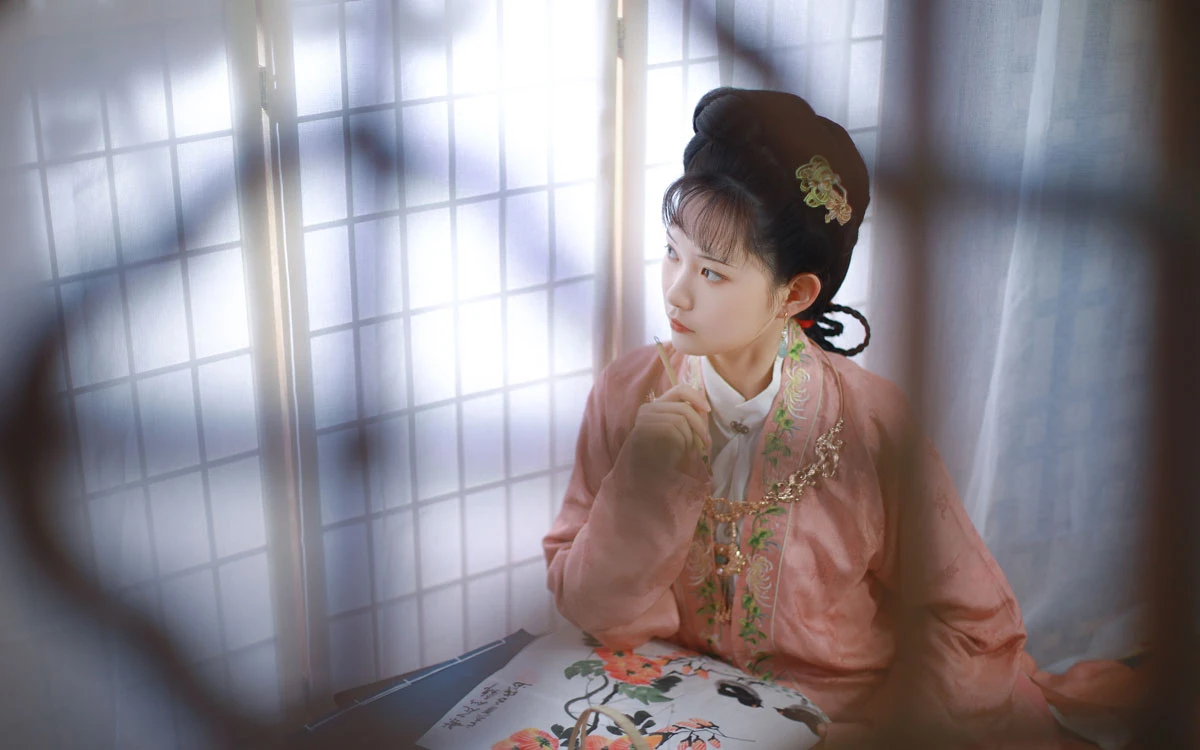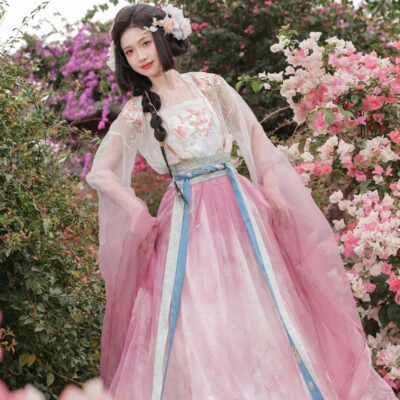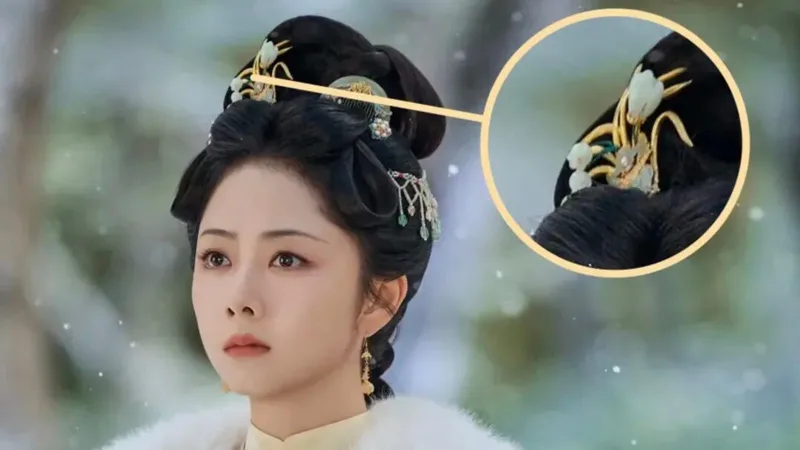
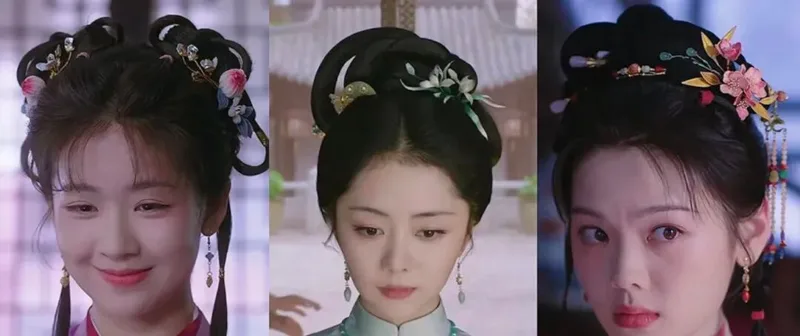
In the costume drama Against the Current (兰香如故), viewers kept pausing on something smaller than a plot twist: the hair. Young women wore soft, springy blooms, not rows of gold pins or strings of pearls. Those ornaments are velvet flowers, a handmade craft that twists silk and copper wire into petals. Their quiet screen comeback challenges an old assumption. Luxury, many stories taught, meant heavy jade and shining metal. Velvet flowers say otherwise. A single stem can hold grace, memory, and skill. The shift is small, but it rewrites a big idea. For decades the craft nearly vanished. Film, fashion, and festival displays pulled it back into view. This essay follows its path through courts and streets, then asks how it can survive without losing its hands.
Court and Street
Hair flowers in China go back at least to the Qin Dynasty. Records say the emperor’s palace women pinned five-colored pith flowers into their hair. Those early blossoms came from the rice-paper plant, whose soft core could be cut and shaped. Fresh flowers were lovelier but fragile; heat wilted them, and winter offered none. So people learned to make flowers that never faded. By the Tang Dynasty and Song Dynasty, wearing blooms had become a common pleasure. Zhou Fang (周昉) captured it in Court Ladies Adorning Their Hair with Flowers (簪花仕女图). Velvet flowers have no clear birth date. Legend places them in Wu Zetian’s (武则天) era, when fine southern pieces reached the throne as tribute.
By the Ming Dynasty, velvet flower making had grown into a real trade. Nanjing helped. Its brocade workshops produced mounds of silk scraps, cheap and fine, perfect for twisting into petals. Palace taste soon pulled the craft upward. The court summoned top artisans from Yangzhou (扬州) and Nanjing to work in imperial workshops, making flowers only for royalty. People began calling them “palace flowers.” Before festivals, workshops rushed out batches for New Year, Dragon Boat, and Double Ninth celebrations. Readers of Dream of the Red Chamber (红楼梦) may recall a scene about fresh-style gauze flowers sent from the palace. Those ornaments were part of the same refined world.
Palace fashion rarely stays behind walls. Velvet flowers moved into ordinary life, appearing at weddings, reunions, and seasonal rites. Their name sounded like “glory and prosperity,” so families pinned them on for luck, protection, and hope. Wang Zengqi (汪曾祺) remembered this in A Tale of Big Nur (大淖记事). Village women tucked bright red cut-velvet flowers into their buns, simple and alive. At temple fairs, buyers chose red blooms stamped with the character for fortune, then wore them home to “bring blessings back.” The habit lasted for generations. It was never only decoration. A flower could mark a marriage, a holiday, a child’s first New Year, or a grandmother’s wish for peace.
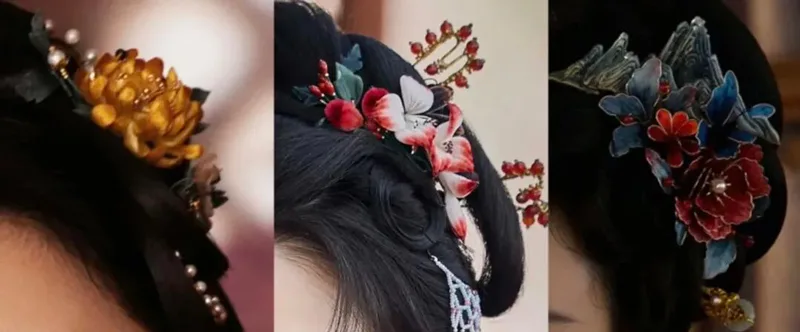
Regional styles gave velvet flowers different accents. Beijing, Tianjin (天津), Nanjing, and Yangzhou became key centers. Southern work often sparkled with bold color, lively and vivid. Beijing’s court-trained makers favored steady, formal tones, especially true red. Yet the meanings stayed shared. A finger citron with a peach wished both fortune and long life. Peony beside swimming fish suggested wealth with surplus. Northern designs spoke plainly: characters for fortune, rank, longevity, and joy, or gourds, pomegranates, lotus, and persimmon. Every leaf and curve carried a gentle prayer. The craft was local in technique but national in feeling.
Craft and Comeback
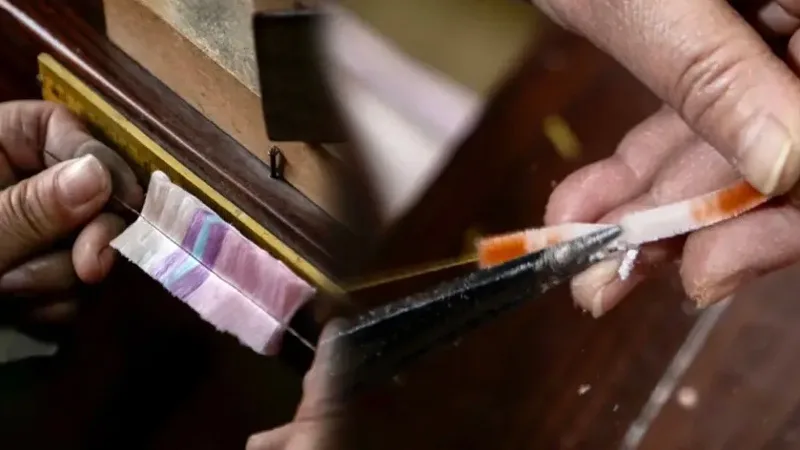
Modern times were unkind. Many traditional skills faded, and velvet flowers almost disappeared. Then screens and international stages gave them new light. The method itself remains exacting. Makers use silk scraps and purple copper wire, shaping every petal by hand. No machine copies the texture. Even a basic flower can take ten steps and two full days. Each piece holds a worker’s time, patience, and breath. That cost is why the craft struggled: it cannot be rushed, and it cannot be cheap. When viewers admire a character’s hair, they are seeing hours of quiet labor, not a factory product.
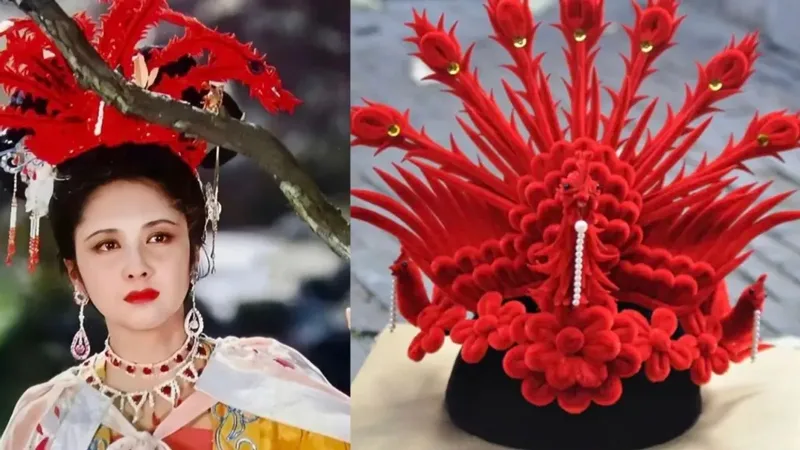
Cheaper materials have changed the market. Twisted chenille sticks and similar substitutes let beginners make flowers at home. The lower barrier is good. More people now recognize the look, wear it with modern clothes, and try simple hair styles. Yet mass-produced fun cannot replace fine handwork. A cheap copy may spread the silhouette, but it does not pay the artisan’s hours. The real question is not whether velvet flowers should be popular. It is how to keep popularity from flattening the skill. Between pure craft and commercial survival, the road remains long.
Foreign luxury brands often borrow Chinese motifs, then sell them back as trend. That should be a warning. If local traditions are not valued, taught, and renewed at home, outsiders may define them first. Velvet flowers cannot stay locked in museums or costume dramas. They need today’s colors, today’s styling, and today’s young wearers. Let them sit beside jeans, a plain coat, or modern Chinese dress. Let makers teach, experiment, and earn. A living craft changes; a frozen one only waits to be copied. The thousand-year bloom still has room to open. Would you wear one?