
Ancient Chinese dress rested on two great structural systems: the "separate upper and lower garments" system and the Shenyi (深衣) system. The first is simply clothing with the top and bottom cut separately; the second joins the upper garment and lower skirt into one continuous body — the ancestor of the modern dress and the long coat. The Shenyi, the garment once called "the most principled clothing in history," had to be cut and sewn according to a strict procedure and worn in correspondence with ritual. The Quju (曲裾) and Zhiju (直裾) both derive from it, and the modern Qipao, the contemporary dress, the Japanese kimono, and the Korean hanbok all owe something to its principle of joined upper and lower garments. This guide walks through the Shenyi's long career, from the ritual codes of the pre-Qin classics to its revival under Song-Ming Confucianism.
The Five Laws of the Shenyi in the Book of Rites
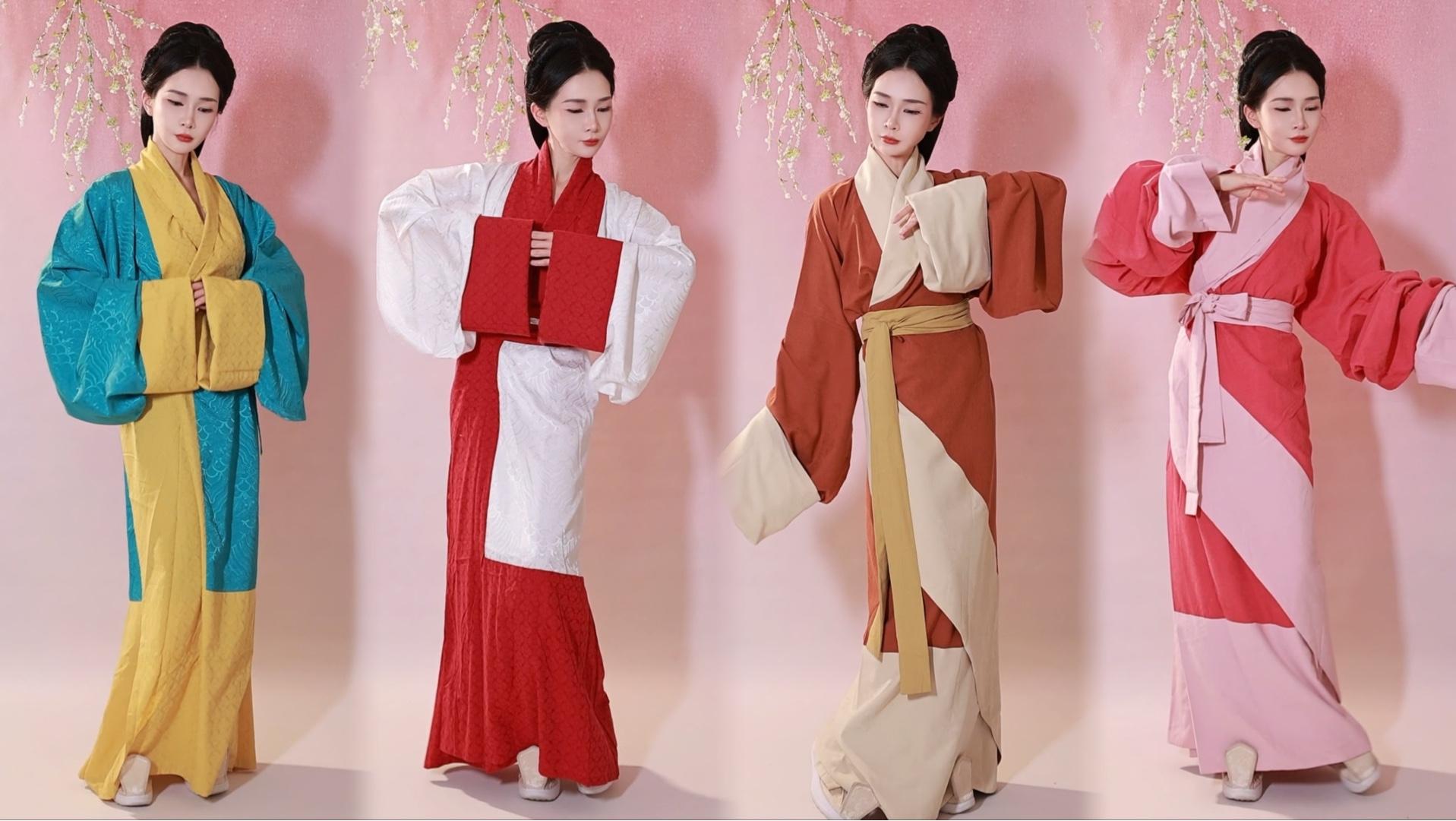
The earliest surviving textual record of the Shenyi is the Book of Rites (礼记), which mentions it in the chapters "Tangong Shang," "Wangzhi," "Yuzao," and "Shenyi." The "Shenyi" chapter states its governing principle at the outset: "The Shenyi of antiquity had its standard, to correspond to the carpenter's square, the compass, the plumb line, and the balance." Concretely: "It is made in twelve widths, to correspond to the twelve months. The sleeves are round, to correspond to the compass. The curved collar is square, to correspond to the square. The back seam runs straight to the ankle, to correspond to the straightedge. The lower hem is level as a balance." A garment designed to these rules, the text explains, "raises the hands and gives a bearing of ceremony, carries the straight back and the square front to make government upright and conduct square, and levels the hem to settle the will and calm the heart."
The cut had explicit limits: "Short enough that the skin does not show, long enough that the hem does not touch the ground." The details followed: "The lapel is continued and the border hooked; the waist seam is sewn at the midpoint below. The armhole is placed so the elbow can move freely; the sleeve is long enough to fold back to the elbow. The sash hangs below without reaching the hipbone and above without pressing the ribs — it sits at the boneless place between." The Eastern Han commentator Zheng Xuan (郑玄) noted: "It is called Shenyi because the text records the system of the Shenyi"; on the lapel clause he glossed, "Xu, to connect... the hooked border is like the Quju of today." Kong Yingda (孔颖达) of the Tang added in his Correct Meaning of the Book of Rites: "It is called Shenyi because other garments keep upper and lower garments unconnected, while the Shenyi joins them; the garment covers the body deeply and fully, and so it is called the deep garment."
Rites of the Spring-Autumn Era, a Han Synthesis
The Shenyi appeared around the transition from the Spring-Autumn to the Warring States period, born of the ancient pursuit of ritual propriety. It developed and spread under the Qin and Han, faded for a time, and regained attention with the Song-Ming Confucian revival. Structurally it was a single body made by cutting upper and lower garments separately and stitching them together, the waist seam a visible marker of ancestral deference. Early Han dress inherited Chu style: tight-fitting bodies, flaring trumpet hems, and low collars; Han people layered garments one over another so each collar showed at the neckline in tiers — a fashion called "threefold layered garments" (三重衣). The Han, the first great unified dynasty of the early empire, dressed with "Qin structure and Chu spirit": the Shenyi as its emblematic garment was a product of Central Plains and Chu cultures, of Confucian and Daoist currents, fused.
Quju and Zhiju: Two Lineages of the Same Principle
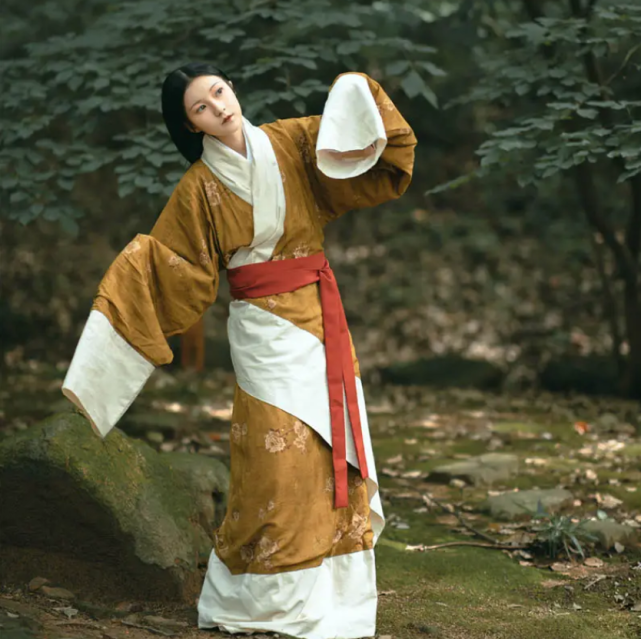
The Shenyi falls into two classes — the Quju (curved-lapel) and Zhiju (straight-lapel) Shenyi — differing mainly in how the skirt border is wrapped. The late archaeologist Sun Ji (孙机), in his essay "The Shenyi and Chu Dress" (深衣与楚服), argued: "Shenyi wearers included men and women, but whatever the state or the sex, the shared feature of this costume is a section of curved lapel that sweeps to the back." The character ju means the garment's edge; the Quju is the Shenyi whose hem edge winds around the body.
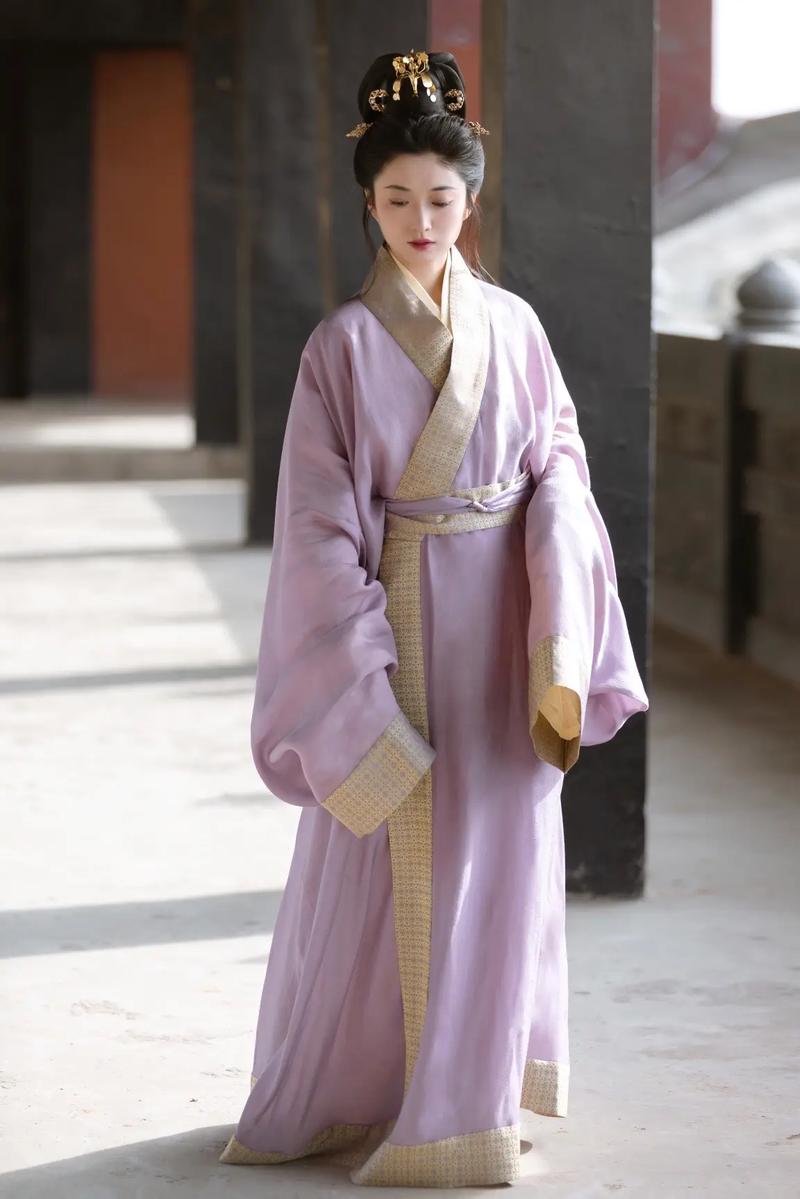
The Quju Shenyi, inherited from Warring States forms, was the standard of the early Western Han. Its wrapping method originated in modesty: the lapel was extended into a triangle, wound around the back, and tied with a sash — an overlapping closure that preserved modesty, pleased the eye, and saved cloth. Women's versions extended the lapel to wrap several layers around the torso, each layer's trimmed border showing, binding the waist tightly and flattering the Han taste for slenderness; the many layers rippled as the wearer walked. Because trousers were still immature — only "shin garments" resembling modern leggings existed — the wrapped Quju closure was the most rational way to stay covered. In the Western Han the Shenyi, worn by both sexes, served mostly as ceremonial dress; palace ladies wore it to court as the "silkworm robe" (蚕衣), and the Grand Empress Dowager's version had silk-trimmed collar and edges pieced in blue above and light blue below.
The Zhiju Shenyi, also called chanyu (襜褕), had a straight square hem. It appeared in the Western Han and became widespread in the Eastern Han. Compared with the Quju it was broader and looser, with differences in the details. Because trousers lacked crotches, the Zhiju had to be worn with underclothes and could not serve as formal ceremonial dress at first — only as daily wear. As trousers improved and gained crotches, the wrapped Quju lapel became redundant, and from the Eastern Han through the Wei-Jin and Northern and Southern dynasties the Zhiju spread and replaced it. "It can serve civil ends and military ends, as usher at ceremonies and commander in the field" — the Shenyi worked for both civil and military occasions, distinguished by fabric, pattern, and color according to context and rank, uniting beauty and utility.
Excavated Evidence
Archaeology shows joined upper-and-lower garments existed from prehistoric times through the Han, fading only after the Wei-Jin period. The Shang-dynasty jade figure no. 371 from the tomb of Lady Fu Hao (妇好墓) at Yinxu in Anyang shows "crossed lapels falling to the chest, long sleeves to the wrist, narrow cuffs, a wide sash at the waist, and a hem reaching the ankle." The bronze standing figure from Sacrificial Pit No. 2 at Sanxingdui wears a long joined inner garment. A Western Zhou bronze figure from Tomb No. 1 at Rujiazhuang, Baoji wears a joined robe as well. The Warring States finds from Tomb No. 1 at Mashan, Jiangling are especially precious — a group of joined garments in fine silk with brilliant ornament, including padded robe N16 in small-rhombus-patterned brocade and unlined robe N13 of purple-red silk gauze embroidered with a dragon-and-phoenix design.
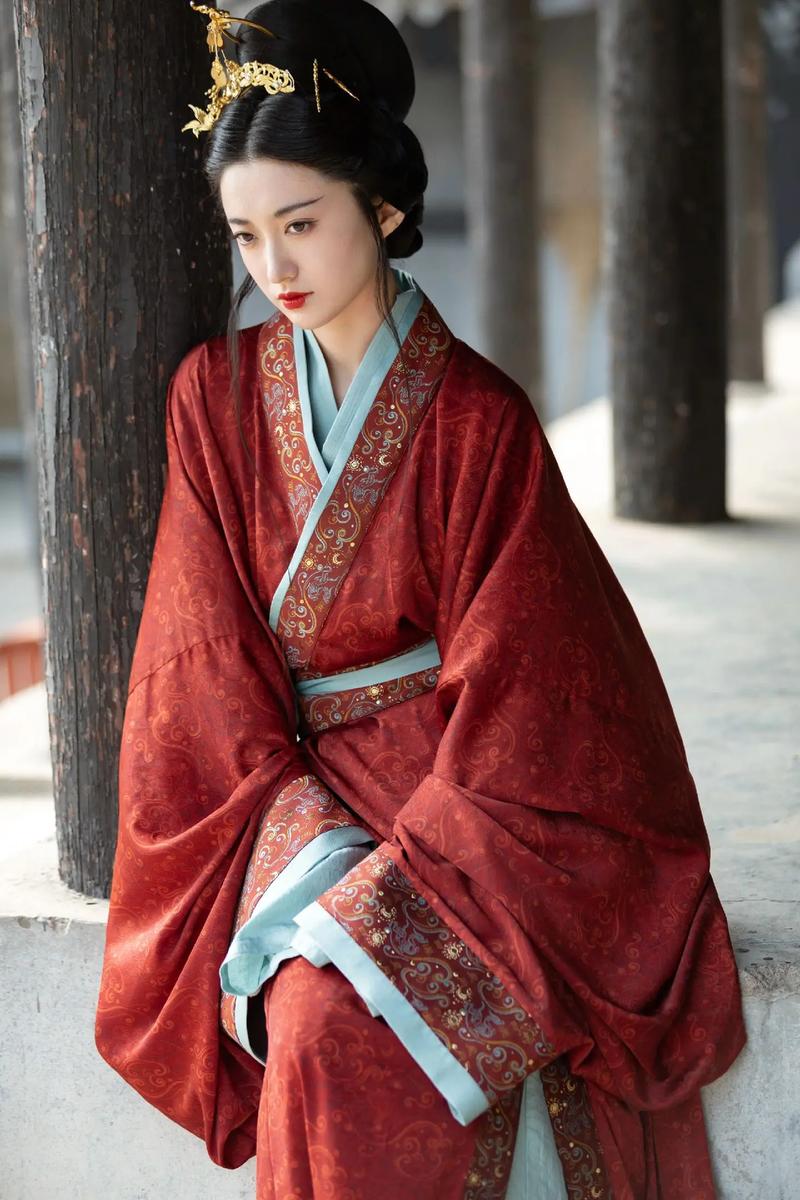
In the Western Han, the joined Quju robe was the leading style, worn by men and women alike and dominant in women's dress. Han materials were generally light and thin: the plain gauze robe (素纱禅衣) from Tomb No. 1 at Mawangdui, Changsha weighs a mere 49 grams — the earliest, best-preserved, most finely worked, and lightest garment in the world. Many researchers have tried to reproduce it without success; the silk thread available today is thicker than Han thread, so the replica always comes out heavier. The same tomb yielded a crimson gauze printed-and-painted Zhiju silk wadded robe, a vermilion rhombic-lattice gauze Quju wadded robe, and a gauze "Xinqi embroidery" (信期绣) wadded robe — joined garments whose surfaces carry patterns of branches, buds, pistils, and flower clusters, hemmed with flat, firm brocade and decorated with cloud motifs: "garments embroidered, edges brocaded" (衣作绣、锦为沿).
Working from these objects, Jiang Yuqiu (蒋玉秋), professor at the Beijing Institute of Fashion Technology, led a team that reconstructed the Quju Shenyi using the "crowned figure" (冠人俑) and painted wooden figurines from the Mawangdui Han tomb as reference, and completed a Zhiju Shenyi reconstruction based on the tomb's crimson gauze printed-and-painted Zhiju robe. Costume restoration teams have also reconstructed early Western Han ladies' Quju ensembles — spare and elegant, faithful to early-Han aesthetics.
The Shenyi as a Confucian Symbol
Once the Book of Rites became canonical, the Shenyi took on a heavy Confucian coloring and came to be called simply the Confucian robe. The Book of Rites, chapter "Ruxing," records Duke Ai of Lu asking Confucius: "Is the Master's garment the Confucian robe?" Confucius answered: "In my youth I lived in Lu and wore the broad-sleeved robe (逢掖之衣); grown, I lived in Song and wore the Zhangfu cap (章甫之冠). I have heard that the learning of the gentleman is broad and his dress follows his native place. I know no Confucian robe." The actual forms of the Confucian robe changed with the times: in the Spring-Autumn and Warring States periods, the "broad-sleeved robe" and "Zhangfu cap"; after Emperor Wu of Han "dismissed the hundred schools and honored only Confucianism," official students wore Quju robes; in the Eastern Han, the straight Zhiju chanyu paired with the Jixian cap (进贤冠) and the cloth headwrap (幅巾).
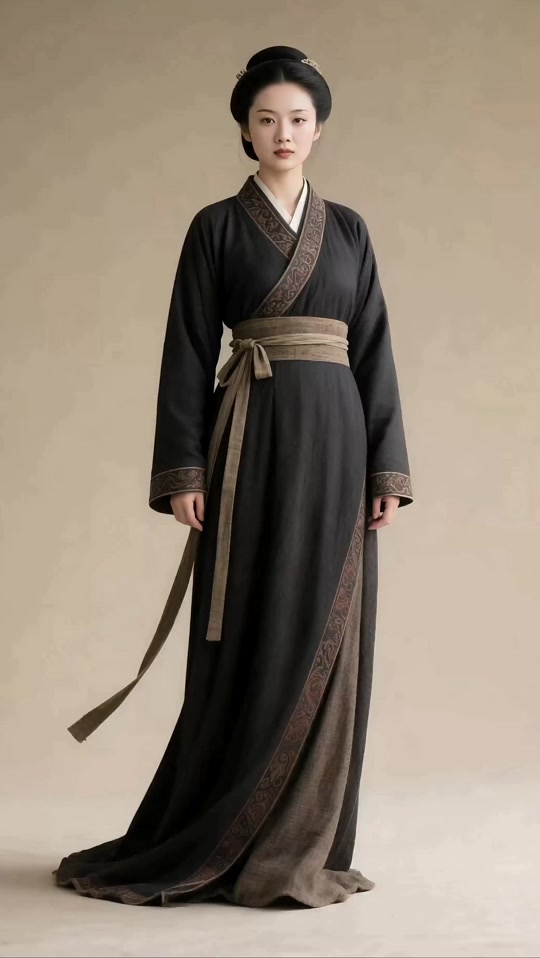
An essay published by the Capital Library of China, "The Shenyi: A Platonic Symbol of Confucian Thought", observes that successive generations of Confucian scholars annotated and diagrammed the Shenyi with great zeal, yet mostly argued about the tailoring, each defending his own reconstruction. Even so, core features can be identified: twelve widths of cloth, separately cut upper and lower garments joined at the waist, and decorative edging. Liu Lele (刘乐乐), a doctoral researcher at Wuhan University's School of Philosophy, argues that the Book of Rites Shenyi carries ritual requirements in "color, form, and meaning": in color it means plainness — cut from fine white cloth, with collar, sleeves, and hem edged in black silk; in form it means depth — long enough not to drag, short enough not to bare the skin; in meaning it means the mean — a form both upright and numerically harmonious, yielding the virtue of harmony. "The body the Shenyi presents is a social body under ritual-music culture, not an individual, self-aware body." In other words, the Shenyi is an ideal-type symbol abstracted by Confucian scholars from real clothing to carry Confucian thought — in the classic formulation, "China is called Xia for its greatness in ritual; is called Hua for its beauty in dress" (中国有礼仪之大,故称夏;有服章之美,谓之华).
Later Descendants: The Tang Lanshan and Song-Ming Revival
After the Han, as ethnic exchanges deepened, the tight dress of the northern peoples entered the Central Plains while the "metaphysical" fashion made robe-and-shirt sets popular — and the Shenyi retreated. Its line re-emerged with the Tang lanshan (襴衫). The New Book of Tang (新唐书), in the section on chariots and dress, records Grand Councilor Ma Zhou's (马周) proposal: "The rites contain no provision for the shirt; the institutions of the Three Dynasties had the Shenyi. Let a cross-band, sleeves, cuffs, and borders be added, to make it the formal upper garment of the scholar-official." Judging the Wei-Jin broad shirts improper, Ma Zhou reformed the garment on Shenyi principles — "imitating antiquity while honoring the ancients."
With the Song-Ming Confucian revival, the Shenyi itself was revived and eagerly taken up by Confucian scholars and the literati. The History of Song (宋史), in its dress regulations, records: "After the restoration, the dress of scholar-officials largely followed the old standards of the Eastern Capital, with later changes. The first is the Shenyi, the second the purple shirt, the third the cool shirt, the fourth the cap-shirt, the fifth the lanshan." Because Song scholars knew the Han Shenyi only through texts, the Song version mixed inherited practice with new variation; in the Yuan, Ming, and Qing, different scholars read the "continued lapel, hooked border" clause differently, producing the competing Shenyi systems of the textual critics — Jiang Yong's Textual Study of the Shenyi (深衣考误), Dai Zhen's Analysis of the Shenyi (深衣解), and Huang Zongxi's Shenyi diagrams all belong to this tradition.
Zhu Xi's Family Rites and the Korean Won Note
Born in China, the Shenyi traveled abroad. Confucian learning reached Japan during the Sui-Tang; in the Song-Ming period, Confucianism and Zhu Xi's Family Rites (家礼) reached the Korean peninsula, where Confucian scholars made Shenyi garments after that text, giving Chinese Shenyi culture a second development. Japan still preserves many portraits of Confucian scholars in Shenyi; on the Korean peninsula, the portrait of the Neo-Confucian master Yi Hwang (李滉) wearing a Shenyi has been used on the Korean won banknote. The History of the Later Han (后汉书), in its dress regulations, records the "Tongtian crown... with its robe in the Shenyi system, with a padded coat, matching the five seasonal colors" and that "the Grand Empress Dowager and the Empress Dowager wore temple robes, purple above and black below; for the silkworm rite, blue above and light blue below — all in the Shenyi system." Down to the modern Qipao, the contemporary dress, the Japanese kimono, and the Korean hanbok — all heirs of the Shenyi's joined-garment principle — the Shenyi, the core archetype of Chinese dress institutions, reaches across time and across borders.
Reconstruction and Modern Wear
Today the reconstruction and re-creation of the Shenyi is a major strand of the Hanfu revival: archaeology and academic teams have reconstructed the Quju and Zhiju Shenyi from the Mawangdui and Mashan finds, and the reconstructed ensembles are widely seen at Hanfu gatherings, museum presentations, and traditional ceremonial scenes. For modern wearers, the choice follows the occasion: for everyday outings, an adapted Zhiju Shenyi with a plain sash and embroidered edges; for ceremonial gatherings, a reconstructed Quju Shenyi with its layered wrapped lapels and trailing hem, paired with flower-pinned hair, jade pendants, and the raised-soled chongtai shoes (重台履) for the full dignity of Han dress. To understand the "continued lapel, hooked border" archetype of the Shenyi is to hold the key to the Quju, the Zhiju, and the Hanfu system as a whole.
