
Few garments in the Chinese clothing tradition have generated as much scholarly argument — or as many physical reconstructions — as the shenyi. Mentioned in the Liji, the Yili, and the Book of Rites as the foundational "deep robe" of Confucian ritual, the shenyi has been lost to history in any unbroken sense for roughly two thousand years. There is no surviving physical example that we can be certain was worn in the Warring States period; every "shenyi" that exists today is a modern scholar's reconstruction, and as one widely cited overview notes, "each restorer's version is different, which is why there are so many." In 2012, the Shanghai Confucius Temple gathered the historical reconstructions of successive dynasties of Confucian scholars and identified twelve distinct interpretations — nine of which fall within the broader hanfu canon, and three of which post-date the Qing dynasty and sit outside it.
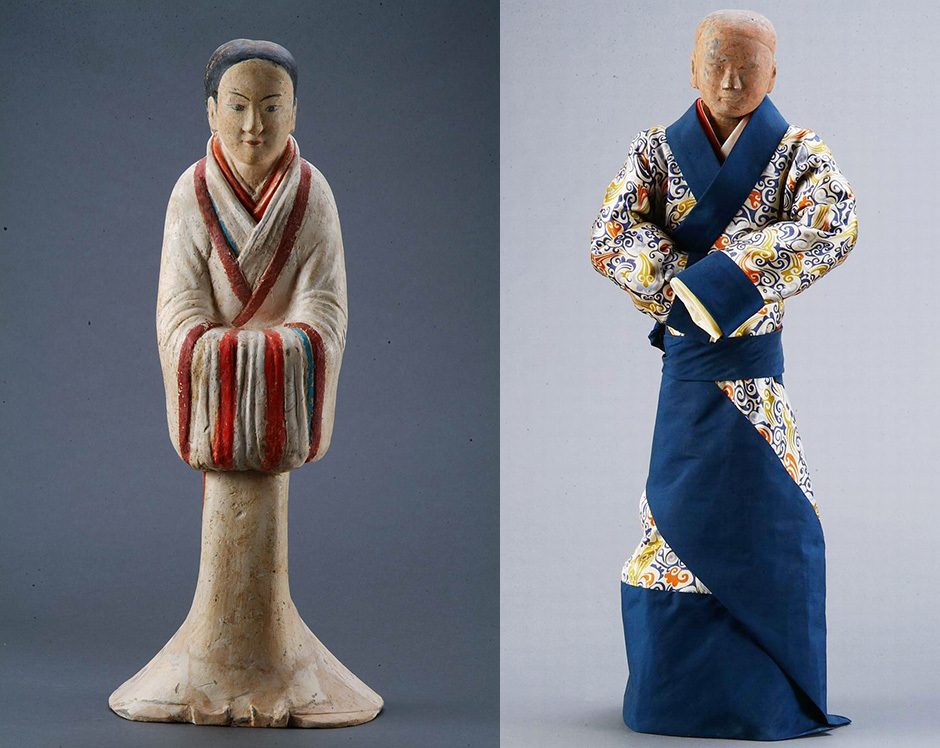
The term itself is a category rather than a single garment. In its original ritual sense, "shenyi" referred to any upper-and-lower-body robe in which the top and the skirt were cut as one continuous piece of cloth, the hem wrapping the body in a single unbroken line. The two surviving subtypes — the quju (curved-hem robe) and the zhiju (straight-hem robe) — are not, strictly speaking, "shenyi" so much as the two main ways of finishing a shenyi hem. Both were worn in the Han dynasty, both were simply called "pao" at the time, and both were used by men and women.
The defining technical feature is the small rectangular panel, called the ren, set into the side seam at the armpit. The ren allowed the upper body to move freely while the long lower panel — the part that produced the dramatic wrap — stayed in place. In the quju version, the lower panel was wound once or twice around the body before being pinned at the chest, producing the elegant "continuously curved hem, hooked at the edge" silhouette described in the Liji. The zhiju version dropped straight down, and is the more practical ancestor of the later Ming dynasty daopao (scholar's robe).
What makes shenyi relevant to the contemporary hanfu movement is not its antiquity but its prestige. Among the nine "shenyi" variants catalogued in the Shanghai study are the Zhu-zi shenyi (reconstructed by the Song dynasty neo-Confucian Zhu Xi), the Li-zhou shenyi (reconstructed by the late-Ming thinker Huang Zongxi, also known as Huang Lizhou), the Nan-shan shenyi, the Hu-zhai shenyi, and the Zhao-ming shenyi. Each encodes a different theory about how a Confucian gentleman should have looked in the Warring States period — and therefore how a contemporary hanfu enthusiast should look when performing Confucian ritual today. The Zhu-zi shenyi, with its long body, conical hat, and black-edged hem, has become the default ceremonial garment of the hanfu movement in mainland China, used in coming-of-age ceremonies, sacrifices to Confucius, and graduation rituals.
The scholarly dispute has not gone away. Restorers disagree on whether the original shenyi had a back seam (some reconstructions show a single back panel; others show the back and front cut as one piece), whether the lower edge should "hook" the way a quju does, and whether the hem should fall to the ankle or to the floor. What is no longer disputed is the cultural weight of the question. A garment that vanished from daily life in the Warring States period has, after two thousand years, become the highest-status ceremonial dress in the most rapidly growing heritage clothing movement in the world.
