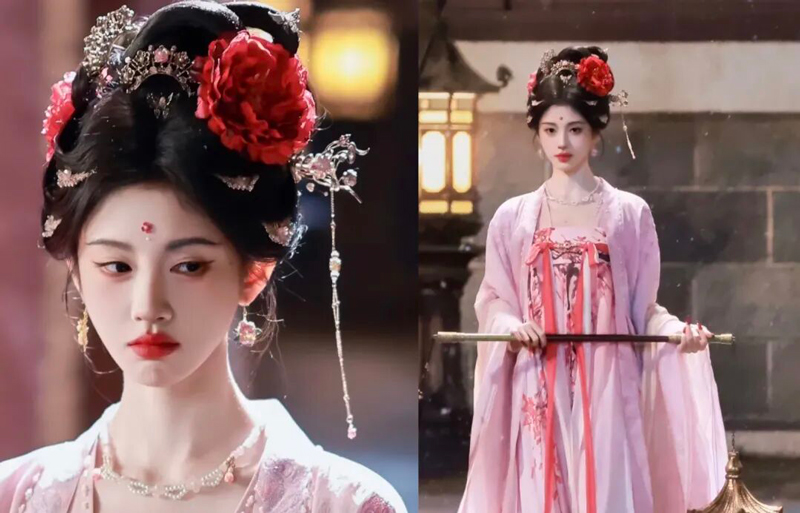
Is Ju Jingyi (鞠婧祎) wearing a flower the size of a dinner plate on her head in the new costume drama Veil of Shadows (月鳞绮纪)? Netizens think so, and they are not happy. The actress, playing a character named Lu Wuyi (露芜衣), recently unveiled a Tang Dynasty-inspired look that features an enormous, bright pink blossom perched atop her elaborate bun. While the drama promises fantasy and romance, the internet has zeroed in on one question: is that flower historically possible, or just a stylistic train wreck?
The answer, according to historical records and paintings, leans heavily toward the latter. This isn’t just about one actress’s accessory—it’s about how modern productions misunderstand an entire era’s aesthetic. Let’s dig into why that flower feels so wrong, and what Tang women actually put in their hair.
Historical Reality
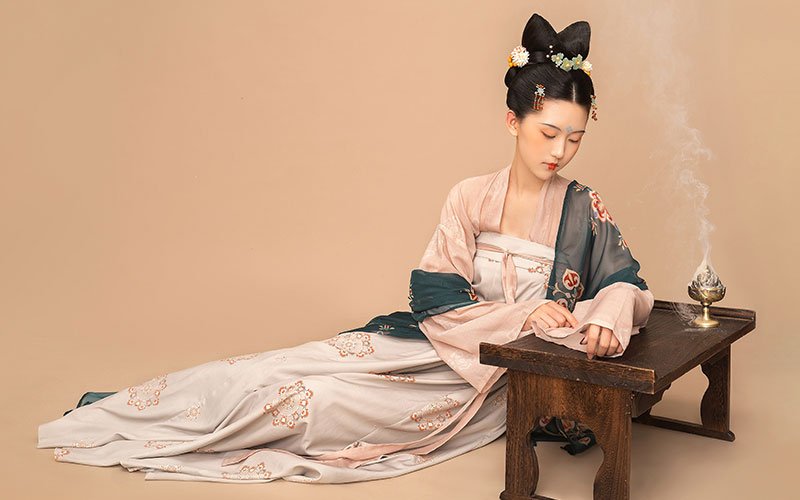
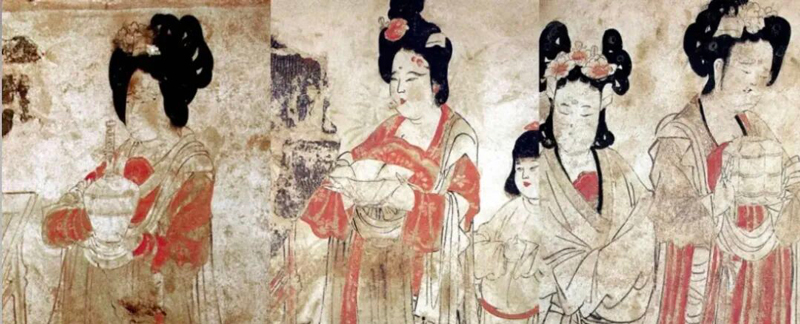
If you time-traveled to the late Tang or Five Dynasties period, you would be hard-pressed to find a lady sporting a flower as loud and oversized as the one on Lu Wuyi’s head. Tomb murals and religious paintings from that era tell a different story. In scenes of daily life, women with complex, sky-high buns often accessorized with small, delicate blossoms or a combination of tiny flowers and ornamental hairpins. The emphasis was on harmony, not a single, screaming focal point. A flower that bright and large would have been considered gaudy and out of place, throwing off the entire visual balance of the hairstyle.
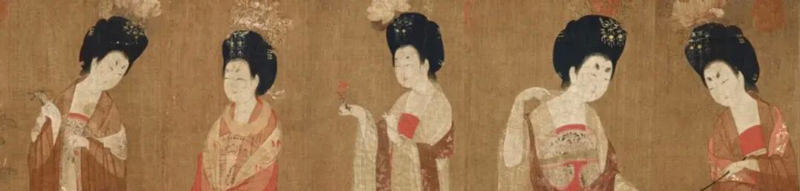
Even in Buddhist devotional images, where women wore elaborate crowns and combs on their lower buns, you rarely see any Zanhua (簪花), the custom of wearing flowers in hair. The headgear was grand—yes—but it was structured, often made of metal or jade, not a fresh peony the size of a fist. This suggests that the “one giant flower” look was not a standard or even popular choice. It might have existed in poetry or as an extreme fashion for festivals, but it was by no means the everyday norm that many TV dramas pretend it is. So where did this obsession come from?
The real culprit is a single famous painting, but even that artwork might be lying to us. Before we blame the Tang, we need to look at the evidence that the flower trend was actually a later invention. Shen Congwen (沈从文), a renowned scholar of Chinese ancient costumes, had a sharp theory about this. He noticed that something about the flowers in that iconic painting just doesn’t fit the Tang style. And once you see it, you can’t unsee it.
The Painting Lie
The painting in question is Court Ladies Wearing Flowered Headdresses (簪花仕女图). For decades, it has been the bible for Tang Dynasty costume designers in film and television. Look at any so-called “Tang-style” drama from the early 2000s, and you will see that same giant flower perched on actresses’ heads. It has become a lazy shorthand for “ancient Chinese glamour.” But here is the problem: that painting might not be from the Tang at all. Shen Congwen argued that the flowers are an anomaly. Late Tang hairstyles were already massive—adding a huge flower on top would look “neither fish nor fowl,” something he claims is “unique and absent in authentic Tang art.”
His theory suggests the painting was actually made in the Song Dynasty, which came right after the Five Dynasties period. The Song artists, looking back at the previous era, added their own imagination. They exaggerated the flower because they thought “bigger is more Tang.” This is like a modern movie depicting the 1980s with neon everything—technically inspired by the era, but wildly inaccurate. So the very source that most costume departments rely on is likely a fake, or at least a heavy reinterpretation. That means every drama that copies that flower is copying a copy of a mistake.
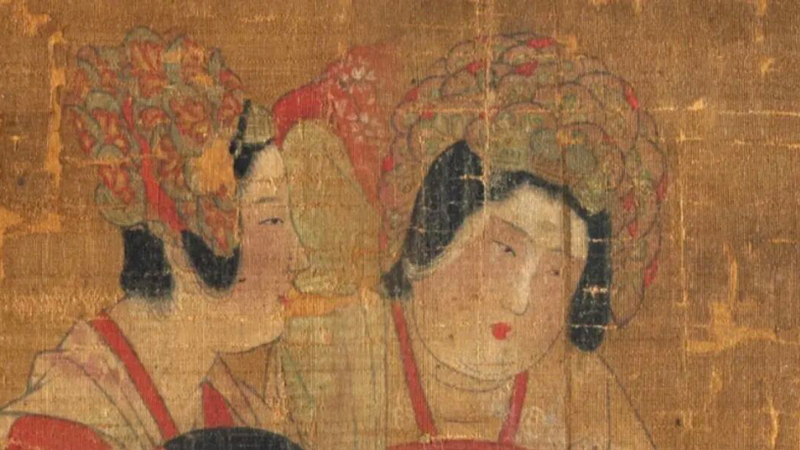
What did real Tang women wear? Look at murals from the actual late Tang and Five Dynasties, such as those in tombs or the Court Music Painting (宫乐图). You see flower crowns, yes, but never a single, isolated, oversized blossom sticking out like a UFO. You see small flowers, combs, and pins working together. The effect is rich but not chaotic. The giant flower, as seen on Lu Wuyi, is a modern invention born from lazy research and the blind repetition of earlier TV shows. And it is getting worse—the flowers today are often even larger and more disproportionate than those in the old paintings.
Proportion Over Size
Let’s talk about Ju Jingyi’s face. She is known for her delicate, small features. That enormous flower does not complement her; it fights her. In any scene, the eye goes straight to the bright pink blob, not to her performance or the costume’s details. It is the definition of overwhelming. Good makeup and costume design should enhance the actor, not distract. Here, the flower has become the main character, and Lu Wuyi is just the hanger. Netizens have put it bluntly: “That big flower is completely unnecessary.” They are right. It breaks the immersion and makes the character look more like a walking floral arrangement than a noble lady of the Tang.
There is a common misconception about Tang Dynasty aesthetics. People think “big hair, big everything.” Yes, the buns were large, often using wigs and padding to create volume. But the accessories—aside from ceremonial crowns—were generally small, refined, and balanced. Think of it as a symphony: the big bun is the cello, deep and full; the small flowers and pins are the violins, adding sparkle without drowning out the melody. The giant flower is a brass band playing solo. The real artistry of Tang style lies in “simplicity within complexity” and “order within chaos.” It is about layering, not piling. You add elements, but each has its place and proportion.
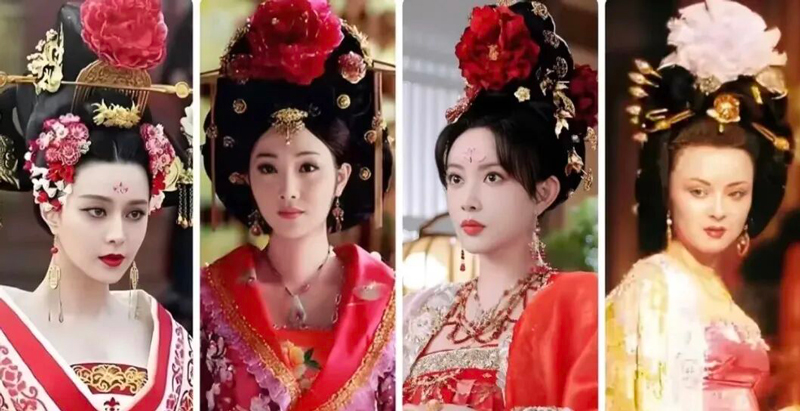
So why do modern productions keep making this mistake? Because it is easy. A giant, colorful flower reads immediately as “ancient” and “luxurious” to a casual audience. It requires no subtlety or historical knowledge. But for those who care, it screams inauthenticity. The drama Veil of Shadows might be a fantasy, not a documentary, but even fantasy needs internal logic and visual coherence. When a costume looks this jarring, it breaks the spell. Ju Jingyi is a talented actress, but she deserves a headpiece that works with her, not against her. Until costume departments re-read Shen Congwen and look beyond that one suspicious painting, we will keep seeing these floral disasters. And the internet will keep asking: that giant flower—really?