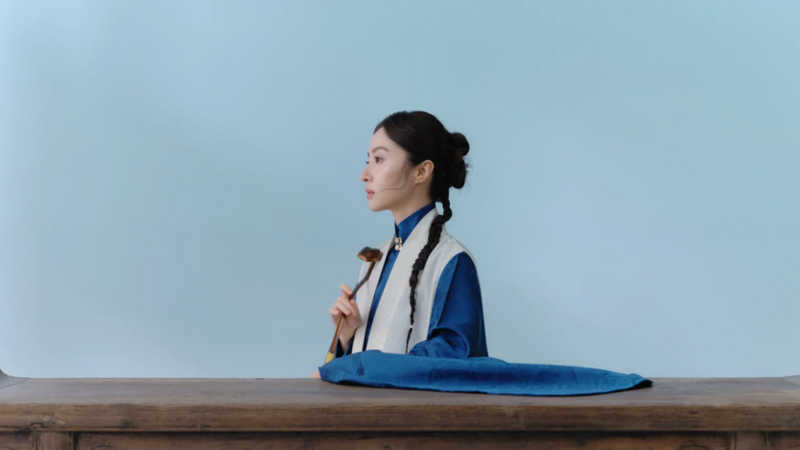
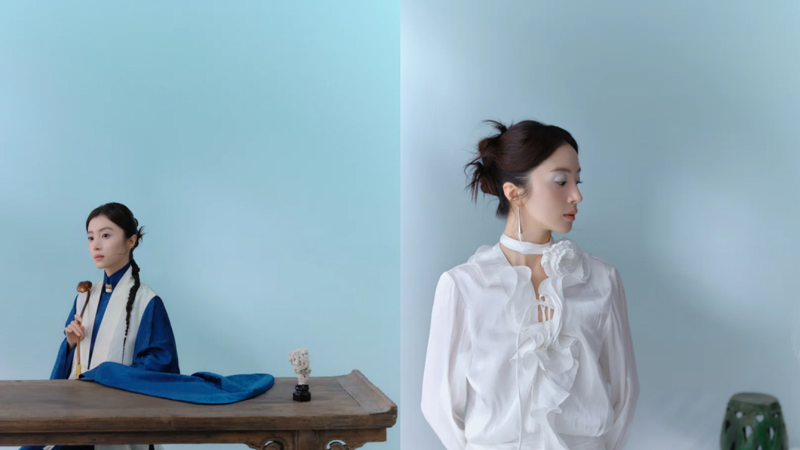
She looks like she just walked out of a silk painting. When actress Hu Bingqing (胡冰卿) released her latest magazine photoshoot in Hanfu, the internet paused. Unlike the typical glamorous or overly romanticized styles seen on other celebrities, her outfit carried a quiet, scholarly elegance. The color palette was unusual—deep, almost moody green paired with crisp white.
And the garment itself? A sleeveless, open-front long coat that few modern wearers would recognize. It wasn’t a familiar Ming Dynasty robe or a Tang Dynasty skirt. It was a Bijia (比甲), a forgotten piece of nomadic practicality turned aristocratic fashion. Hu Bingqing didn’t just wear clothes; she wore a historical footnote. And in doing so, she reminded us that the most striking fashion statements are often the ones buried deepest in the past.
A Vest from History
At first glance, the Bijia resembles a modern vest or a long waistcoat. But look closer. It has no sleeves, no standing collar, and opens straight down the front with a center split. The sides are slashed from armpit to well below the knee. Its length varies—some versions stop at the hip, others at the knee, and a few nearly graze the ankle, leaving less than a foot of air between the hem and the ground. Hu Bingqing’s version falls gracefully around her calves, moving with her like a second skin. This is not a garment for freezing winters or formal banquets. It was made for motion.
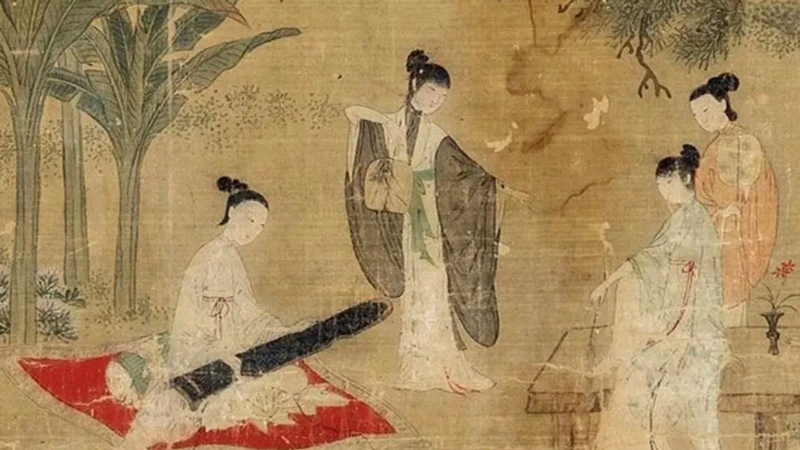
During the Yuan Dynasty, the Bijia had a peculiar asymmetry: the back panel was longer than the front. Two small cord loops hung at each side slit, allowing the wearer to tie the front flaps back when needed. Fastening happened at the chest with either fabric sashes or small buttons. Every detail served a purpose. The open sides freed the legs for mounting a horse. The sleeveless cut meant no flapping fabric to catch a bowstring. This was riding gear disguised as court attire.
According to the History of Yuan: Consorts’ Biography (元史・后妃传), the Bijia was designed by Empress Chabi (察必), the wife of Kublai Khan. She supposedly wanted something practical for horseback archery. The original description reads: “A front skirt without lapels, the back twice as long as the front, also without sleeves or cuffs, with two cord loops attached—called ‘Bijia’.” But was she really the inventor? Sleeveless coats had appeared in China before, during the Tang and even earlier. Empress Chabi likely revived an old idea, stripped off the oversized sleeves that were cumbersome for nomads, and gave it a new name. She didn’t create from nothing. She adapted.
The Queen’s Ingenuity
Think about Empress Chabi for a moment. She was a Mongol queen ruling over a conquered Chinese empire. Her people lived on horseback. Yet she was surrounded by the flowing silks and wide sleeves of Han Chinese court fashion—beautiful, but useless for her warriors. Her solution was not to abandon Chinese dress but to hack it. She removed the sleeves, shortened the front, and added ties. The result was a garment that looked elegant at rest but became functional in motion. It’s a rare example of nomadic practicality influencing settled aesthetics, not the other way around.
Why did sleeves have to go? Imagine drawing a composite bow while wearing a standard Song Dynasty robe. The excess fabric would tangle with the bowstring, flap in the wind, and block your peripheral vision. For a mounted archer, every inch of loose material is a liability. The Bijia eliminated that risk entirely. By baring the arms, it allowed full range of motion. And because the sides were open, a rider could straddle a horse without splitting seams. This wasn’t just fashion. It was functional design born from a specific lifestyle: steppe nomads who conquered half the world on horseback.
After the Yuan fell, the Bijia didn’t disappear. The Ming Dynasty kept it, but softened its edges. Sleeves crept back in, lengths varied, and the garment became more decorative than practical. By the Qing Dynasty, it had evolved into different forms. Today, most Hanfu enthusiasts ignore it. They prefer the dramatic flowing robes of Tang or the structured jackets of Ming. Hu Bingqing’s photoshoot is a rare exception. She didn’t choose the obvious. She chose the Bijia—a garment that says more about cultural exchange and adaptation than any pristine, unbroken tradition ever could.
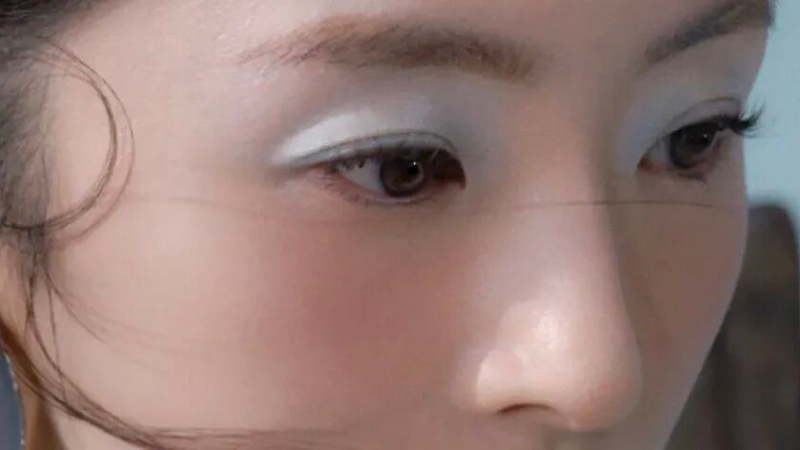
Shades of Green and White
Now look at the colors. Hu Bingqing wears a deep, almost blackish-green outer robe under a white Bijia. The combination is striking because it’s restrained. No gold embroidery. No bright reds. Just a dark, earthy green and a clean, blank white. In traditional Hanfu aesthetics, this pairing is classic but underused. The deep green—called qing (青)—is not the “sky blue after rain” that most people imagine. It’s the green of “indigo blue extracted from indigo plant.” The very phrase “qing comes from blue but surpasses blue” (青出于蓝而胜于蓝) refers to this color. It’s darker, richer, and more mysterious than ordinary green.
Chinese poets loved qing because it reminded them of hair. Under sunlight, healthy black hair can reflect a bluish-green sheen. So they called hair qing si (青丝)—”green threads.” A lover’s cut hair was “qing si cut,” a promise of devotion. Hu Bingqing’s deep green robe echoes that poetic connection. It’s the color of ink wash paintings, of old forests, of a scholar’s midnight thoughts. The white Bijia over it acts like fresh snow on dark earth—it lifts the heaviness without competing. This is not accidental. Traditional Chinese color theory valued balance: the dark, advancing color (青) and the light, retreating color (白) create a visual harmony that feels both calm and alive.
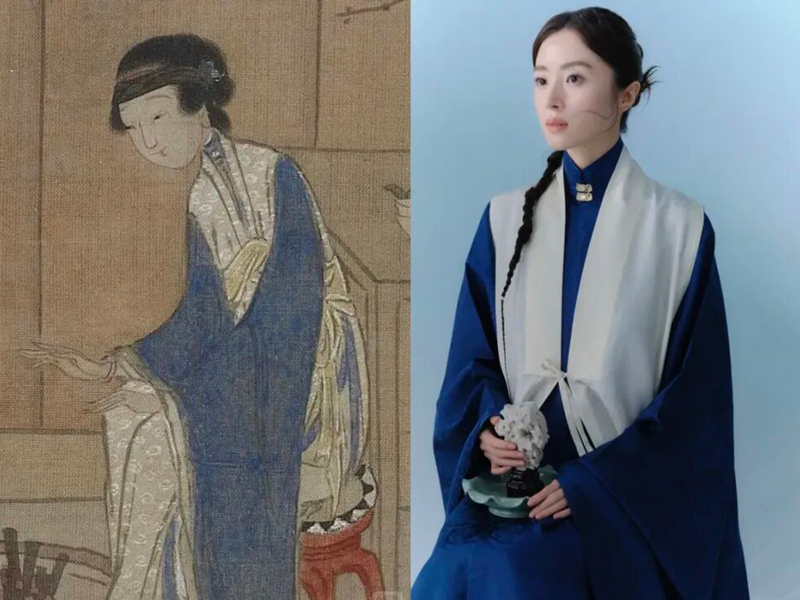
You can see similar outfits in surviving Yuan and Ming paintings. Scholars and ladies alike wore layered looks with a long inner robe and a sleeveless outer garment. But there’s one difference: the hairstyle. In ancient paintings, women often pinned their hair into three distinct buns—a Sanliu Tou (三绺头), or “three-strand head.” Hu Bingqing’s stylist chose a modern “new Chinese style” updo instead, simpler and cleaner. Yet somehow, she still looks like a figure from a scroll. Maybe it’s the way the white Bijia frames her face. Maybe it’s the deep qing robe that absorbs light instead of reflecting it. Or maybe it’s just that some clothes carry their history so naturally that they make the wearer timeless.