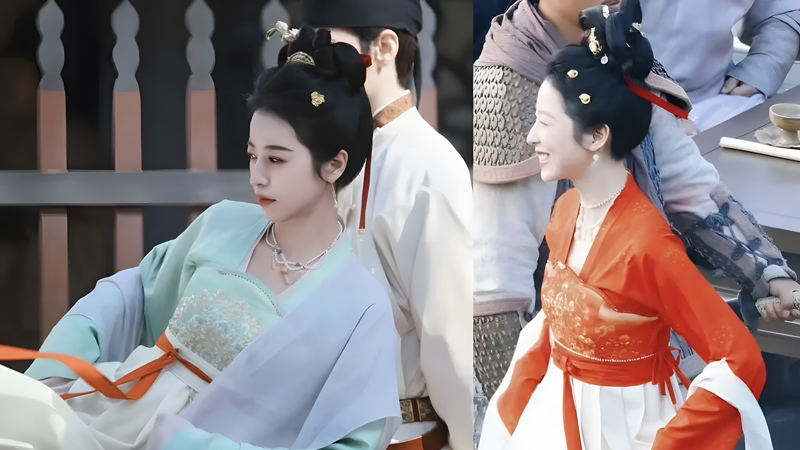
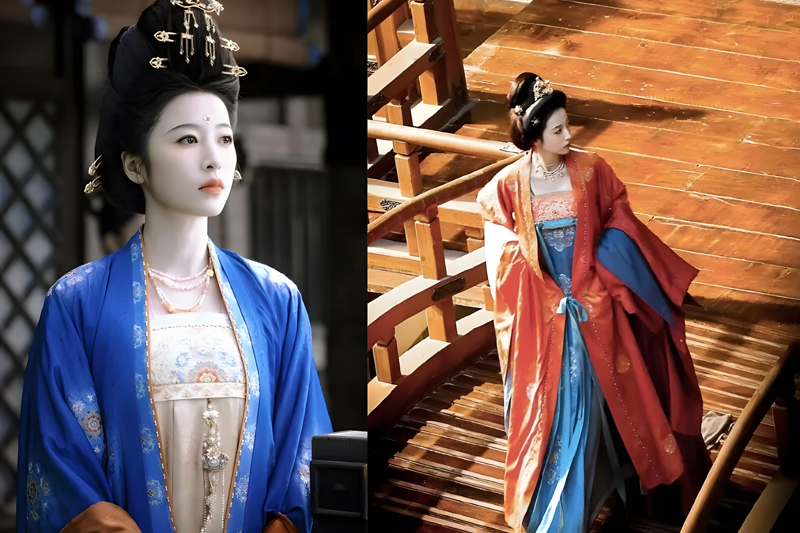
A recent period drama has sparked a lively online debate not about its plot, but about a character's wardrobe. In the television series Swords into Plowshares (太平年), the actress Zhou Yutong (周雨彤), who portrays the character Sun Taizhen (孙太真), appears in several stunning outfits that have left viewers puzzled. The garments feature what looks like a structured, bustier-style top worn over a flowing skirt, leading many to wonder: is this a case of ancient "underwear as outerwear"?
The style feels surprisingly modern, reminiscent of contemporary tube or bandeau dresses, yet it is presented as historical costume. This visual anachronism has ignited curiosity about the origins and accuracy of this particular fashion choice within the drama's claimed historical setting.
Historical Roots
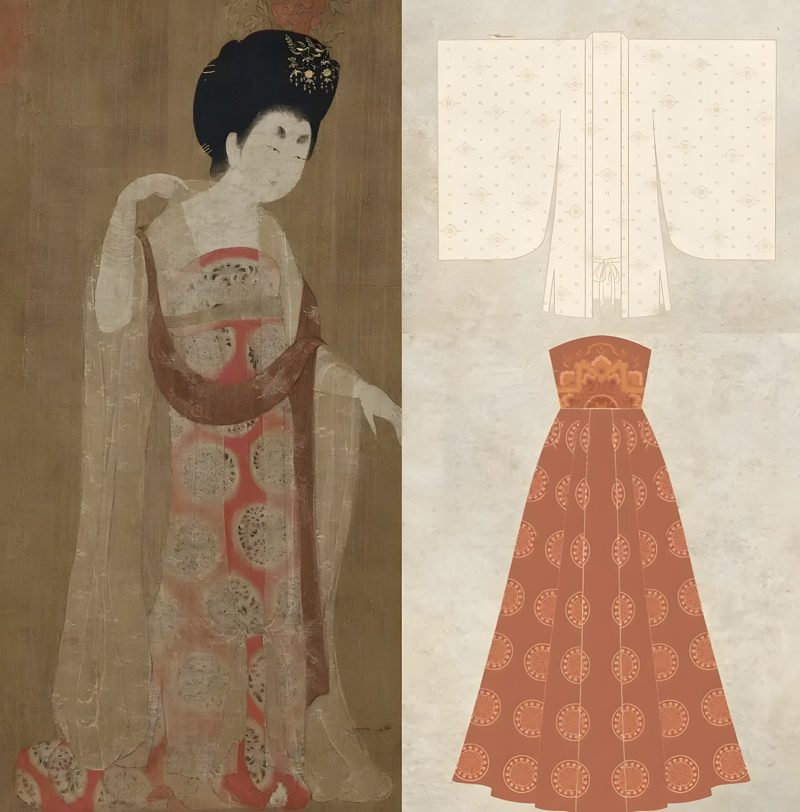
The costume in question is what many in modern traditional clothing circles call a Hezi skirt (诃子裙). However, its status within the spectrum of Hanfu is contentious. A primary reason is the lack of archeological evidence; no physical example of this specific garment has been unearthed. References to a "Hezi" exist in historical texts, but not as a compound term for an entire skirt. The most famous visual association comes from the Tang dynasty painting Court Ladies Adorning Their Hair with Flowers (簪花仕女图) by Zhou Fang (周昉), which depicts noblewomen in high-waisted, bustier-style dresses under sheer robes. Scholars believe the painting may actually represent Five Dynasties period fashion, a turbulent era between the Tang and Song dynasties marked by sartorial experimentation and flux.
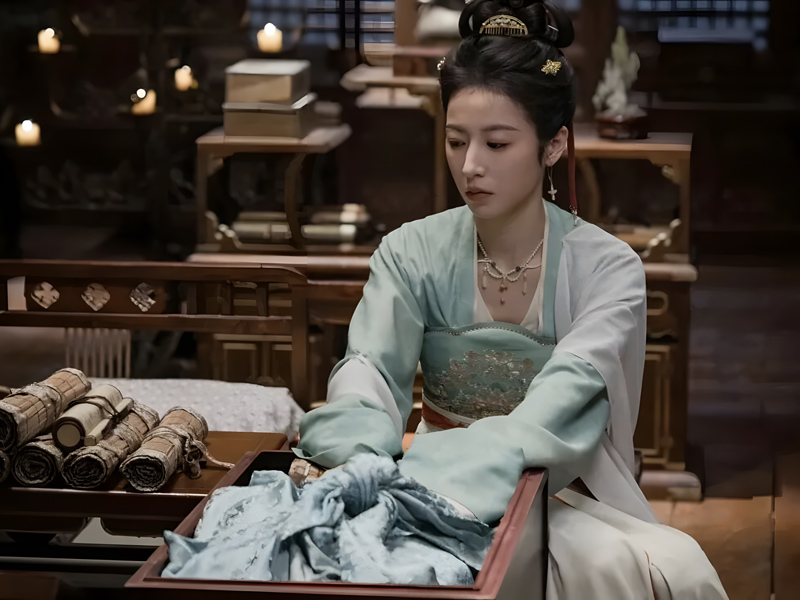
This historical context is key. The Five Dynasties was a transitional time where established clothing norms from the glorious Tang era began to shift and blend. The costume designers for Swords into Plowshares seem to have drawn inspiration from artifacts like the murals in the Tomb of Wang Chuzhi (王处直) and late-Tang colored relief sculptures. These sources show female figures in long skirts with distinctive, wide, petal-shaped top edges. This style, where an undergarment-like top becomes the focal point of the outer ensemble, fits the concept of "innerwear worn outward," a practice that may have found a brief foothold during this less rigidly codified period.
The term Hezi itself has a traceable literary history. It first appears in Song dynasty unofficial histories, notably in a possibly apocryphal story about a Tang imperial consort. Later, Ming dynasty scholar Tian Yiheng (田艺蘅) described it in his notes as a type of chest-wrap or stomacher that fastened from the back to the front. This matches the general construction of the modern interpretations seen today. Therefore, while the complete "Hezi skirt" is a modern construct, its central component—the Hezi—has roots in historical texts, describing an item that served an intimate, foundational purpose within the layers of traditional attire.
Modern Interpretation
Today's Hezi skirt exists in two primary forms. The first treats the Hezi as a separate, wrap-style bodice worn over an under-robe and paired with a high-waisted skirt. The second, and more popular version, is a one-piece dress where the wide, supportive top is integrated seamlessly with the skirt, creating the sleek, column-like silhouette seen on screen. This design directly references the aesthetics of classical paintings. However, experts caution that art is not a perfect blueprint. Paintings and figurines involve artistic license and may not depict everyday, practical clothing with complete accuracy. They are inspirations, not strict historical documents.
The popularity of dramas like Swords into Plowshares has propelled the Hezi skirt into the spotlight as a symbol of "Tang style." This is somewhat misleading. Mainstream Tang women's fashion predominantly featured a combination of a short jacket or blouse worn over a long skirt. The Hezi silhouette was likely not the standard. Consequently, within the Hanfu revival movement, there is an ongoing discussion about categorization. Garments like the Hezi skirt are best understood as "art-inspired" or "historically influenced" Hanfu, distinct from styles with direct archeological reproductions to support them.
Does this mean it has no place in cultural expression? Not necessarily. The conversation highlights how historical costume evolves in the public imagination. Film and television serve as powerful mediums for sparking interest in the past, even if they take creative liberties. The key is mindful distinction—celebrating the Hezi skirt for what it is: a beautiful, modern adaptation inspired by ancient art and fragments of history, rather than a definitive representation of a bygone era. It stands as a testament to the ongoing dialogue between past and present, where ancient aesthetics are continually reinterpreted for new audiences.
