
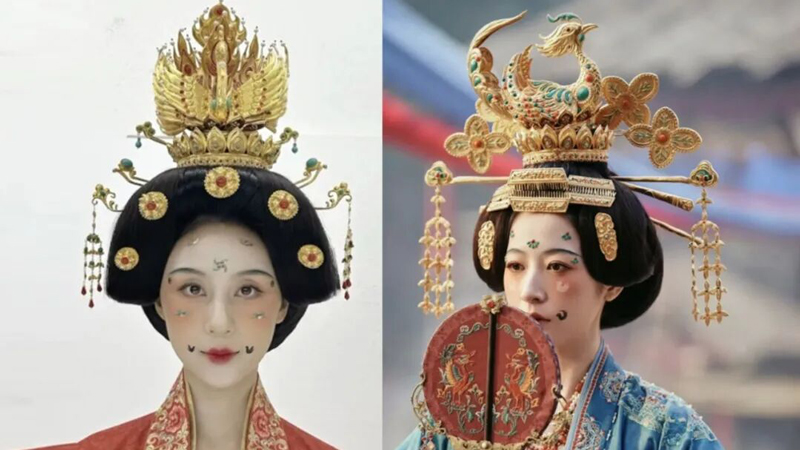
In the historical drama Swords into Plowshares (太平年), viewers were treated to a visual feast of intricate costumes. One detail, in particular, has sparked curiosity: the majestic bird crowns worn by characters He Zhen (贺贞) and Sun Taizhen (孙太真) during their wedding scenes. While both headpieces are stunning, their orientation differs.
He Zhen's crown sits perfectly straight and forward-facing, while Sun Taizhen's appears to be worn at a slight angle. This isn't a random stylistic choice or an error, but a deliberate nod to historical accuracy and the deep-seated principles of traditional Chinese adornment. This distinction opens a window into the forgotten rules governing ceremonial dress, where every element carried weight far beyond mere decoration.
The Problem with Props
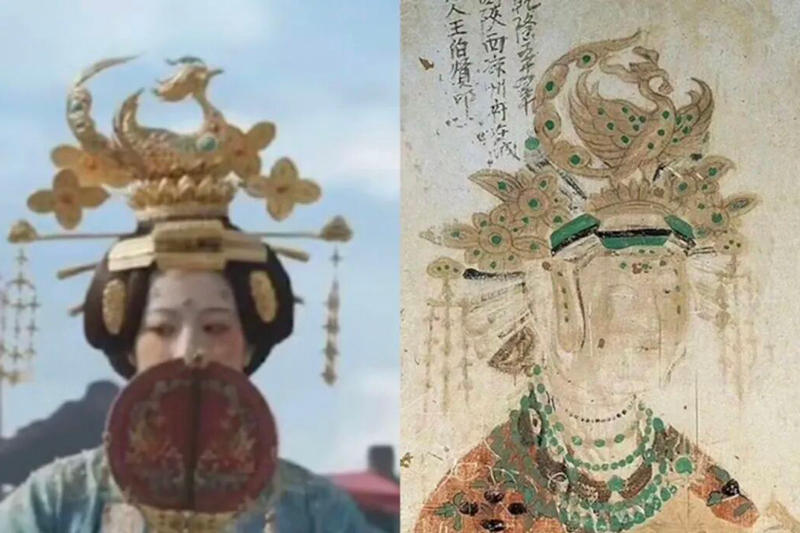
The design of these crowns finds its primary inspiration in donor portraits from the Five Dynasties period. A common issue in modern costume design arises when referencing these historical sources. The original portraits often depict figures in profile, making their elaborate headdresses appear sideways due to perspective. Many contemporary designers, however, misinterpret this visual effect and create crowns intended to be worn at an angle. This is a fundamental misunderstanding.
The standard and historically correct method was to wear such significant crowns facing directly forward. This error isn't unique to Swords into Plowshares; it has appeared elsewhere, such as in the drama Flourished Peony (国色芳华), where a three-dimensional bird crown was flattened into a purely decorative hairpin. These are not minor quibbles but notable anachronisms that occur when the context and purpose of the original artifacts are not fully considered.
Prop and costume creation for historical narratives faces a constant tension between visual appeal and authenticity. The rush to produce spectacular visuals can sometimes overshadow the need for meticulous research. The case of the bird crown demonstrates how a detail rooted in specific cultural logic can easily become just another pretty accessory if its original function is ignored. Accurate cultural transmission in media is a marathon, not a sprint. It requires patience, deep research, and a respect for the intrinsic "why" behind every item of clothing or jewelry, especially those reserved for the most solemn occasions like weddings.
This focus on correct orientation is not about pedantry. It is about reconstructing a worldview. In the context of the drama, correctly portraying He Zhen's crown aligns her character with the formal, balanced ideals of the era. It subtly communicates her status and the ceremonial gravity of the moment. Getting these details right builds a more immersive and believable world for the audience, allowing the setting to feel lived-in and governed by its own consistent rules, rather than just serving as a beautiful backdrop.
Why Symmetry Rules
The insistence on forward-facing placement for major headdresses like the Feng Niao Guan (凤鸟冠, Phoenix Bird Crown) stems from core aesthetic and practical principles. Across many dynasties, while smaller hair ornaments could be mixed and matched with relative freedom, major crowns were governed by strict conventions of balance and symmetry. This was because such crowns served a ritualistic function. They were part of "Li" (ritual propriety) and formal regulation, distinguishing them from everyday decorative hairpins. Their purpose was to denote solemnity and order.
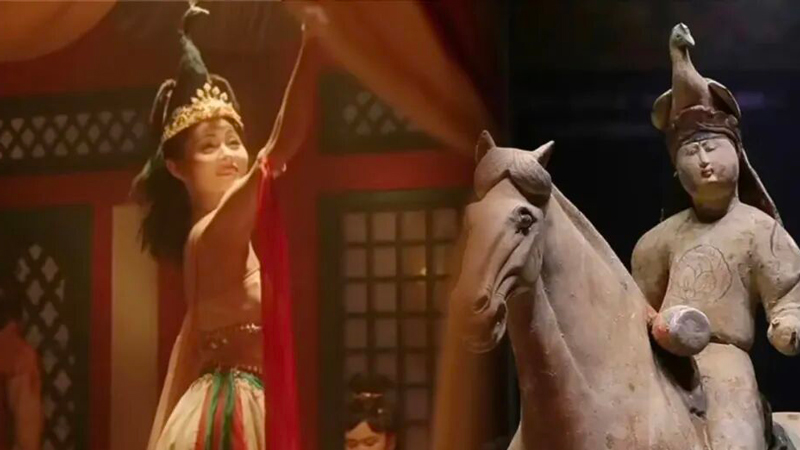
On a purely physical level, these crowns were often crafted from metal and were exceedingly heavy. A sideways orientation would create an unstable, lopsided weight distribution, making the crown precarious and uncomfortable to wear. A forward-facing position, however, allows the weight to be centered. Any front-to-back imbalance could be strategically counterbalanced by the hairstyle itself and supporting hairpins driven through the elaborate coiffure. The logic of wearability, therefore, demands a centered, upright position. Even the ornate Kong Que Guan (孔雀冠, Peacock Crowns) worn by Tang dynasty dancers featured the bird facing forward, proving this was a universal standard for stability and dignity.
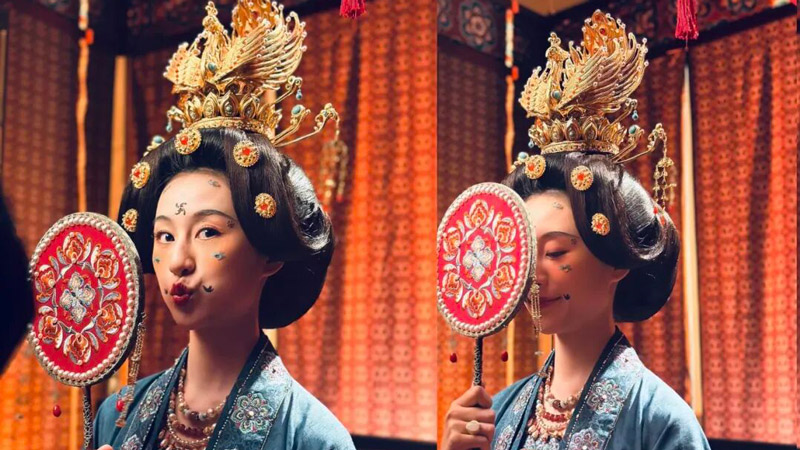
This pursuit of central balance extends beyond the crown itself. When wearing such a significant headpiece, the number, size, and placement of smaller accompanying hairpins were also meticulously arranged to be symmetrical. This created a holistic and harmonious aesthetic centered on the wearer's midline. This visual equilibrium is a cornerstone of traditional Chinese aesthetics, reflecting a desire for order, stability, and cosmic harmony in formal human presentation. The crown was the anchor of this entire system.
Stage to Status Symbol
The history of the standing bird crown is one of cultural migration and adaptation. Its origins are traced to performers and nobles from Western Regions. Initially worn by dancers and court attendants, the style traveled east to the Central Plains of China. Here, artisans transformed it, crafting versions from precious metals, feathers, and inlaid gems, elevating it into a headdress beloved by the aristocracy. The birds depicted were not limited to phoenixes; they included parrots, mynas, and others, each carrying its own symbolism. The phoenix, representing virtue and grace, became the most prevalent and enduring motif.
By the time of the Ming and Qing dynasties, particularly during the socially fluid late Ming period, phoenix imagery became less restricted by sumptuary laws and proliferated among the populace. Even then, the manner of wearing phoenix hairpins followed conventions. A "front phoenix" style, where the ornament was placed centrally at the front of the hair bun, was reserved for solemn, formal occasions. It projected grandeur and seriousness. In fact, during the late Ming, a substantial front-facing phoenix hairpin could even substitute for a full crown in certain formal contexts.
In contrast, a "side phoenix" style, with a smaller, more delicate hairpin placed off-center, was suitable for daily wear. This style offered flexibility and a more approachable elegance for informal social settings. However, even this casual style often adhered to principles of balance; for important daily events, one might wear a matching pair of side phoenix pins, one on each side of the bun.
The driving forces behind these styles were a blend of practicality, ritual requirement, and an innate cultural preference for balanced beauty. Modern interpretations that label the "front phoenix" as exclusive to formal wives and the "side phoenix" to concubines are largely fictional constructs from later novels and popular lore, not historical dress codes. They make for compelling drama, but the true story of the bird crown is a richer tale of art, engineering, and cultural meaning woven into gold and feathers.
