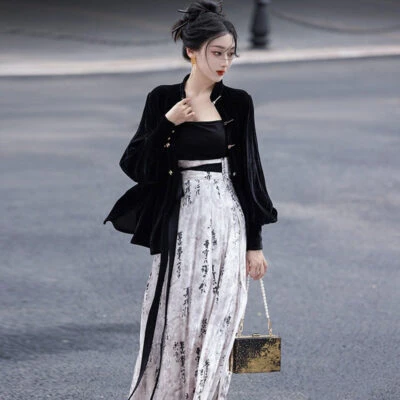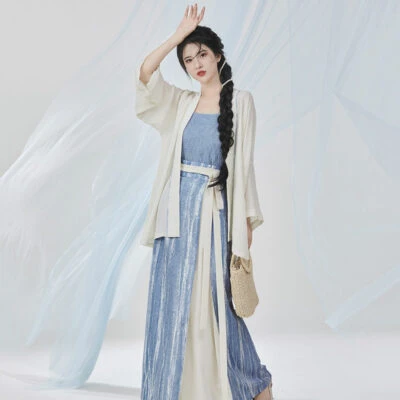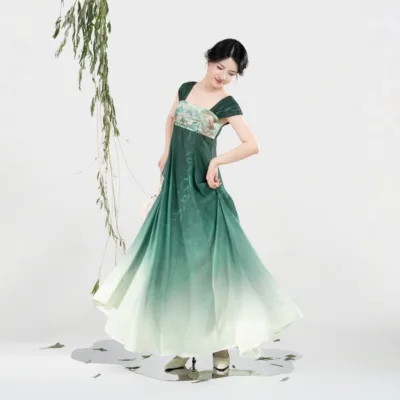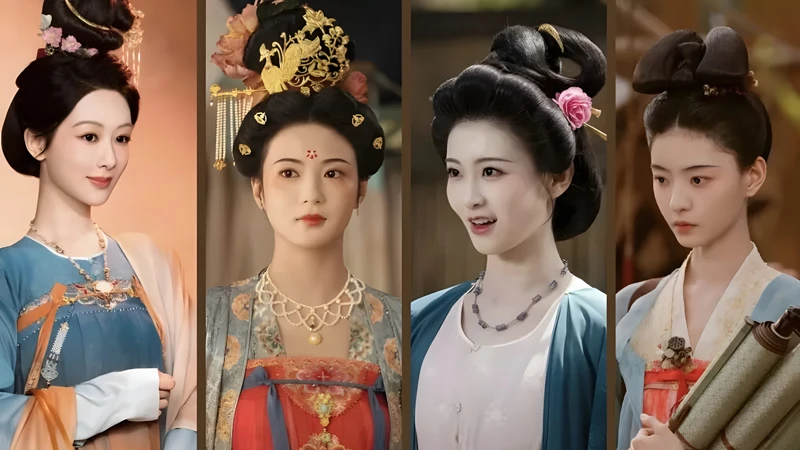
Audiences often question the authenticity of clothing in period dramas. What appears on screen blends artistic vision with historical reference, creating a visual language that speaks to modern viewers while hinting at the past. Accurate garment reconstruction offers more than beauty; it provides a tangible link to bygone eras, functioning as an informal guide for those curious about traditional dress. Yet, perfect fidelity remains elusive, as every production makes compromises between fact and spectacle.
Several recent series have attempted serious sartorial homage. For instance, The Wind Blows From Longxi (风起陇西), set in the Three Kingdoms period, features layered robes and specific sleeve cuts that reference Han Dynasty styles. Similarly, The Longest Day in Chang’an (长安十二时辰) meticulously presents Tang era Hanfu, with its distinctive silhouettes and rich fabrics. These details matter, as they ground the narrative in a specific time and place, allowing viewers to sense the weight of history through cloth and stitch.
Other productions, like Generation to Generation (江湖夜雨十年灯) and Flourished Peony (国色芳华), draw inspiration from Wei-Jin and early Tang aesthetics. They capture a certain mood—the flowing drapery, the subdued palette—but often blend elements for dramatic effect. This approach can illuminate broader stylistic trends while sacrificing precise replication. Even well-regarded shows such as Serenade of Peaceful Joy (清平乐) exhibit this mix, where some costumes feel rooted in research, while others seem designed primarily for the camera.
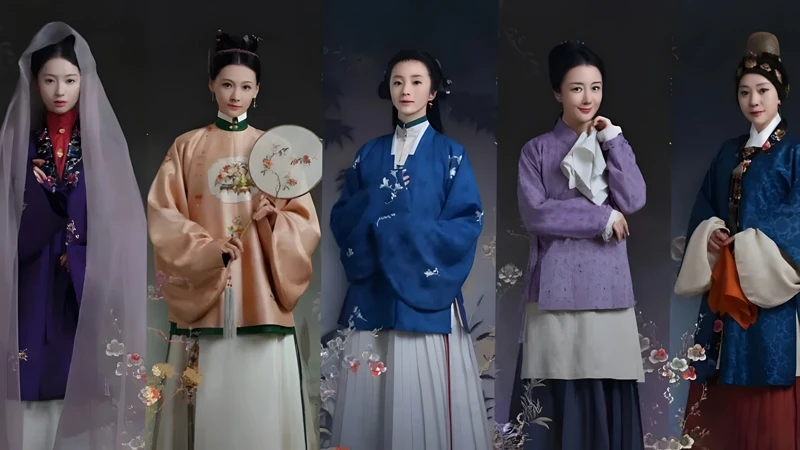
The challenge extends beyond clothing. Accessories like headdresses and hairstyles frequently receive less attention, breaking the illusion of a fully realized world. A drama might source a robe from historical records but pair it with an anachronistic hat, reminding us that these are constructs, not documentaries. This inconsistency is not necessarily a failure; it reflects the practical constraints of television production, where time, budget, and visual coherence dictate choices.
Ultimately, these dramas serve as a starting point for curiosity. They introduce viewers to concepts like the cross-collar design of Ruqun (襦裙) or the ornate hairpins of the Ming Dynasty, sparking interest that may lead to deeper exploration. While no single series holds all the answers, the collective effort to portray historical dress keeps the conversation about our visual past alive and evolving on screen.

Han Dynasty
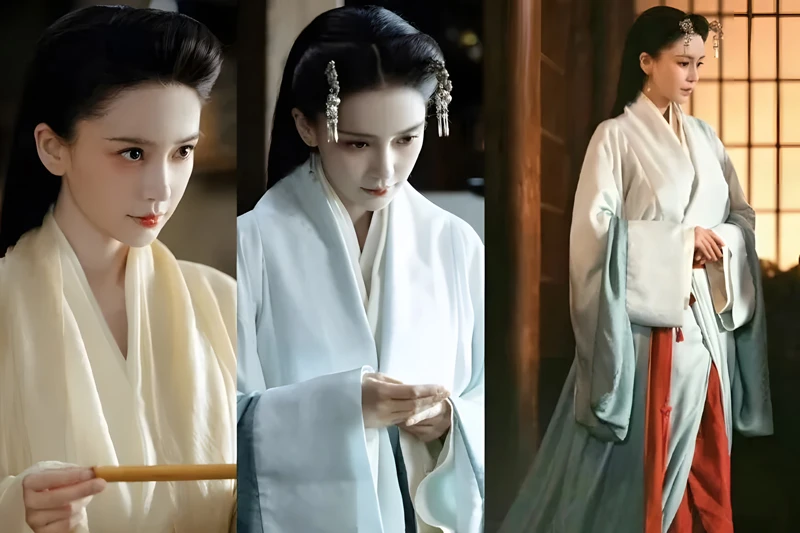
Capturing the essence of Han Dynasty clothing proves complex. The series The Wind Blows From Longxi uses the deep robe, or Shenyi (深衣), as its core. Garments feature the crossed collar fastened to the right, waist ties, and a central back seam. The color palette relies on muted blacks, whites, and grays. However, the show merges styles from both Western and Eastern Han periods. Female costumes lean toward Western Han aesthetics, with sleeves and hems sometimes exaggerated beyond historical precedent.
Another series, Secret of the Three Kingdoms (三国机密), receives praise for its fabric patterns from the Eastern Han. Yet, its hairstyles and headwear for men often feel anachronistic, leaning into a generic “ancient” style. These choices prevent it from being a definitive reference. No current drama has perfectly rendered Han attire, highlighting the difficulty of balancing detail with cohesive period portrayal.
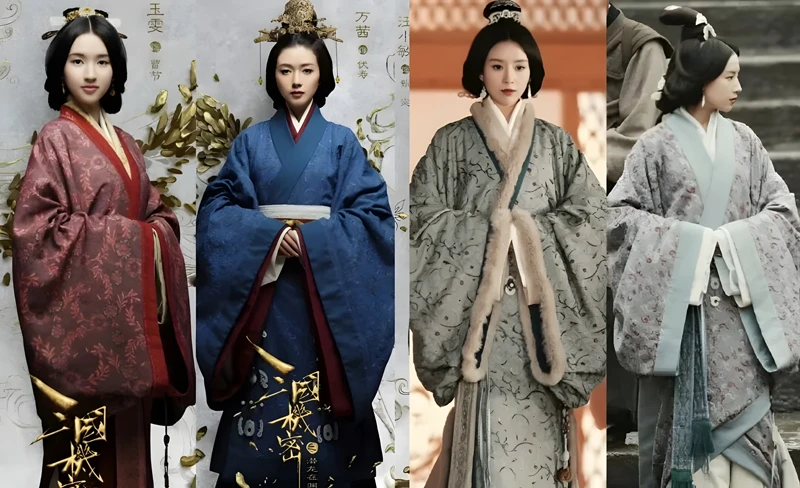
The task involves more than copying relics. Designers must interpret how clothes moved and felt. The Han ideal combined dignity with ease. While some shows grasp structural elements like the straight or curved hem, the overall spirit—the way fabric draped on a living body—often remains elusive. The search for a convincing Han silhouette on screen continues.

The Wei, Jin, and Northern and Southern Dynasties
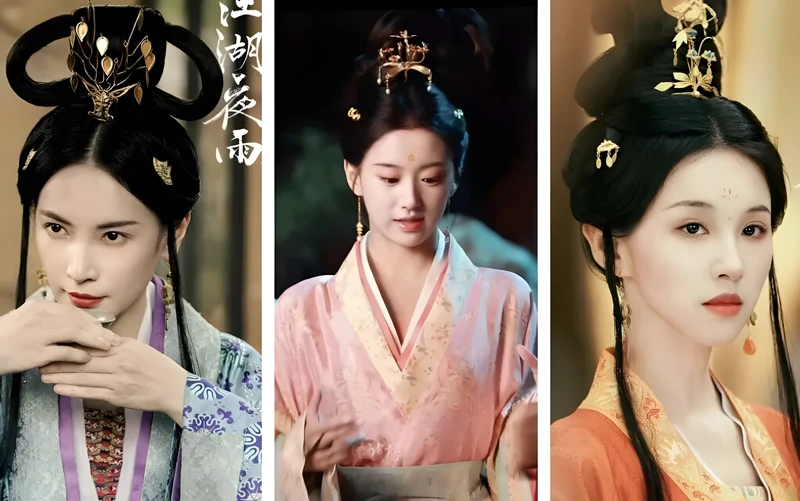
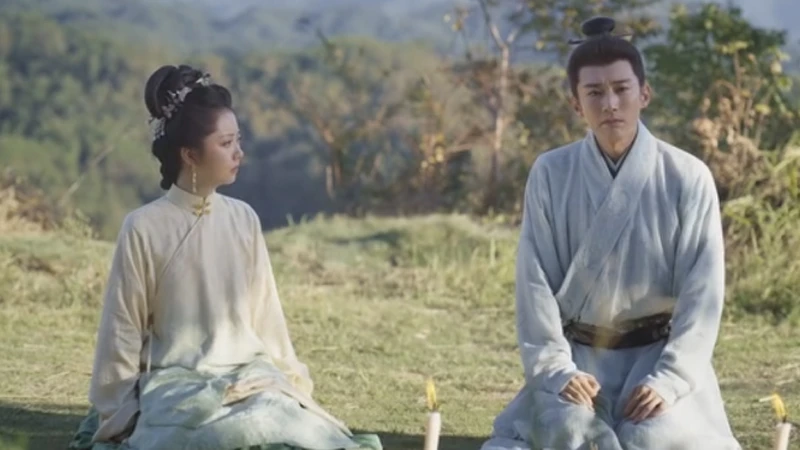
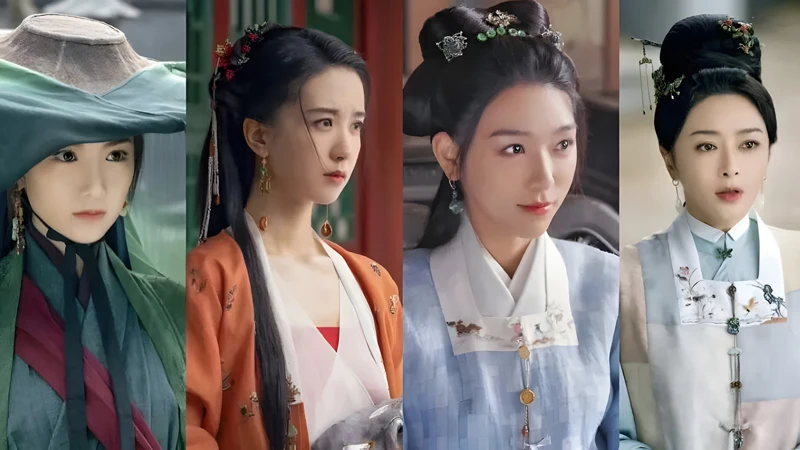
The Wei, Jin, and Northern and Southern Dynasties celebrated a scholarly, unbound spirit known as Fenggu (风骨). The upcoming series A Decade of Lights in the Martial World attempts to channel this. Promotional images show women with the distinctive Chushao (垂髾) hairstyle, adorned with step-shake hairpins. They wear short jackets over high-waisted, striped paneled skirts with colorful trims.
Male costumes feature the hallmark wide-sleeved robe, loose belts, and simple head cloths like the Pingjin Ze (平巾帻). This look aimed for effortless elegance. The series Yong’an Dream (永安梦) is noted for its male military court dress, including the Liangdang (裲档) armor and fitted riding garments. However, its female costumes mix too many elements from different eras.
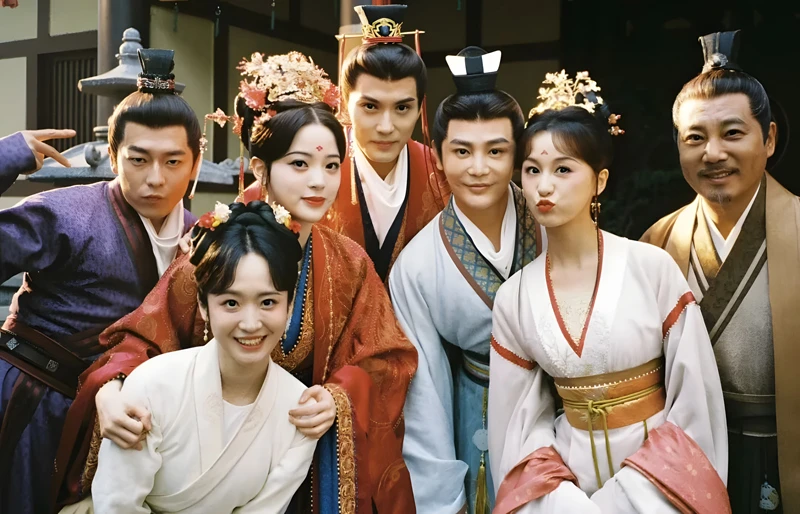
A significant missed opportunity in most series is the period’s iconic makeup. The bold, expressive styles documented in art are rarely explored. While individual pieces of clothing might be correct, the complete visual grammar—how clothes, hair, and makeup created a cohesive identity—is often fragmented. This leaves the portrayal feeling incomplete, capturing the form but not the celebrated free soul of the era.

Early Tang
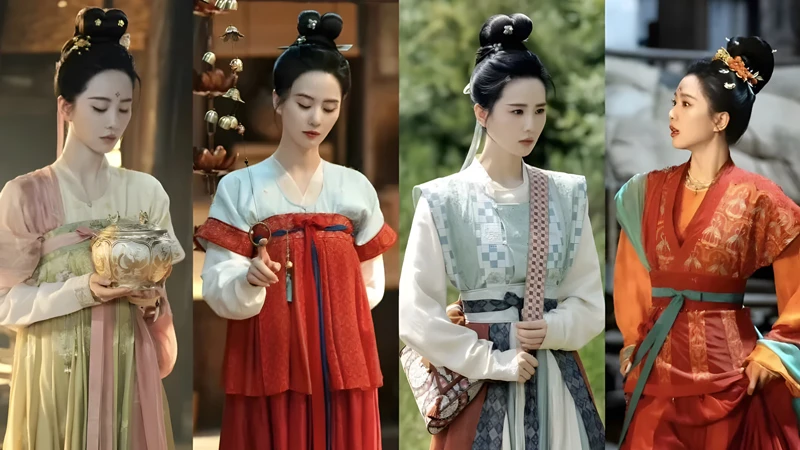
Contrary to the opulent stereotype of the Tang, early Tang style was notably restrained. The drama Palm of the Hand (掌心) focuses on this early period, skillfully avoiding later extravagance. Costumes reflect a sleek, robust elegance that bridged the Sui and Tang Dynasties. The silhouette is more contained, suggesting a culture in thoughtful transition.
Women often wear narrow-sleeved short jackets paired with high-waisted skirts. These skirts sit just above the waist or slightly higher, with hems gracefully pooling on the floor. The look achieves a light, flowing quality. Paneled skirts in subtle, low-saturation stripes of pale pink or light blue are accurately used, mirroring styles popular during the Yonghui (永徽) reign.
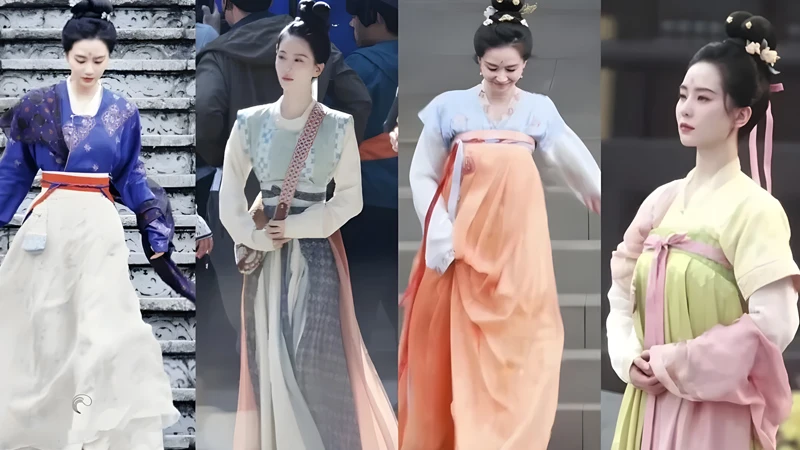
For men, the round-collar robe paired with a simple Futou (幞头) cap is standard. The series also showcases Central Asian-inspired fashion: fitted long robes with turned-down collars, worn over trousers and boots. This reflects the era’s openness to foreign influences. The production corrects the common misconception that Tang fashion was solely about voluptuousness and gold-threaded brocade, presenting instead a period of sophisticated, understated hybridization.

High Tang
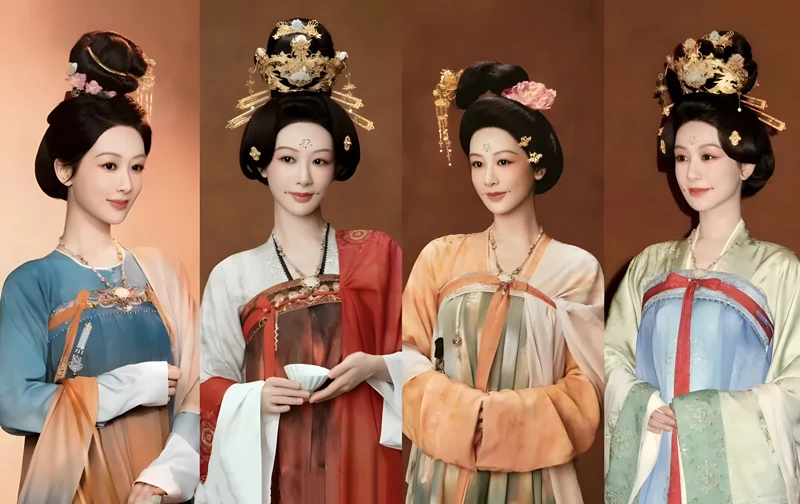
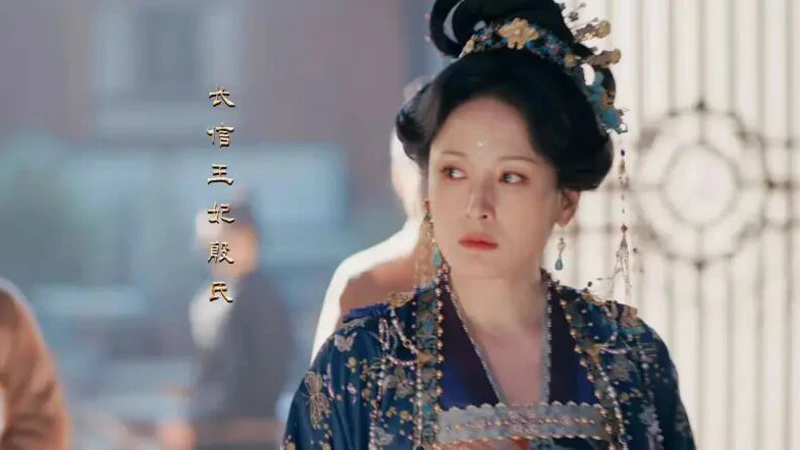
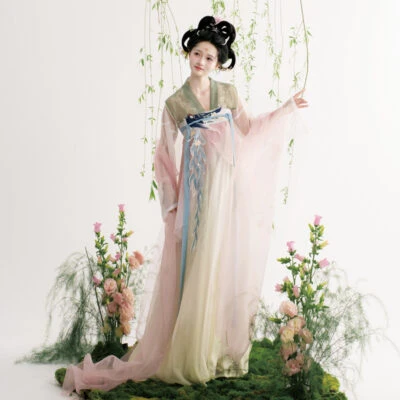
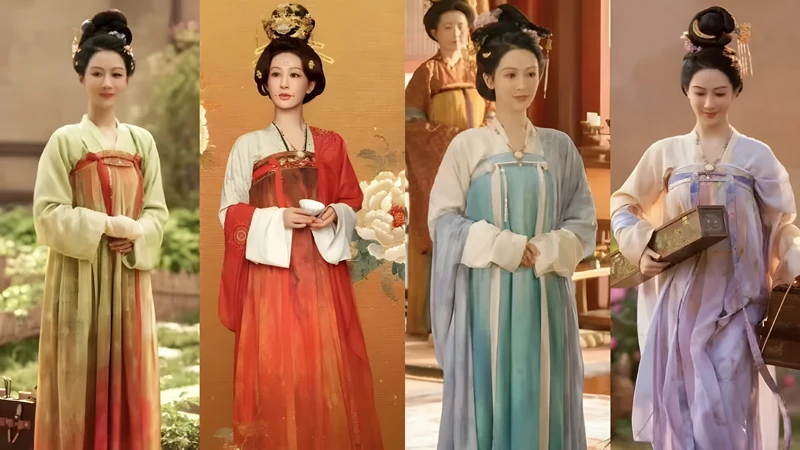
The High Tang period is synonymous with cosmopolitan grandeur, and this is meticulously built stitch by stitch in dramas like Flourished Peony. The costumes here capture a specific “magnificent restraint,” a shift from earlier exuberance to a more structured elegance. Women’s attire often features short jackets with remarkably wide sleeves paired with high-waisted skirts and long, flowing scarves known as Peizi (帔子). The silhouettes are expansive, with skirts trailing on the ground, yet the color palettes can be surprisingly deep and somber, reflecting a late-Tang sensibility.
Beyond courtly finery, these dramas show a full social spectrum. We see practical work-wear for laboring characters and the simple, masculine elegance of the round-collared robe, or Yuanlingpao (圆领袍), adopted by women in disguise. For grand ceremonies, the production teams reconstruct elaborate Chaidian Liyi (钗钿礼衣) ceremonial gowns and ornate floral headdresses for noblewomen, based directly on surviving murals and artifacts. The men’s official robes adhere to strict color hierarchies denoting rank, their solemnity emphasized through dark, rich hues and the ubiquitous Futou headwear.
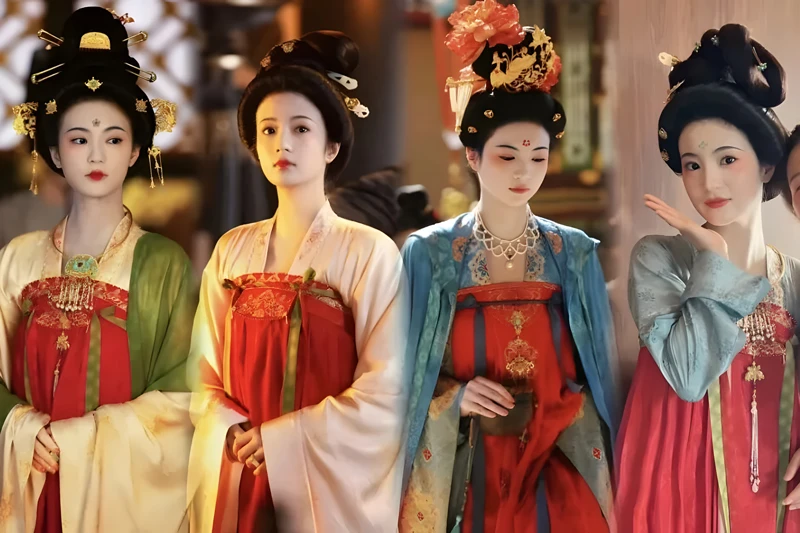
It is in the details where the era truly comes alive. The evolution of hairstyles and makeup tells its own story. While early Tang styles were bold, High Tang ladies favored elaborate, towering chignons. Their forehead ornaments, or Huadian (花钿), became more refined, with makeup leaning towards intense, dramatic coloration. This creates a vivid visual contrast against other periods, making the Tang’s “ultimate prosperity” immediately recognizable on screen.

Five Dynasties
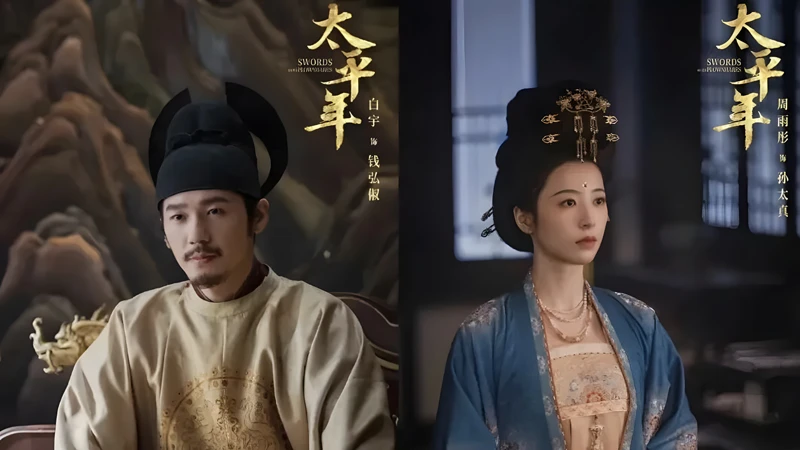
The short, tumultuous Five Dynasties period served as a crucial bridge between the Tang and Song dynasties. The upcoming drama Swords into Plowshares (太平年) appears poised to visualize this often-overlooked transition. Its costumes capture the “carrying forward from Tang and initiating Song” aesthetic, blending residual grandeur with emerging simplicity. The sartorial mood shifts toward practicality and a quieter rationality.
This is clearest in women’s fashion. Large sleeves remain, but the overall effect is less flamboyant. Hairstyles feature the exaggerated, high Eji (峨髻) chignon, often decorated with large floral clusters. Male scholars are depicted in round-collared Lanpao (襕袍) robes paired with the stiff-winged Futou. These designs carefully reference period sources like the famous painting Han Xizai Gives a Night Banquet (韩熙载夜宴图), even replicating technical details like silk strings inside the headwear’s wings to maintain their shape.
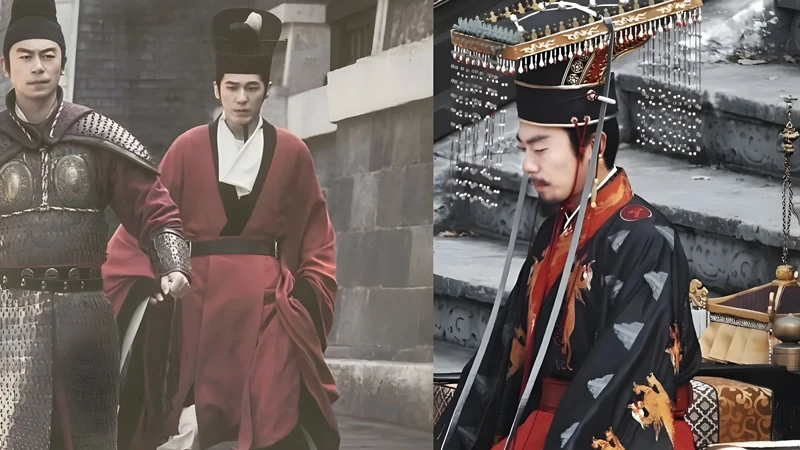
Some design choices, however, invite scrutiny from historians. An early glimpse of an emperor’s ceremonial crown, or Mian (冕), appears to borrow styles from the later Song dynasty, adorned with anachronistic decorations like amber and rhinoceros horn vessels. While creatively striking, such elements highlight the constant negotiation between historical fidelity and dramatic necessity that defines this craft.

Song Dynasty
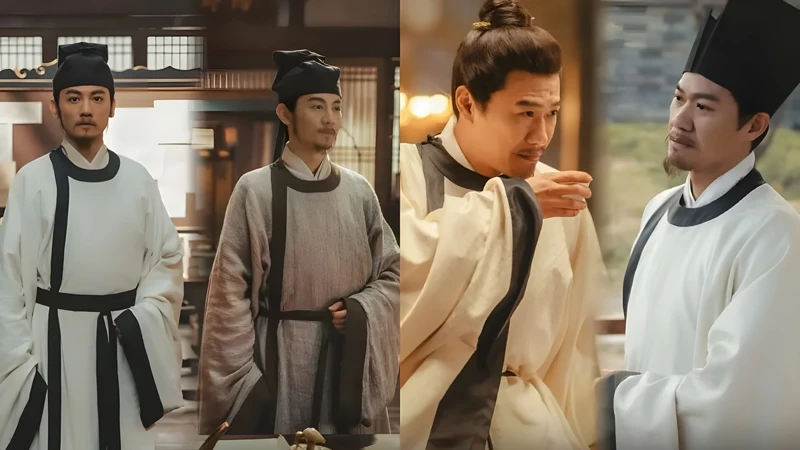
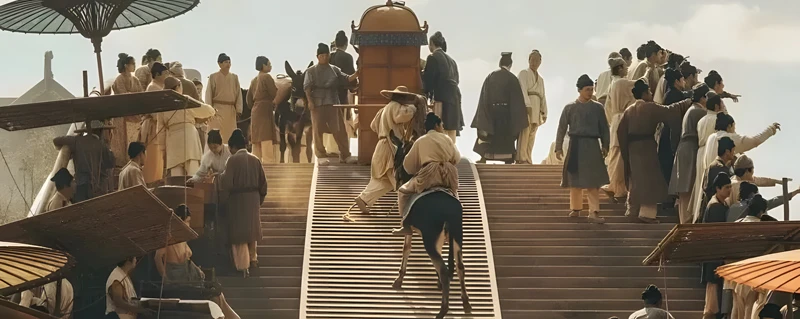
If Tang style was a symphony, Song fashion was a restrained poem. The drama Riverside Code at Qingming Festival (清明上河图密码) embodies this shift perfectly. Its palette is dominated by low-saturation blues, greens, greys, and browns. This quiet elegance visually defines the Song scholarly ideal, reflected in the men’s simple Lanshan (襕衫) robes and the women’s ubiquitous Beizi (褙子) jacket.
The production’s most remarkable feat is its direct dialogue with historical art. Costumes for both nobles and commoners are faithfully recreated from the seminal Song dynasty painting Qingming Shanghe Tu (清明上河图), from which the drama takes its name. The distinction in social status is woven into the fabric itself: fine brocades with delicate embroidery for the elite, coarse hempen cloth for laborers. The clothing never feels like a static costume but functions as part of the environment, naturally suited to the character’s actions, be it a scholar’s contemplation or a porter’s toil.
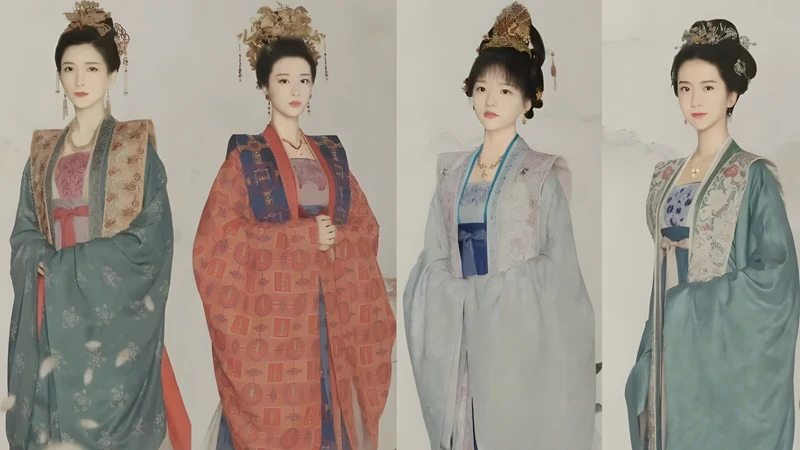
Comparisons are inevitably drawn to the earlier hit Serenade of Peaceful Joy, which pioneered accurate Song silhouettes and popularized trends like pearl-facet makeup. However, its occasional blending of Ming dynasty elements in hairstyles and some accessories has led critics to note that the overall authenticity and cohesion of the later Riverside Code at Qingming Festival feel more assured. This shows the evolving nature of the craft, where each project builds upon and refines the research of its predecessors.

Ming Dynasty
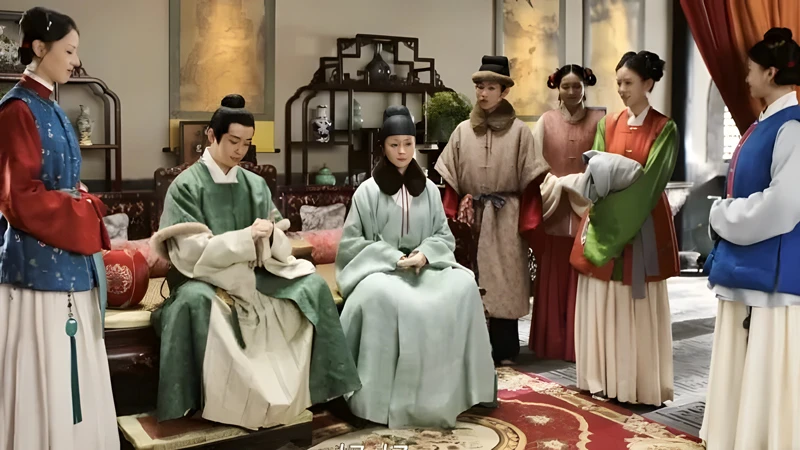
Some productions treat historical records as a blueprint. The drama Under the Moonlight (锦囊妙录) focused on court dress, with its designers consulting texts like the Ming Gong Guan Fu Yi Zhang Tu (明宫冠服仪仗图). For imperial and noble male attire, from the emperor’s Yishan Guan (翼善冠) crown and dragon-embroidered round-collar robes to the officials’ Bufu (补服) with rank-denoting animal patches, a coherent hierarchy was maintained. The logic of ceremonial regulation, a core Ming principle, was preserved.
Female court costume in the same show largely featured cross-collared or stand-collar jackets paired with Mamian Qun (马面裙) pleated skirts. Simplicity in cut and color for palace maids reflected the dynasty’s documented preference for restraint. However, attempts at grandeur sometimes faltered. The show’s interpretation of the noblewomen’s high Diji (䯼髻) wig was criticized for being overly solid, unlike the more translucent, lacquered gauze versions found in artifacts.
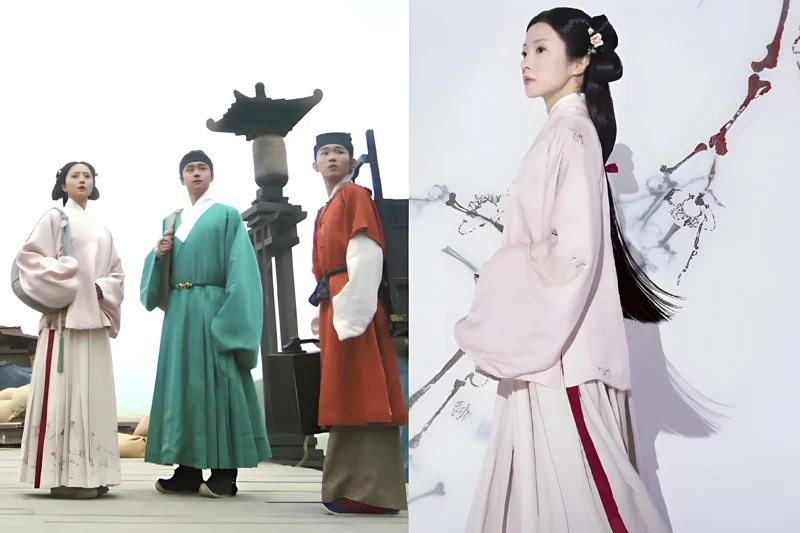
A more significant controversy arose with formal headdresses. While Ming Fengguan (凤冠) and Diguan (翟冠) phoenix crowns exist in museum collections, the show’s designers occasionally opted for styles bearing a closer resemblance to Qing dynasty aesthetics. This choice highlights a tension: the pull of a more recognizable “imperial look” for audiences versus a commitment to period-specific design.

Later Ming Dynasty
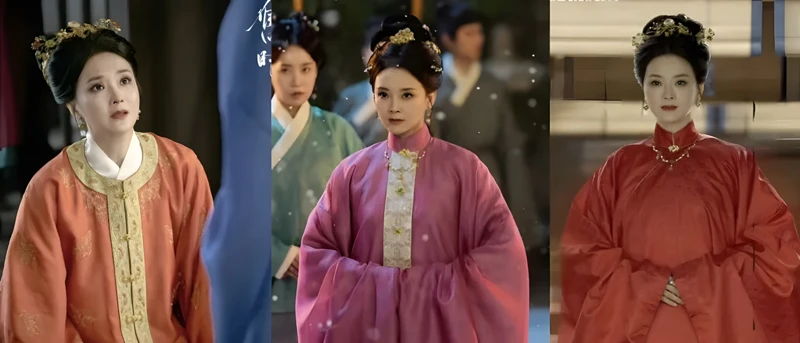
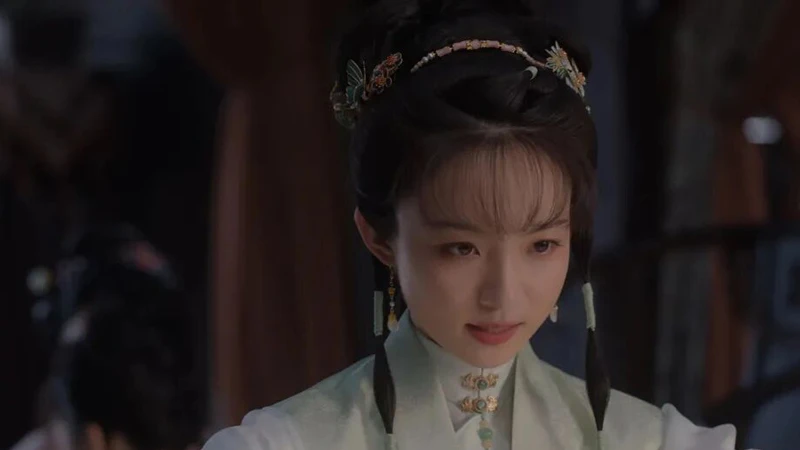
Later Ming style, from the mid to late period, embraced a different sensibility. Dramas like The Glory (雁回时) capture this shift from early Ming simplicity to expansive elegance. Garments with larger, unrestrained cuts create a sense of draped weight and dignified flow, challenging modern expectations of a fitted silhouette.
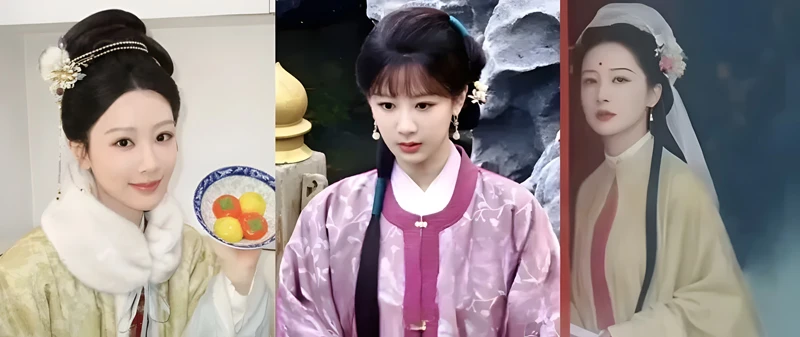
This series pays particular attention to the stand-collar jacket, a Ming staple often misattributed to later eras. A matriarch in a deep blue gown with golden clasp-buttons conveys authority, while a concubine in pink with delicate pendant collars shows nuanced status differentiation. The clothing itself becomes a narrative device, correcting historical misconceptions through accurate design.
The precision extends to men’s wear. Scholars’ cross-collared Daopao (道袍) robes with solid leather belts and officials’ round-collar court dress with ornamental hanging belts are meticulously rendered. The texture of a low-ranking official’s coarse hemp robe in Under the Microscope speaks volumes about his station and hardship, a detail often glossed over in favor of mere color coding.
Other series navigate a middle path, blending accuracy with creative flair. The Ingenious One (云襄传) sparked a trend for the long stand-collar gown, and its inclusion of the square-necked Bijia (比甲) waistcoat was noted. While its male costumes earned praise, its overall aesthetic leaned heavily into a stylized, fictionalized “rivers and lakes” sensibility, prioritizing atmosphere over strict historical replication.
This highlights a central challenge. Productions like Under the Microscope (显微镜下的大明) present a mixed legacy; a stunningly recreated phoenix crown might sit atop an otherwise anachronistic costume design. The crown becomes a solitary island of historical truth, praised for shouldering the entire burden of the show’s visual authenticity.
The audience’s role is evolving. Viewers now dissect collar shapes, fabric weights, and fastener styles online. This informed scrutiny pushes creators toward greater accountability. The promise of upcoming projects like The Mo (家业) lies in this new, collaborative dynamic—where compelling narrative and respectful, insightful design are no longer mutually exclusive, but interdependent.

A New Fabric for the Past
In recent years, a shift has occurred within the realm of Chinese period television. A growing number of productions are moving beyond generic, fantastical costume design, instead choosing to ground their visual storytelling in historical research. This approach prioritizes the accurate representation of clothing forms, materials, and colors specific to dynasties like the Tang and even distinct periods within them. Series such as The Longest Day in Chang’an and The Story of Ming Lan (知否知否应是绿肥红瘦) serve as notable examples, constructing a vivid sartorial landscape that educates as it entertains.
While not without flaws—sometimes impeccable garments are paired with anachronistic hairstyles or makeup—the intent marks significant progress. This dedication provides audiences with a tangible, visual connection to history. It builds a framework for a more nuanced standard in production design, one that distinguishes between the early and late phases of a single ruling house.
The value of this work extends beyond academic precision. When a character like Guanyin (观音) is portrayed with period-appropriate dress, it does more than please the eye; it offers a silent narrative about societal norms, available textiles, and aesthetic values of that era. These choices transform the screen into a dynamic exhibit, inviting viewers to appreciate the subtle language of clothing across China’s long history. This trend, championed by dedicated designers and scholars, redefines what historical drama can achieve.