If you were captivated by the enigmatic beauty of Goose Mountain (鹅鹅鹅) from Yao-Chinese Folktales 2 (中国奇谭2), then its spiritual successor, Ear Dweller, demands your attention. Directed by the same visionary, Hu Rui (胡睿), this short film continues to carve a distinct niche within the anthology, one defined by silent storytelling, symbolic depth, and a hauntingly beautiful aesthetic that challenges viewers to look inward. While some find its narrative elusive, the key lies not in deciphering a literal plot, but in understanding the internal landscape of its protagonist. This isn’t a ghost story about an external monster; it’s a psychological portrait of a battle waged within the confines of one’s own mind.
A Lantern in the Dark
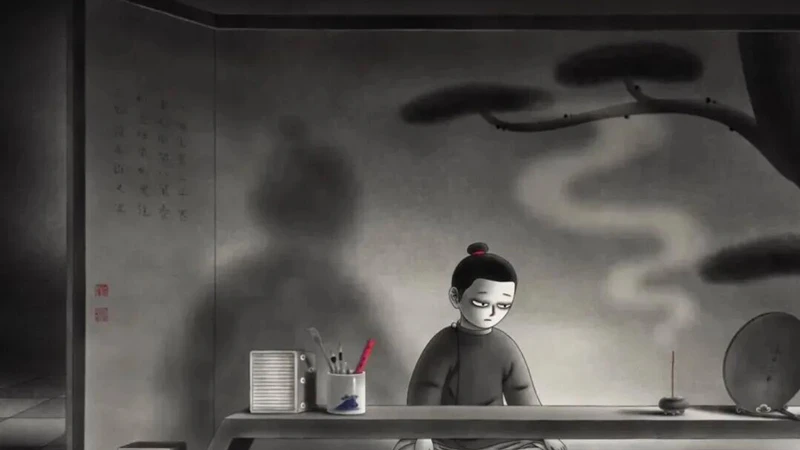
The tale begins with a scholar, exhausted by his studies, glimpsing a strange little creature holding a lantern marked with the character for “rain”. This moment is the seed of everything that follows. The scholar’s subsequent discovery of a mystical Tianshu (天书), or “Heavenly Book,” grants him the power of clairaudience, but with a stern warning: use it only to help others, never for personal gain. He ignores this decree. Drawn by a beautiful melody, he uses his new ability to eavesdrop on a young maiden singing a line from the classic opera The Peony Pavilion. In that instant, his scholarly detachment shatters, replaced by a potent and forbidden longing.
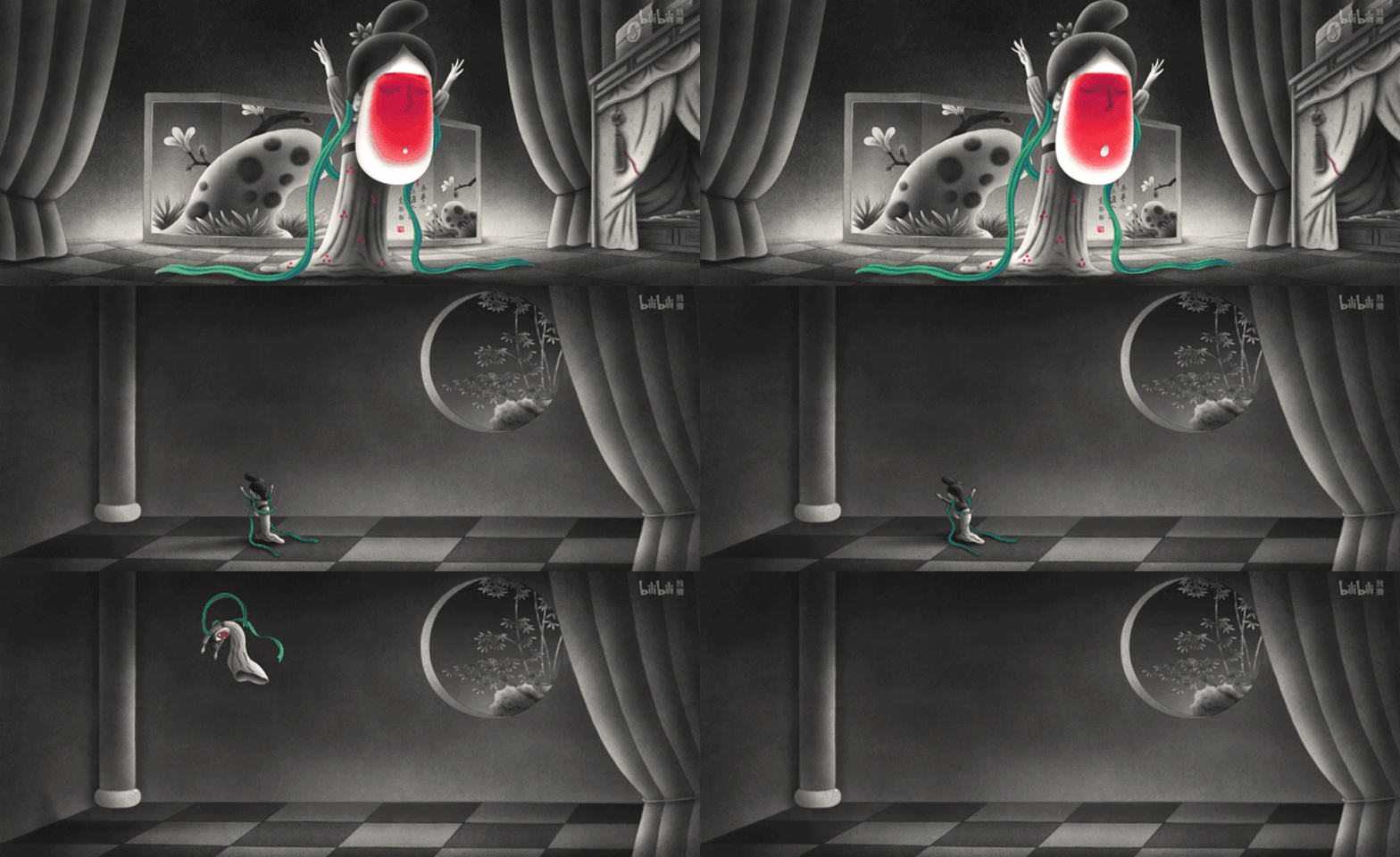
The character for “rain” is pivotal here. In classical Chinese, it is a homophone for “desire”. The lantern, therefore, doesn’t illuminate the physical darkness of the study, but the emerging darkness of the scholar’s own hidden wants. The creature bearing it isn’t an external invader; it is the first visual manifestation of his subconscious yearning, a tiny, silent herald of the turmoil to come. His transgression—using a divine gift for a selfish, voyeuristic purpose—sets the stage for his punishment, which arrives not from heaven, but from within.
The Reflection in the Mirror
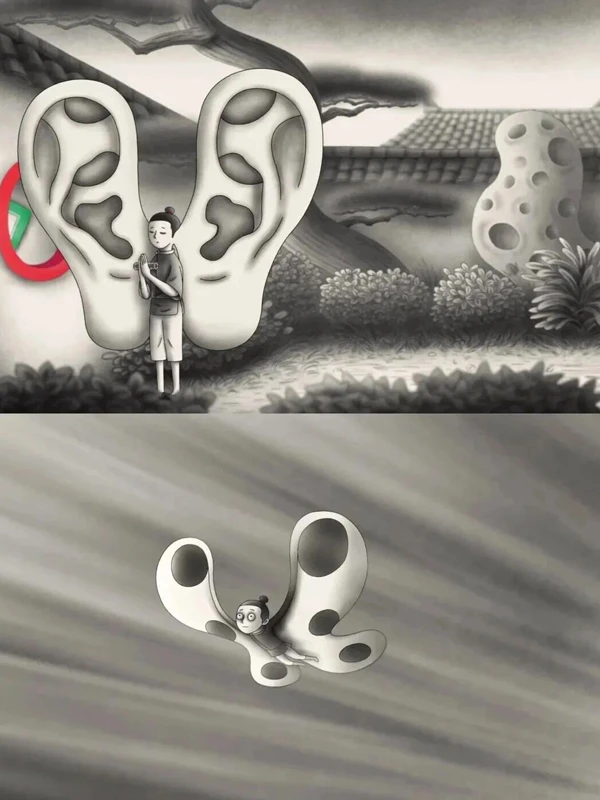
The consequence of the scholar’s actions takes a bizarre and intimate form: a tiny figure takes up residence in his ear. Desperate, he tries to remove it by any means, but physical tools are useless against a psychological affliction. It is only when he looks into a mirror to examine his own ear that he sees the creature clearly—an elegant, official-looking figure from the Wei-Jin period, embodying the scholar’s own idealized self-image. The mirror here is not just a tool; it is the ancient symbol of self-reflection and introspection. The act of looking into it forces a confrontation. He isn’t seeing a foreign monster; he is seeing the embodiment of his own repressed desires, dressed in the garb of his scholarly aspirations.
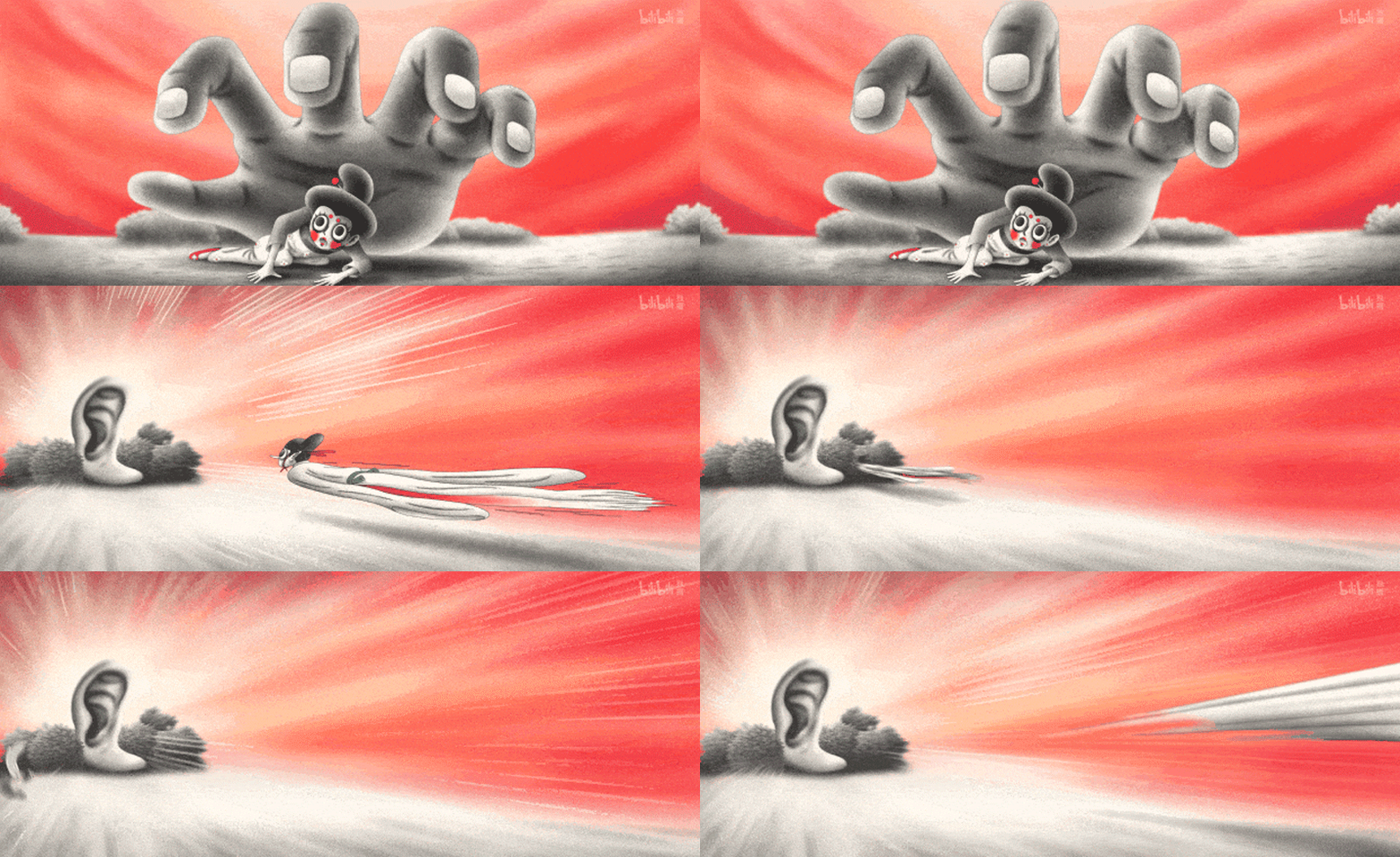
To rid himself of this torment, the scholar concocts a plan. With the help of a puppeteer, he creates a wooden effigy of the maiden. The plan works. The Man in the Ear, driven by the very longing that created it, is lured out and attacked. Yet, in its final, wounded moments, the creature’s actions are tragically pure—it still tries to reach the fake maiden, a poignant display of the raw, unmediated emotion the scholar himself cannot openly express. Its demise leaves only a pool of blood, a vivid stain of unfulfilled passion.
The Monster is Me
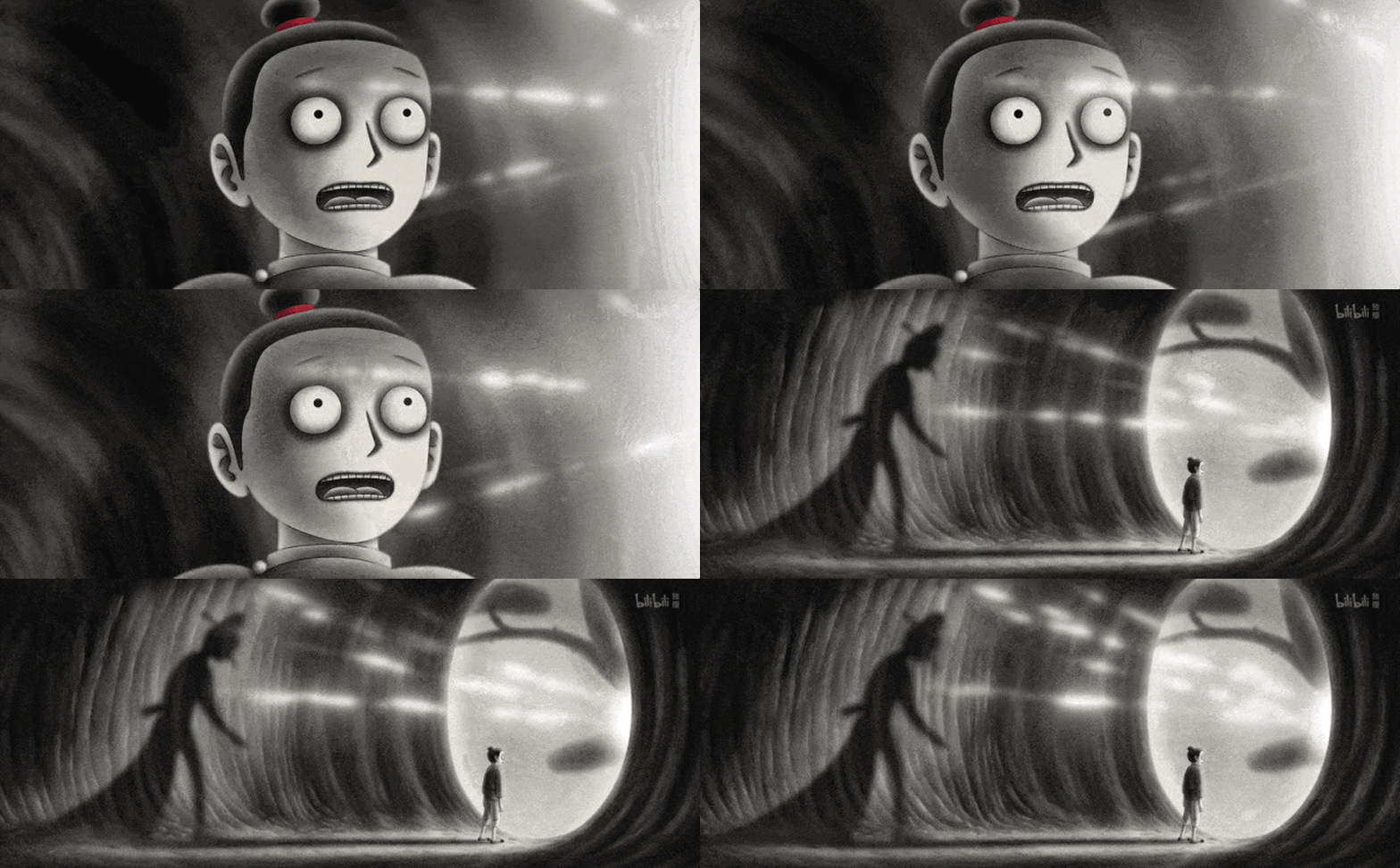
The film’s concluding sequence removes any remaining ambiguity. The scholar walks through a giant, red cochlea—a surreal journey into his own mind. At the center, he looks into a mirror and sees his own reflection. That reflection is the Man in the Ear. The revelation is stunningly clear: the monster and the man are one. His desire, his “heart demon,” has become an inseparable part of his being. The creature’s elegant Qipao-inspired robes and official hat were never a disguise; they were a reflection. He wasn’t haunted by a ghost, but by the version of himself consumed by an obsession he could neither acknowledge nor control.
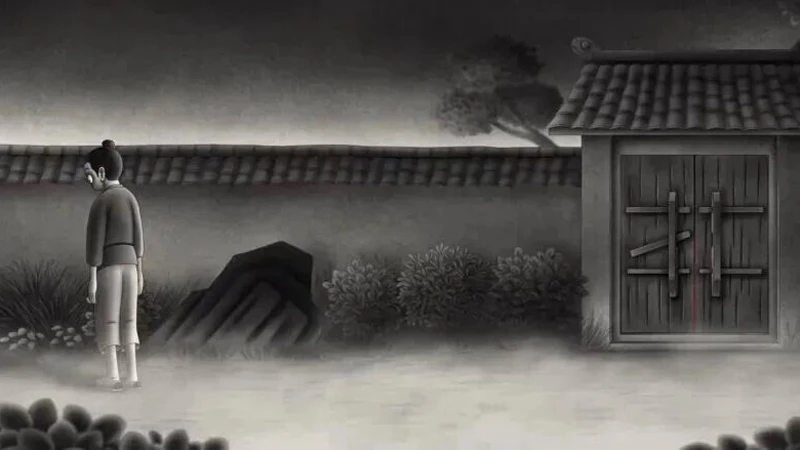
This story, adapted from Strange Tales from a Chinese Studio (聊斋志异), transcends its classical setting. The “ear” is not just a body part but a metaphor for the internal space where our private thoughts and cravings echo. In today’s world, this “man in the ear” could be the relentless noise of social comparison, the whisper of insecurity, or the clamor of unmet expectations. Hu Rui’s genius is in using traditional Zhigua (志怪) aesthetics to frame a universally modern anxiety: the struggle for peace within one’s own consciousness.
By focusing less on the “weirdness” of the imagery and more on its emotional core, the film’s power becomes apparent. It is a bold statement about self-acceptance. The scholar’s tragedy wasn’t having desire, but in fearing and fighting it to the point of self-destruction. The final message is one of profound release: true peace comes not from violently excising parts of ourselves, but from facing them with honesty. Only then can the whispering in our ears finally fall silent.