
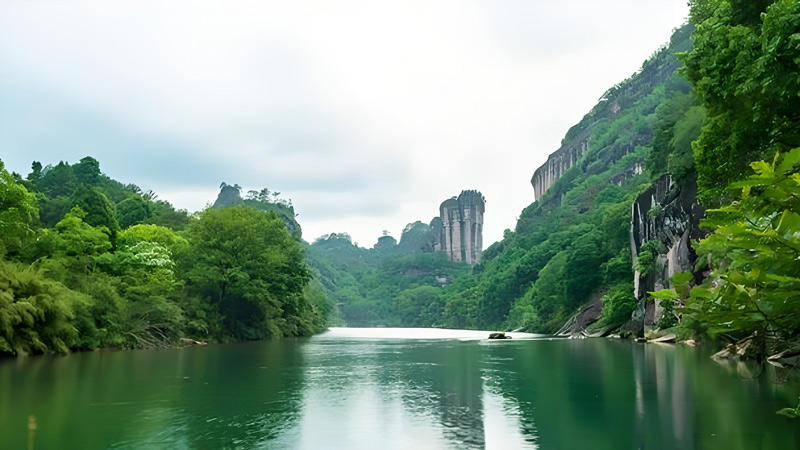
Beneath the watchful gaze of cinnabar cliffs, where the Nine Bend River carves poetry into stone, Wuyi Mountain transcends geography. This UNESCO dual-heritage site—a rare fusion of ecological marvel and cultural crucible—whispers eight centuries of philosophy in its rustling tea groves. When dawn mist clings to bamboo forests, the mountain reveals itself not as a relic, but as a breathing chronicle of China’s spiritual and natural soul.
Footsteps in the Realm of Scholars
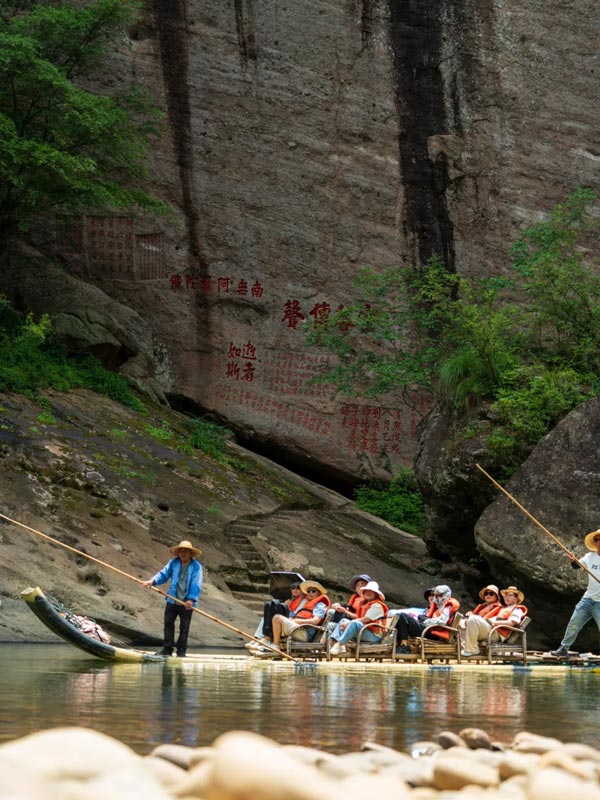
A cobbled path near Thunder Rock echoes with scholarly debates. Here, Zhu Xi’s inscription The Past Flows Like This (逝者如斯) endures on moss-kissed stone—a 12th-century meditation on time’s current, mirrored in the relentless river below. The calligraphy’s bold strokes seem to ripple with the water, bridging Confucian thought and elemental truth.
Nearby, Tea Boulder rises like nature’s altar midstream. Zhu Xi’s verse immortalizes this granite stage where scholars once sipped oolong amid steam and discourse. Though silent now, the rock radiates tranquility, its legacy steeped in leaves and ink.
Further along, the restored Wuyi Retreat (武夷精舍) stands sentinel. Amid cedar-shaded courtyards, foundation stones mark where The Four Books took shape. Visitors tread where disciples parsed cosmic order, the air thick with intellectual ghosts.
At Minyue Kingdom Ruins (闽越王城), terraced foundations unveil a vanished dynasty. Advanced drainage systems and ritual platforms testify to a civilization harmonizing Han ingenuity with mountain pragmatism—until imperial flames silenced it.
Vertical Chronicles of Stone and Water
Suspended 50 meters above the valley, Boat Coffins (架壑船棺) defy gravity and time. These 3,000-year-old cedar capsules cradle seafaring souls, their cotton shrouds rewriting textile history. Each cliff-perched vessel whispers of maritime rituals in a landlocked realm.
The Nine Bend River (九曲溪) demands surrender to its rhythm. Aboard bamboo rafts, travelers glide past egret-haunted shoals as boatmen’s poles tap ancient melodies. Crimson peaks dissolve in liquid jade—a 90-minute dream where geology becomes ballet.
For terrestrial immersion, the Path of Enchanted Wilderness (绿野仙踪漫游道) threads through primordial fissures. At Thread of Sky (一线天), visitors inch through cathedral-narrow clefts as sunbeams pierce rock like celestial arrows, emerging before the Jade Maiden Peak’s (玉女峰) graceful silhouette.
Twilight Epics Under Star-Dusted Skies
As night descends, Moon Over Wuyi (月映武夷) transforms crags into canvases. Water screens cascade with Song-dynasty poetry while holographic tea blossoms bloom across 270 degrees. This liquid-philosophy spectacle embodies Zhu Xi’s vision:"One moon reflects in ten thousand rivers."
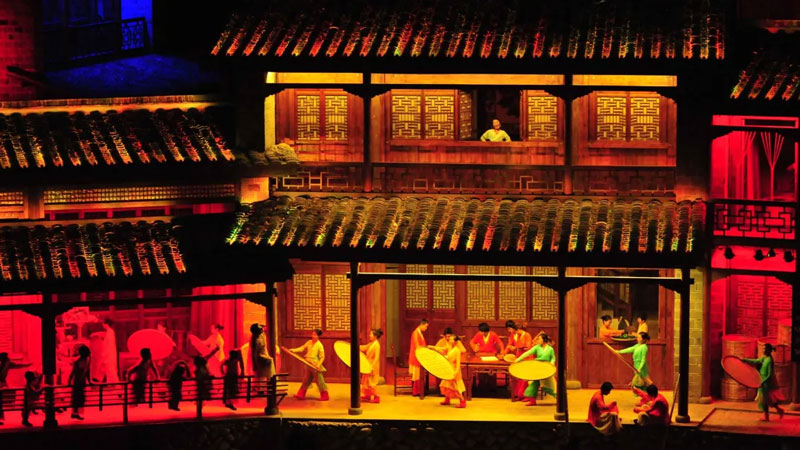
Meanwhile, Impression: Dahongpao (印象大红袍) redefines tea ceremony as kinetic art. Six hundred performers swirl across riverbanks, their crimson robes mimicking unfurling leaves. When mountainsides blaze with projected terraces, the aroma of roasted oolong seems to permeate the night air—a multisensory ode to the leaf that shaped civilizations.
Wuyi’s genius lies in its duality: tea-infused streams nourish both terraced fields and intellectual traditions; cliffside tombs overlook living rivers. Beyond "heritage," it offers communion—where philosophers’ stones meet boatmen’s ballads, and every steep trail leads not just upward, but inward. To wander Wuyi is to tread the watershed between earth and eternity.
Stories Along the Leaf's Journey
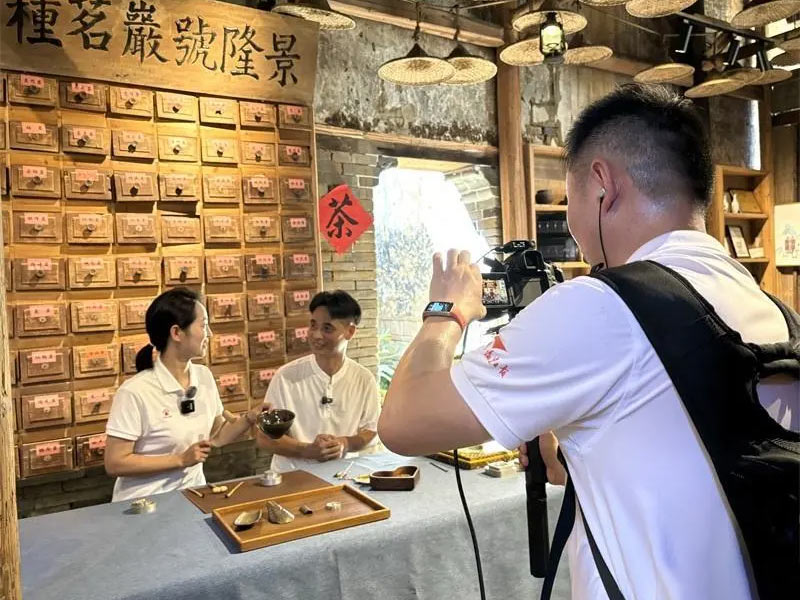
Each province along the route contributes unique chapters to the tea saga, vividly revealed through the live streams. In Henan, the Luoyang Ancient Tea Route Museum became a focal point. Detailed examinations of weathered stone tablets and aged tea bricks illuminated the city's crucial logistical role within the vast network. Further west, in Shanxi's Qixian County, the broadcast delved into the world of Jin merchants. Grand courtyard complexes like the Qiao Family Compound and specialized museums narrated tales of camel caravans braving harsh continental climates to forge trade links deep into Central Asia and Russia.
Reaching Hebei, the imposing Great Wall gateway at Zhangjiakou's Dajingmen took center stage. This strategic pass marked the transition point where wagons gave way to camel trains embarking on the final, demanding leg towards Mongolia and beyond. Each location, meticulously presented through expert guides and evocative visuals, underscores the diverse landscapes, communities, and innovations that sustained the tea trade for centuries. The ongoing broadcasts promise deeper explorations into the traditions of Jiangxi, Hubei, Hunan, and Inner Mongolia.
