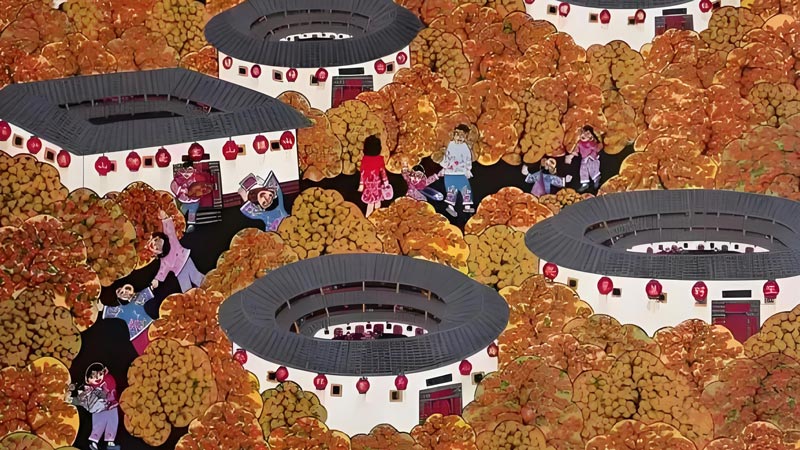
When the monumental folk painting Fujian’s Jubilant Song (3.23m × 2.51m) debuted at China’s inaugural Rural Art Exhibition, its crimson hues and dynamic scenes—from ancient Tulou buildings to lion dances—captured the essence of Fujian’s spirit. Created by seven artists from Zhangping, this work symbolizes the revival of a 400-year-old tradition nearly lost to urbanization. Wu Yuhuan (吴玉环), a master painter, describes the style: "Bold colors, whimsical figures, and auspicious themes that radiate sincerity." Once fading, Zhangping’s folk art now thrives through innovation and community effort.
Roots in Resilience
Zhangping’s painting legacy began in Xin’qiao Township during the Ming-Qing transition. Local artisans blended folk customs with daily life observations, developing a distinct aesthetic recognized as Fujian’s intangible cultural heritage. By the 1980s, "The Zhangping Phenomenon" emerged—a golden era where artists won national awards for works bursting with rural vitality. Yet by the 2000s, economic pressures drove painters toward commercial replica art. Chen Yongfeng (陈永凤), director of Zhangping Art Museum, recalls, "The exodus left villages silent. We feared the tradition would vanish."
The 2010 founding of Zhangping Folk Painting Academy reversed this decline. Veteran artists like Wu Yuhuan and Liu Wenying (刘文英) led free workshops, attracting teachers, farmers, and artisans. Lan Yanping, now the academy’s deputy dean, practiced nightly after teaching school, gradually refining her signature style. Today, over 500 Zhangping works have won provincial or national honors, and 200 pieces grace museum collections worldwide.
Lacquer’s Alchemical Touch
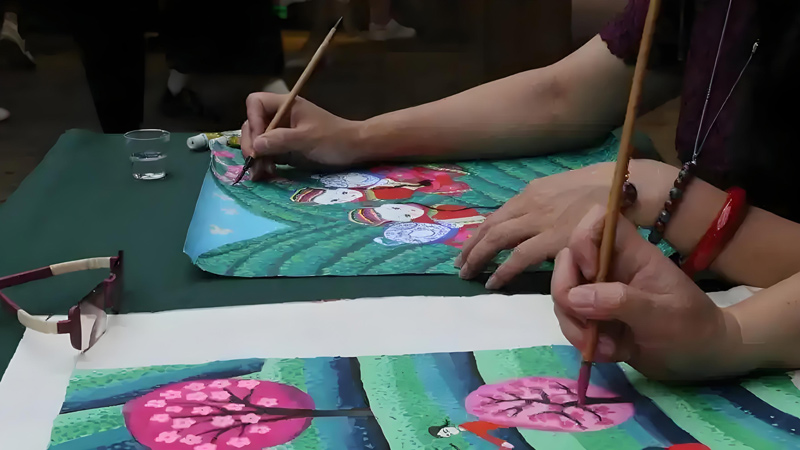
Facing stylistic stagnation and low market value, artists sought transformation. In 2016, Wu Yuhuan and 19 peers joined a lacquer-art training program, fusing folk themes with centuries-old techniques. The process proved grueling: many suffered severe allergic reactions to natural lacquer, while others struggled with intricate processes like gold-sprinkling and layered polishing. "We simplified folk motifs but added lacquer’s texture and depth," Wu explains.
The fusion birthed "folk lacquer art"—a genre where vivid storytelling meets lacquer’s luminous richness. Professor Xu Dongshu of Fujian Normal University notes, "The raw energy of folk art gained lacquer’s elegant intensity, creating a radiant new language." Economically, the innovation paid off: lacquer pieces fetched five times higher prices, with some selling for ¥20,000. By 2017, the Zhangping Folk Lacquer Academy became a dedicated hub for creation and sales.
Seeding Tomorrow’s Masters
Zhangping’s art revival thrives on inclusivity. At painting academies, retirees share benches with children; homemakers like Chen Huimei (陈惠美) discover new callings. After visiting the lacquer academy in 2022, Chen spent nights mastering brushwork while raising toddlers. Her debut work exhibited within a year. "The mentors’ support fuels us," she says. Sculptor Lan Haijin relocated from Fuzhou to open a youth studio, merging contemporary vision with tradition.
Systematic training sustains growth. Local schools use tailored textbooks like Trial - use of Characteristic Art Textbooks for Primary Schools in Zhangping City (漳平市小学美术特色教材试用), while annual contests spotlight emerging talent. Workshops in scenic spots and tourist centers broaden exposure. Market-wise, artists experiment with printmaking, graphic novels, and merchandise like tote bags featuring folk motifs. Partnerships with cultural groups secure bulk orders, ensuring financial viability.
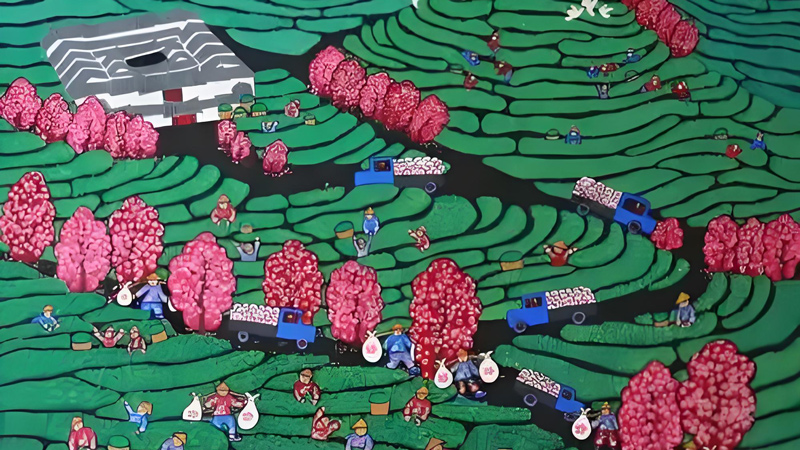
At present, many "painting villages" are developing differently, but Zhangping is not in a hurry. It is already good to move forward steadily, maintain the steady growth of farmers' and lacquer painting artists, and enhance the industrial value, "said Wu Yuhuan. In the future, Zhangping will try to promote stronger vitality of farmers' paintings through measures such as digital protection, cultural tourism integration, and talent cultivation.From near-extinction to dynamic reinvention, Zhangping’s artists prove that tradition, when nurtured collectively, never truly fades—it simply finds new canvases.