Yuan court dress produces one of the strangest survivals in Chinese clothing history. A robe worn at inner-court banquets in the fourteenth century, dyed a single colour from hat to boots and graded by the cost of its cloth, reappears three hundred years later on Ming guards and on an award garment embroidered with a flying fish. The link is not an inference from silhouette. It is written into the Yuan dynastic history, then restated by three Ming and early-Qing writers who each spelled the word differently.
One Colour, Eleven Winter Grades
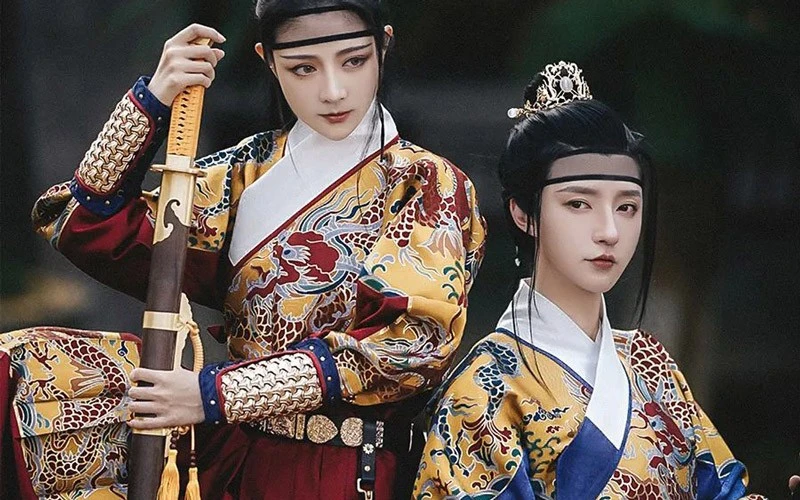
A Zhisun robe was the single-colour garment prescribed for the Yuan inner-court banquet, matched across hat, robe, belt and boots, with rank carried by fabric and trim rather than by cut. The History of Yuan states the rule in one sentence and then refuses to simplify it: “Zhisun, in Chinese a one-colour robe, is worn at the inner-court great banquet. Winter and summer garments differ, and there is no fixed system. It is granted to meritorious relatives, great ministers and close attendants; down to musicians and guards, each has his garment. The fine and coarse work, the distinction of high and low, differ, yet all are called zhisun.”
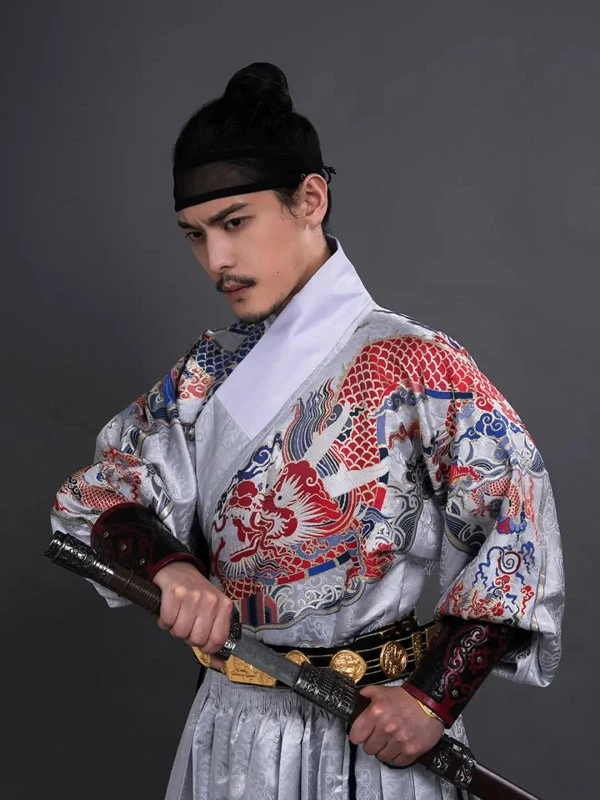
What follows in the same chapter is a schedule, not a description. The emperor’s winter wardrobe is counted at eleven grades and the summer at fifteen, each grade a fabric paired with a specific hat. Officials below him get nine winter grades and fourteen summer ones. The pairing is the point: cloth and headwear were fixed to each other, so a man in gold-shot silk could not wear anything but the gold-brocade warm cap, and a man in white soft leather had to wear the white leather cap with gold plaques.
| Winter, grade group | Cloth named in the chapter | Hat fixed to it |
| 1 | Nasij (gold brocade) and Qiemianli (cut pile) | Gold-brocade warm cap |
| 2 | Crimson, peach, purple, blue and green baoli, a robe cut with a hem band | Seven-treasure double-crown |
| 3 | Red and yellow soft leather | Red-gold tab cap |
| 4 | White soft leather | White-gold tab cap |
| 5 | Squirrel fur | Squirrel warm cap, plus a squirrel shoulder cape |
| Summer, grade group | Cloth named in the chapter | Hat fixed to it |
| 1 | Danadu nasij, gold brocade strung with large pearls | Jewelled phoenix felt hat |
| 2 | Subudu nasij, the same cloth with small pearls | Pearl cloud-curl crown |
| 3 | Plain nasij | The matching brocade cap |
| 4 | White fur with gold-thread hem band | White rattan treasure cap |
| 5 | Camel-brown fur | The matching fur cap |
| 6 | Five-colour gauze in crimson, green, blue, silver-brown and date-brown, plus gold-embroidered dragon gauze | Gold phoenix crown, colour-matched |
| 7 | Blue gauze with gold dragons | Lacquer-gauze phoenix crown |
| 8 | Blue Sufu gold-thread hem band, Sufu being the finest woollen of the western regions | Seven-treasure lacquer-gauze cap with a back brim |
The chapter’s own glosses are the most useful part for anyone reading it in translation. Nasij is not left as a foreign word: the text adds, in parenthesis, that it means gold brocade. Qiemianli is glossed as cut pile. Baoli is glossed as the robe that carries a hem band. Danadu nasij is gold brocade strung with large pearls, subudu nasij the same cloth with small ones, and Sufu is identified as a woollen from the western regions. Four glosses in a single paragraph tell you the compilers expected readers who did not know the vocabulary.
The Guest List Behind the Colour Rule
What made the garment matter was who could wear it, not how it looked. Access ran through a grant, and the chapter is explicit that the grant descended far below the throne: meritorious relatives and close attendants received theirs by favour, while musicians and guards had theirs as issued kit. One system, two functions. For the men at the top it was ceremonial dress; for the men at the bottom it was uniform, and the same word covered both because the same visual rule covered both.
Reading the Yuan chapter alongside its own public-service dress code shows how differently the two ranks were marked. Official public dress was ranked by motif size, stated to the half-inch: first rank, a large single spray five inches across; second rank, a small single spray three inches; third rank, scattered flowers two inches and leafless; fourth and fifth ranks, small mixed flowers one and a half inches. Zhisun ranking used no measurement at all. It used material, and material spoke in fur, pearl count and gold thread rather than in inches.
That is why the robe reads as Mongol court custom rather than as a Chinese ceremonial system, even though the compilers placed it inside one. The chapter’s opening admits the borrowing outright: when the dynasty was founded, dress and carriages followed old custom, and Kublai Khan took recent practice from the Jin and Song and older practice from the Han and Tang. The zhisun is the part of that settlement that could not be folded into Han precedent, so it was scheduled instead of theorised.
The Same Word in Ming Notebooks
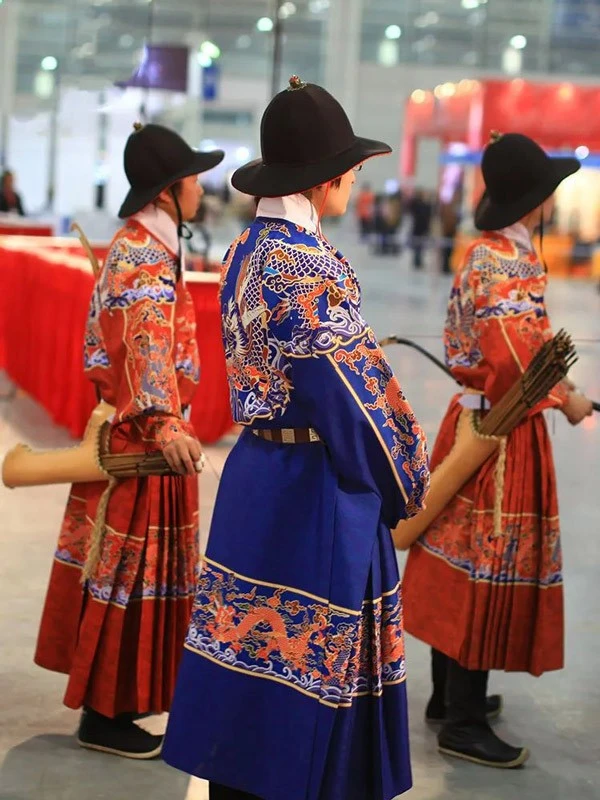
Ming writers did not treat the zhisun as a lost foreign costume. They treated it as the garment the men at the palace gate were still wearing, and they said so while complaining about it. Shen Defu, writing in the Wanli reign, recorded that imperial orders still specified numbers of zhisun to be made, that the garment originated under the Yuan, that favoured officials once wore it into the palace for a summoned banquet to signal the occasion, and that by his own day it had come down to guards’ everyday wear. His closing line is the complaint of a man watching a status garment decay into a uniform.
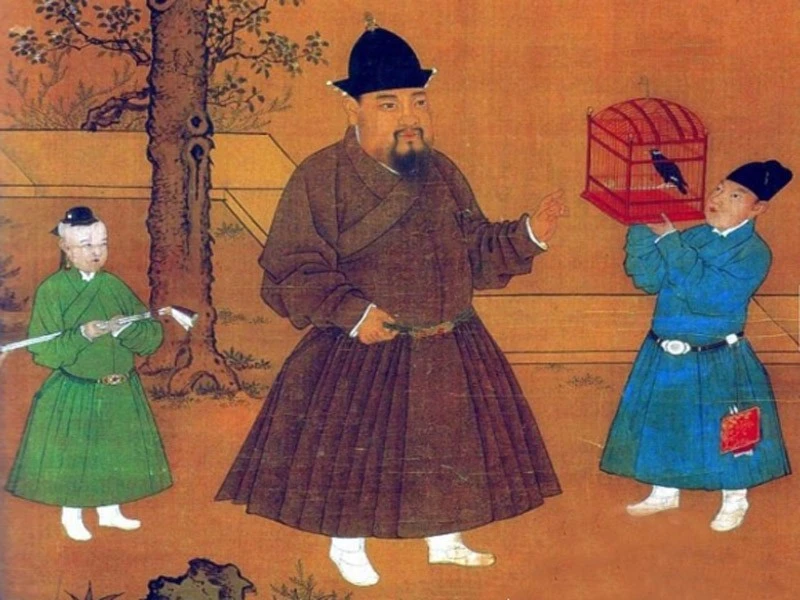
Sun Chengze, writing after the dynasty fell, was blunter. He noted that the guards all wore jixun, that the name itself was a Yuan legacy, and that what had once been the ceremonial dress of Yuan officials had ended as the dress of servants. Fang Yizhi, in his Tongya, supplied the detail the others left out: the Ming guard’s version was a five-colour round-flower weave, and he traced the hat as well, calling it a naobao and comparing it to a Five Dynasties headwrap. He also preserved the pun that makes the whole transmission visible, noting that zhisun meant one-colour dress, that it had no fixed system, that high and low wore it with finer or coarser work, and that by his time it dressed only guards and was written with a different character.
The dynastic history closes the loop with a date. In 1373, the sixth year of the Hongwu reign, an order directed guards to wear zhixun with a belt, a soft cap and boots, and the compilers added a note that the name was a Yuan institution and meant one-colour clothing. A Ming emperor legislating the uniform of his own guards therefore wrote the Yuan banquet garment into Ming statute, and the scribes who copied the order kept the foreign word.
A Robe Cut in Two Halves
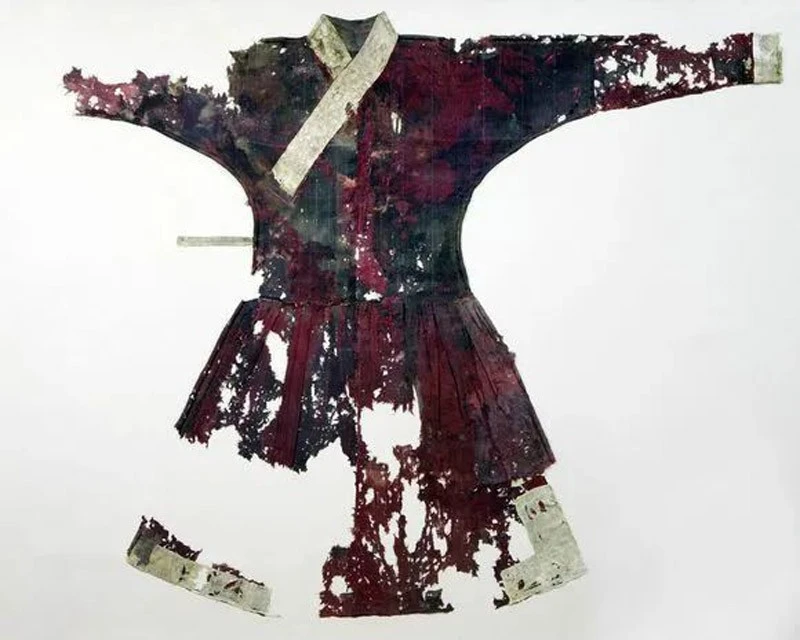
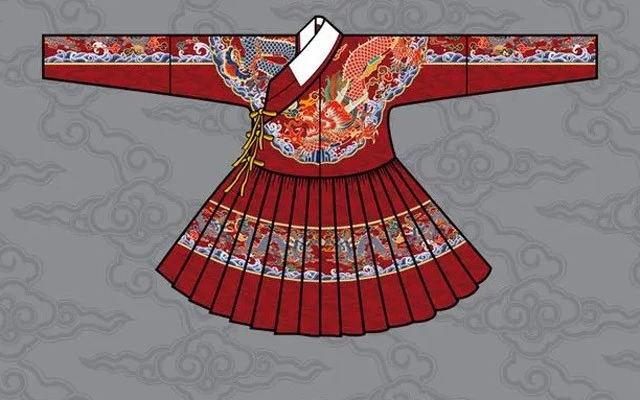
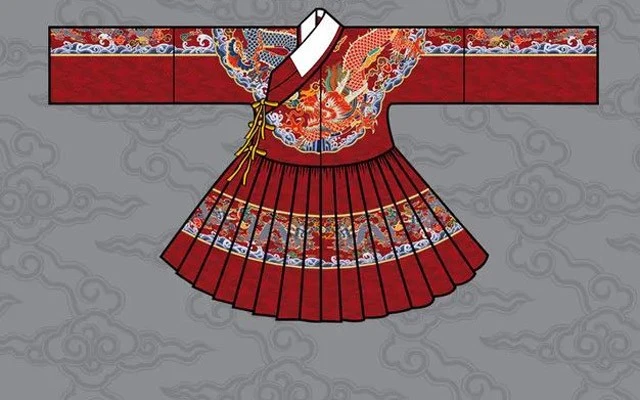
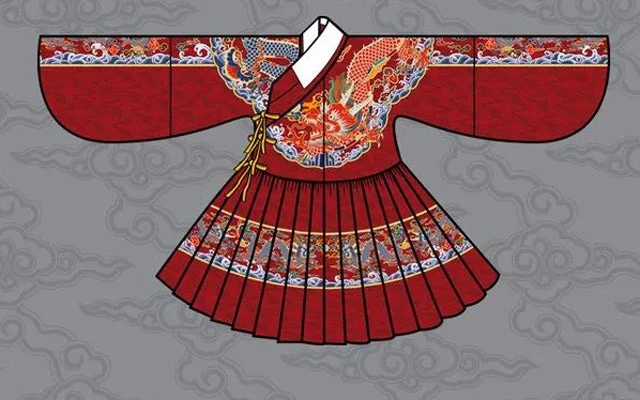
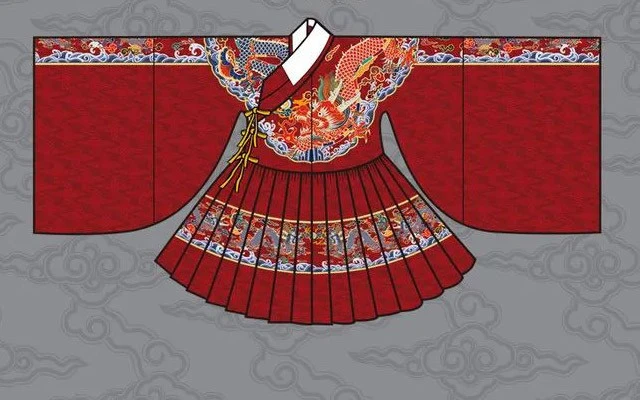
What Ming kept was the cut; what it dropped was the banquet. A Yesa is a robe whose front is cut into two sections at the waist while the back stays whole, pleated below the waist and split at the sides with a panel added at each opening. A late-Ming palace memoir describes it in exactly those terms and adds who could wear it: from the scribes of the Directorate of Ceremonial up to the chief eunuchs, only men holding office in a department dared put it on. The red version carried the wearer’s rank badge; the blue one did not.
Wang Shizhen, writing in the Jiajing years, gives the terminology that separates the two related garments. In his account, the short-sleeved or sleeveless version with a break at the waist, horizontal pleats below and vertical pleats beneath those, was called kuzhe; when the sleeve was long, it was a yesa. Courtiers wore yesa to banquets, he notes with distaste, which is how a cavalry garment settled into Ming dynasty clothing as formal wear. Shen Defu made the same complaint from a different angle, asking why scholars had taken a cavalry garment for formal wear.
Where the pleats came from is the one point on which current Chinese accounts diverge, and the divergence is worth stating rather than smoothing over. Xinhua’s feature on Yuan dress treats the zhisun and the braid-line coat as separate garments, distinguishing the zhisun by a waist seam without the fine waist pleating, and derives the Ming yesa from the braid-line coat instead. Popular reference entries take the shorter route and treat zhisun, yesa and the Ming guard’s robe as one name in three spellings. Both readings agree on the substance: a fitted, waist-seamed, pleated riding coat entered Han dress through the Yuan court, and the Ming kept it while rewriting its justification.
Where the Flying Fish Fits
A flying-fish robe is a Ming award garment, not a Yuan one. The fish is a Ming motif with no place in the Yuan schedule; what descends from the Yuan banquet is the body underneath it, the yesa cut, and the logic of a single prescribed colour and grade of cloth. A Ming flying-fish robe from the Kong family collection in Qufu shows the combination in one object: the Ming motif on the inherited cut. Law tried repeatedly to keep the garment tied to a grant, which is the clearest sign that it had stopped signalling anything reliably.
Set the two ends side by side and the survival is easy to describe and hard to explain. A fourteenth-century banquet robe ranked by gold thread and squirrel fur became a sixteenth-century guard’s coat woven with round flowers, and then an award garment with a fish on it. What travelled was not the ceremony, the rank or the cloth. It was the cut, the waist seam and the pleats, plus the habit of prescribing one colour and letting material carry the difference. Modern Hanfu catalogues list the yesa as Hanfu for men and read it as Ming. The Yuan banquet it came from has largely dropped out of that description, which is why the robe still needs its own page in accounts of traditional Chinese clothing.