The Shanghai History Museum opened a show of Guizhou ethnic dress on 21 November with a curatorial argument built into its title: the clothes and the silver are one subject, not two. Rainbow Robes, Silver Adornment brings more than 130 sets of costume and related objects from the Guizhou Provincial Museum collection into a first-floor gallery in west Shanghai, where it runs until 7 March 2027 in four linked sections that move from silhouette to narrative to technique to metal.
| Dates | 21 November 2026 to 7 March 2027 |
| Venue | Shanghai History Museum, west building, first floor |
| What it is | Rainbow Robes, Silver Adornment, a Guizhou ethnic dress exhibition co-organised with the Guizhou Provincial Museum |
| Scale | More than 130 sets of costume and related objects, in four sections |
| Hours | 9am to 5pm, last entry 4pm; closed Mondays except public holidays |
| Tickets | Free, no booking required |
A Wedding Coat Called Xiongyi
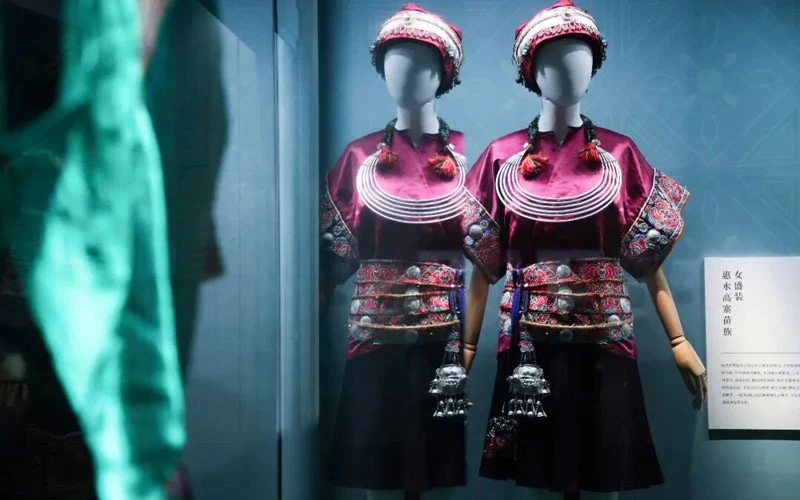
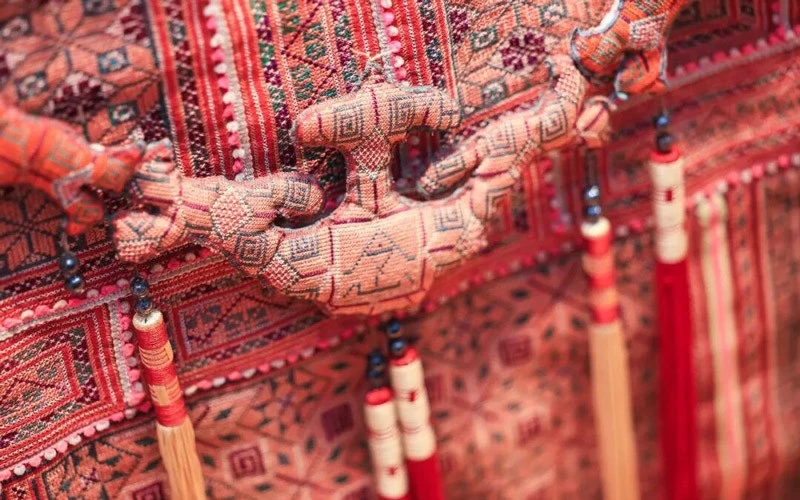
A single garment does the work of an introduction. It is the festival dress of a Miao woman from Xijiang in Leishan, known locally as Xiongyi (雄衣), and it is worn for weddings and for the Miao New Year. Read it from the top and the construction is legible without a label: a collarless crossed neckline with the collar points swept back over the shoulders, embroidery packed across shoulder, sleeve and collar, silver plaques sewn onto the body of the coat.
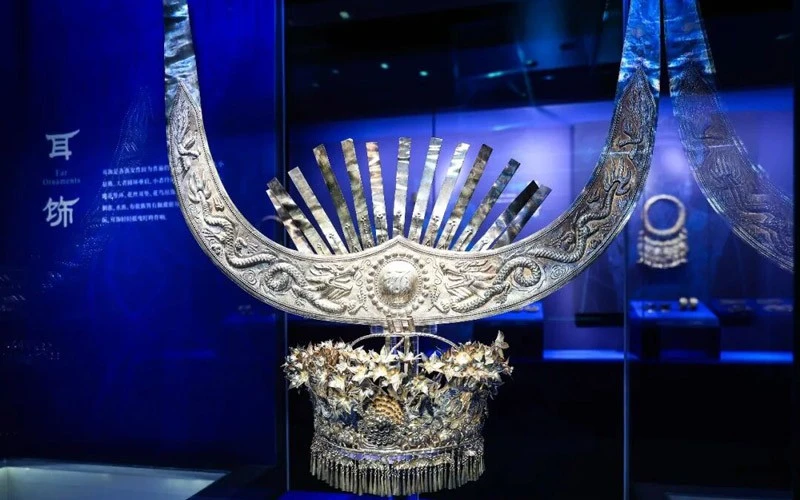
Below the waist the same outfit changes register. A heavy pleated skirt sits under an embroidered phoenix-tail streamer skirt, and the head carries a pair of oversized silver horns with a silver cap, a chest press and multiple neck rings layered beneath them. The effect is softness and mass at once, which is the recognised signature of festival dress from the southeast of the province. The section that follows widens the frame to other forms, so the visitor meets the coat as one solution among many rather than as a regional costume.
Cloth as a Migration Map
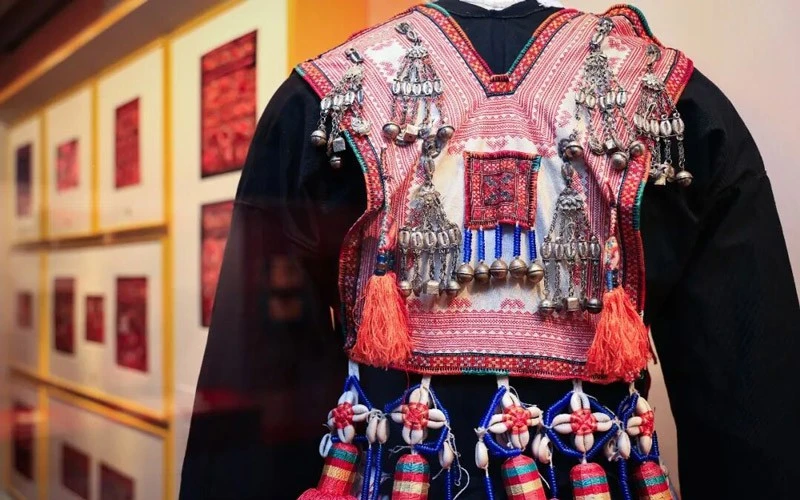
The second section makes the case that the embroidery is a document. Many of Guizhou’s ethnic groups had no writing system of their own, and the exhibition argues that history, creation stories, ancestral belief and courtship custom travelled in oral song and in the patterns on cloth. The evidence is specific. On a Zhijin Miao woman’s jacket, two square panels on the shoulders are read as sky and earth at top and bottom, the diagonal lattice in the middle as farmland, the toothed border as mountain ranges, and the square at the back as a walled town. Three red bands on the pleated skirt stand for the Yellow River, the plain and the Yangtze.
Read together, those elements form a migration map worn on the body, which is a stronger claim than the usual line about patterns carrying meaning. Myth gets the same treatment. A sleeve panel from Shidong in Taijiang shows the butterfly mother laying twelve eggs in a maple tree, with the wagtail bird hatching dragons, snakes, oxen, the thunder god and Jiang Yang, the ancestor of the Miao. Festival dress from Gulong in Huangping and a Shui horsehair-embroidery baby carrier carry the same logic into lifecycle ritual.
Twenty Pounds Worn as Savings
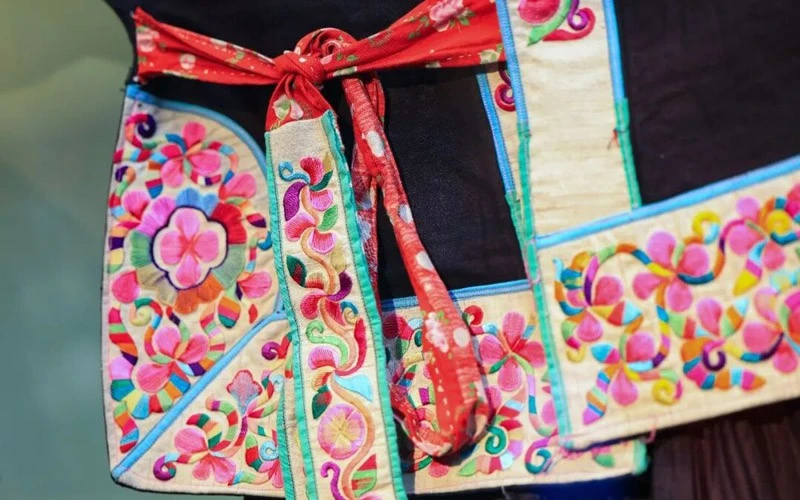
The third section dismantles the labour. A single fine festival outfit can absorb years of work, and the show takes the components apart: embroidery built on a paper-cut pattern, then stitched over in flat stitch, braid stitch, crepe stitch, wrapped-thread stitch and seed stitch, each with a different surface. Tin embroidery and wax resist appear on the same garments, which is useful for visitors who assume one technique per region. Nothing here is presented as a survival of an older method alone; the point is the division of labour inside one garment.
Closing the run is silver itself, and the most arresting number in the show. Miao and Dong women along the Qingshui and Duliu river systems wear silver from the head to the chest on major festivals, and the heaviest sets exceed ten kilograms. The display runs through the sequence of wearing: horns, cap, hairpin, comb, hairpins of a second type, and the forehead band, stacked in the order they go on. The aesthetic is stated plainly as large, many and heavy.
That weight is also an accounting fact. A family’s silver is portable property that can be valued, pledged or passed down, and it is displayed at a wedding because the wedding is when a family’s standing is read by others. Calling the silver decoration misses what the visitor is looking at. The metal is the household balance sheet, and the festival is the annual audit.
Where the show earns its ticketless admission is in refusing the usual arrangement by ethnic group, the one most surveys of traditional Chinese clothing fall back on, which leaves visitors remembering colour and glare. Geography and function do the sorting here instead, and the result turns looking into reading: a square on a shoulder is sky and earth, a red band on a skirt is a river. The museum has made dress one of its standing exhibition themes, and this loan show extends it westward into the province whose clothing carries the most encoded information per square centimetre.