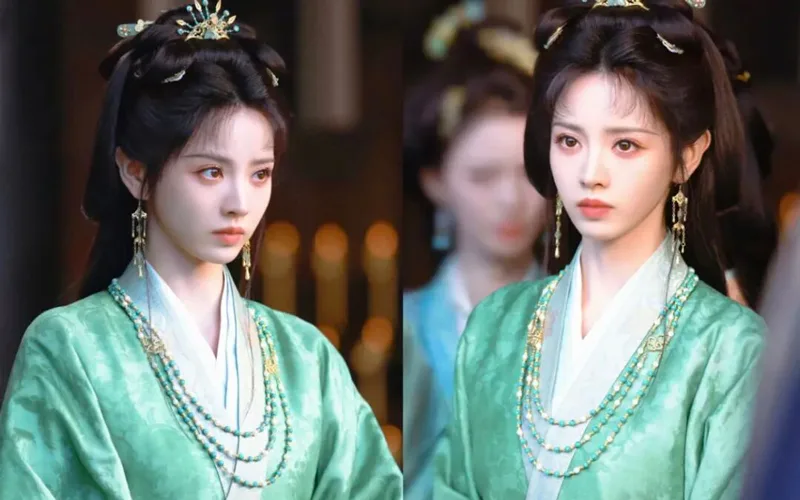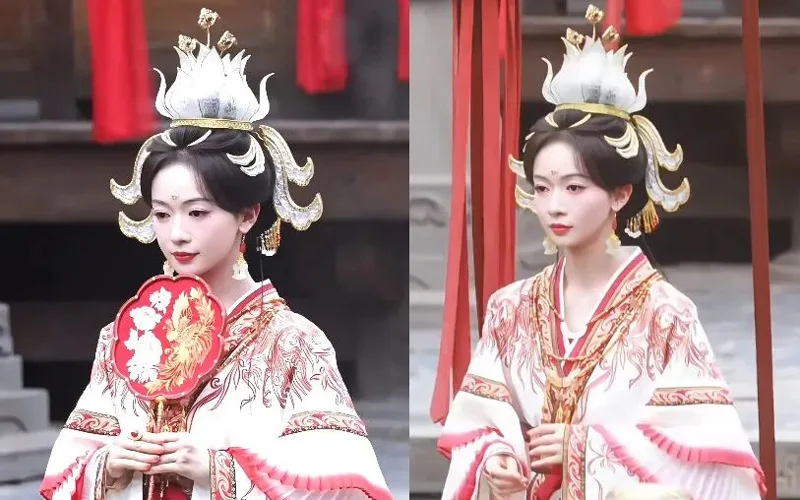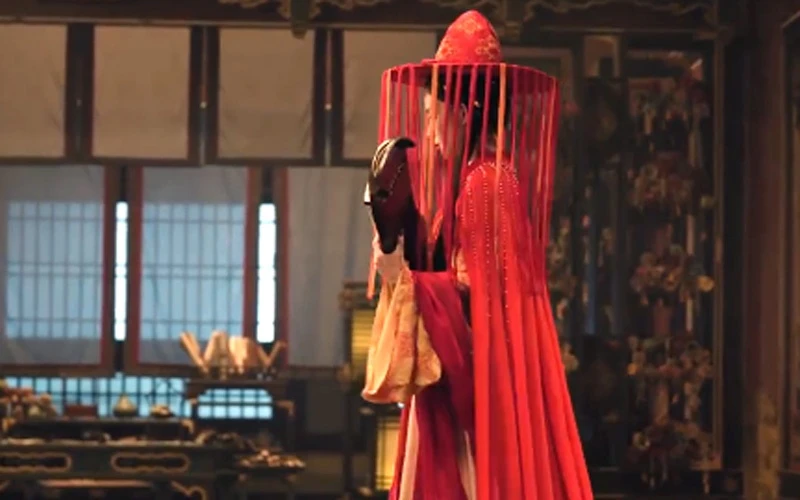
In Tigers Sniff the Rose (尚公主), Meng Ziyi (孟子义) plays Danyang (丹阳), a princess whose costume includes a pointed cap ringed with long red strips. On screen, the strips sway and the cap seems to float, so viewers quickly compare it to a jellyfish. The question is not just “Why so strange?” It is also “Is there a real model?” The answer sits between costume drama fantasy and museum research. The design borrows from a rare Tang-era brocade cap, then bends that source toward story, mood and camera. That mix explains why the hat feels unfamiliar yet believable.
A Historical Prototype
The closest model is a Tang brocade cap held by the China National Silk Museum. Its crown rises to a point. Woven roundels contain linked pearls, a flowering tree and paired deer. Those motifs show a meeting of western-region taste and central-plain weaving. Unlike the familiar wide-brim gauze hat, this cap does not drop a full sheet of cloth. Instead, narrow bands hang near the shoulders and neck. Surviving examples are rare, and the shape may have belonged to a western-region noblewoman or grown out of an earlier veiled hat. The museum piece gives the drama a firm anchor.
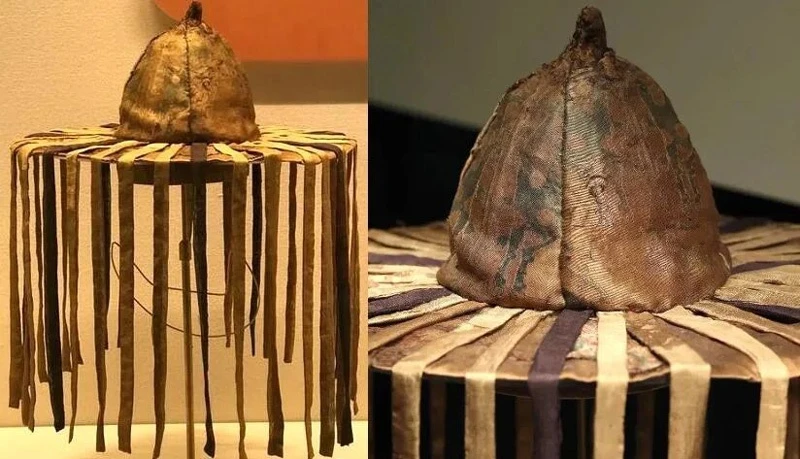
That anchor matters because the cap is not random fantasy. A pointed crown changes the silhouette; hanging strips change movement. Brocade adds weight and shine under lamps. The linked-pearl roundel also signals trade, travel and court fashion rather than a simple “ancient” look. For a costume team, such details offer a shortcut: the hat can say “foreign influence” without a line of dialogue. It can also say “high status” while hiding the face. When Tigers Sniff the Rose moves, the strips turn still fabric into motion. The cap becomes a small machine for visual rhythm.
The drama does not copy the museum object exactly. The original pattern is dense and its colors are muted. On screen, the crown uses a simpler floral roundel, and the red is brighter. That red matches the dance costume and survives dim palace lighting. A direct replica might read as heavy or muddy on camera. A looser version keeps the recognizable outline while letting the audience follow the character. In other words, the hat is a research-based costume, not a textbook illustration. It respects the source but serves the scene first.
From Veil to Hat
Older head coverings explain the cap’s family tree. A full-body veil came from Central Asian nomadic life, where windblown sand made long cloth practical. It reached the central plains through trade routes. In the Sui and early Tang, noblewomen often wore it outdoors, hiding the face and body. By the Yonghui (永徽) era, wearers shortened the heavy veil. The new form kept a cap and a ring of gauze that reached the neck. This was easier for riding and garden trips. Tang figurines show women in this practical veiled hat, so the change was not only fashionable but useful.
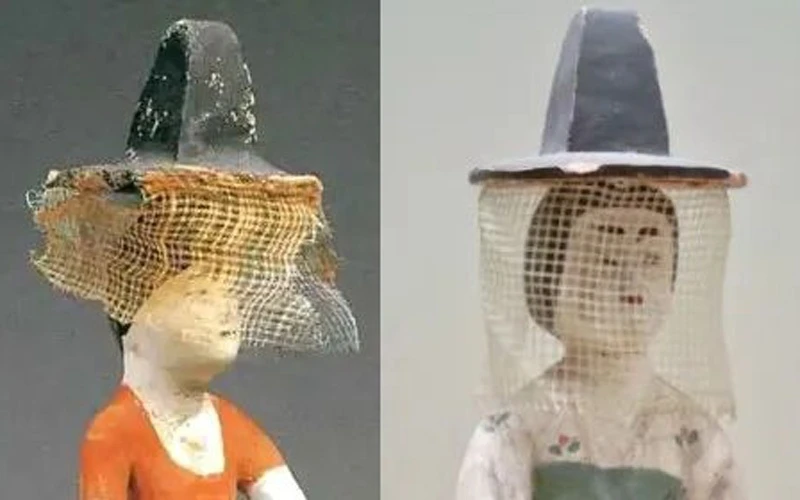
During the Wu Zhou (武周) period, the veiled hat became common. It blocked dust, framed the face and allowed movement. Later, High Tang society grew more open. Women went out without covering their faces. Foreign-style caps with flipped brims or pointed crowns entered court fashion, and the Old Book of Tang (旧唐书) notes the taste for such headwear. The older veiled hat did not vanish overnight, but it lost its everyday role. That shift left room for caps like the one in the drama: less about hiding, more about style, dance and spectacle.
This history helps explain the red strips. They are not a modern invention for shock value. Long bands belong to a longer story about cloth that protects, conceals and decorates. When a designer removes the gauze sheet and keeps only strips, the cap becomes lighter and more theatrical. It still hints at a covered face, but it also invites the eye to follow each ribbon. The result feels exotic without leaving the Tang frame. The past is present, but it has been edited for a camera.
Why It Works
In the story, she disguises herself as a dancer to enter a hall. A normal wide-brim gauze hat belongs to a noblewoman visiting relatives; it would read as too polite for this plan. The pointed cap with hanging strips leans toward music and dance. It also echoes an early Tang court that enjoyed foreign music and movement. The costume therefore does plot work: it hides Tigers Sniff the Rose while pushing her toward the performance she needs. The hat is not just decoration; it is a small disguise with a personality.
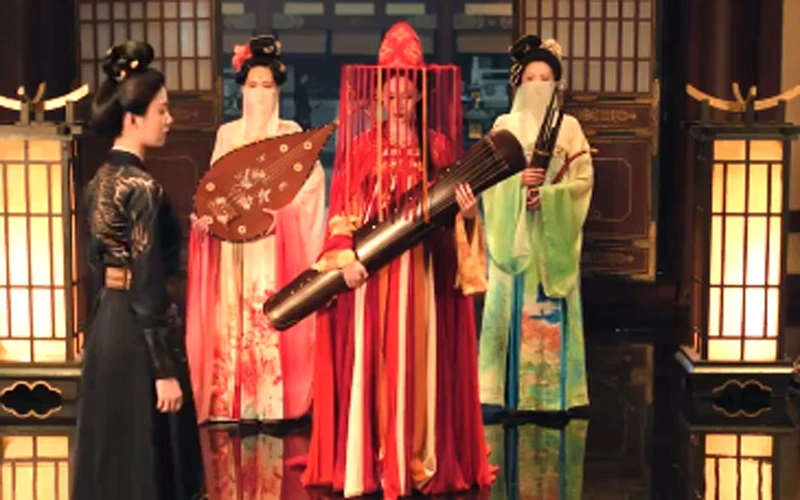
Camera logic matters too. Palace halls are often dark and crowded. A bright red cap and moving ribbons pull the eye away from background noise. A plain gauze hat can flatten on screen, because its shape is familiar and soft. The pointed crown and hanging lines create a clear silhouette. That silhouette is easy to remember and easy to tell apart from other dramas. In a crowded market of historical shows, a single strong image can travel farther than a dozen accurate but quiet details. Here, the strange look is a deliberate visual tool.
The final balance is clever. The team took a rare Tang cap, kept its pointed crown and hanging strips, then simplified the pattern and brightened the color. The result nods to the museum piece without becoming a replica. It fits the dance costume, the dark hall and Tigers Sniff the Rose’s secret plan. Viewers may first laugh at the “jellyfish” comparison, but the hat has a reason to exist. That is why the costume moment lingers: it looks odd at first glance, then makes sense once the history and the scene are placed side by side.