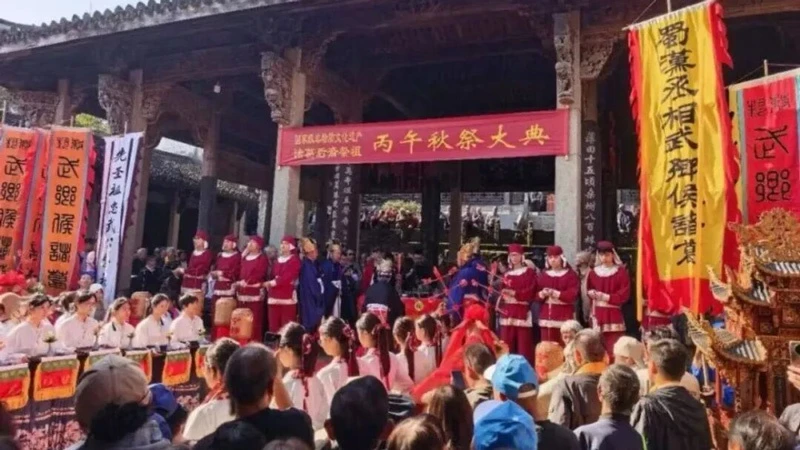
On October 8, 2026, the autumn ancestral ceremony of Zhuge Bagua Village (诸葛八卦村) in Lanxi (兰溪), Zhejiang, drew attention for its solemn ritual and striking costumes. The chief officiant and attendants wore unified robes in a Ming-dynasty style as they offered incense, presented offerings, and recited the sacrificial text. Because the ceremony honors Zhuge Liang (诸葛亮), a statesman from the Three Kingdoms period, some viewers wondered why the clothing looked Ming rather than Three Kingdoms. The answer lies in the ritual’s own history, not in costume trends or photography. The village’s autumn sacrifice took its present shape during the Ming dynasty, and the attire follows that inherited framework.
According to the Gaolong Zhushi Zongpu (高隆诸葛氏宗谱), the spring sacrifice was set on the second Ding (丁) day, while the autumn sacrifice was fixed on the twenty-eighth day of the eighth lunar month. After the Chengxiang Citang (丞相祠堂) was expanded in the Wanli and Chongzhen reigns, the ritual grew more complete. It developed a sequence of incense offerings, three presentations of offerings, recitation of the sacrificial address, and drum-and-music signals. The Ming-style garments therefore do not attempt to recreate Three Kingdoms dress. They express the village’s own memory of how the rite has been performed for centuries.
Reading the Ceremony Costumes
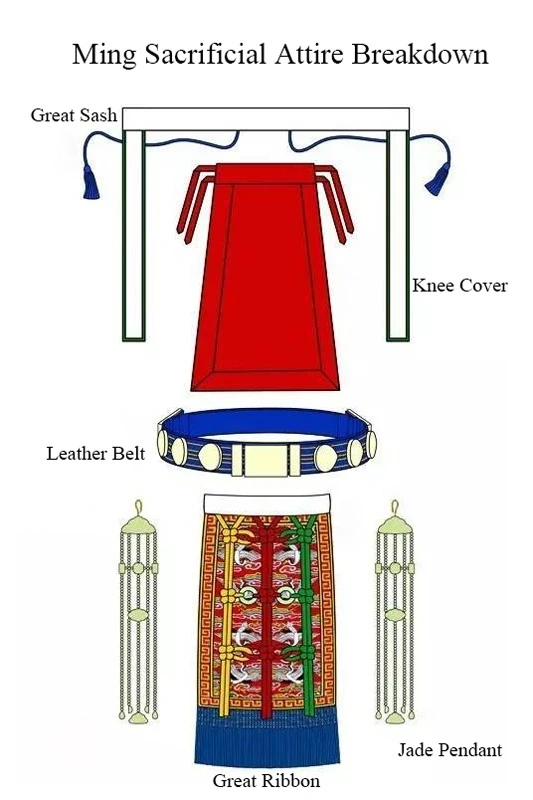
The robes worn on site look broadly Ming, yet they are not exact copies of official sacrificial dress. Historical regulations from the twenty-sixth year of the Hongwu reign describe a full ensemble for officials attending major state sacrifices: a black-edged blue silk upper robe, a white gauze inner garment, a black-edged red lower skirt, and a red bixi (蔽膝) apron hanging before the body. Higher-ranking officials could also wear a fangxin quling (方心曲领), a formal collar piece, along with belts, pendants, and ribbons matched to rank.
The chief officiant’s tall black crown recalls the Liangguan (梁冠), a formal Ming cap with horizontal bars, but it adds a golden forehead ornament and blue side ribbons that do not belong to the standard form. His deep blue outer robe echoes the blue silk upper garment of Ming sacrificial dress, while the bright blue collar edge should not be mistaken for the white gauze inner garment. The red fabric visible below is partly covered by a wide multicolored hanging panel, which differs from the plain red bixi prescribed in ritual codes. The white sash, tassels, red floral decoration, and “chief officiant” ribbon are modern additions meant to clarify roles during the ceremony.
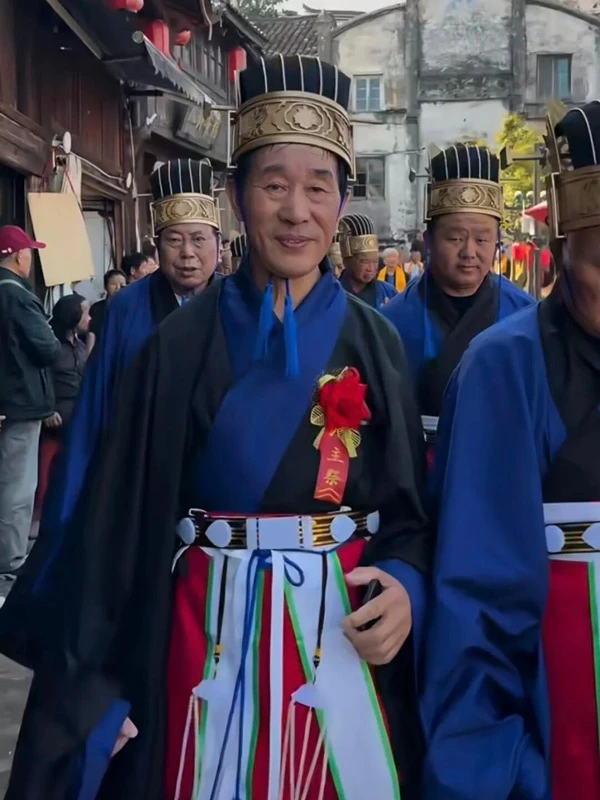
The attendants wear simpler blue robes and matching caps, without the chief officiant’s special ornaments. This contrast shows the guiding idea behind the costumes: use Ming ceremonial logic to mark status and create order, while adapting details for a living clan ritual. The set preserves the dignity of traditional sacrificial dress without pretending to reproduce a specific Ming official rank.
What Ming Sacrificial Dress Actually Was
Ming sacrificial clothing was not a single robe. It was a layered system built from a crown, outer robe, inner garment, lower skirt, front apron, belts, pendants, ribbons, socks, and shoes. In state sacrifices, the number of bars on the Liangguan, the materials of belts and pendants, and the patterns on ribbons all helped distinguish rank. The upper garment was blue silk, the lower skirt red silk, and the inner layer white gauze, creating a clear visual hierarchy.
The Zhuge autumn sacrifice, however, belongs to local clan worship, not to imperial state ritual. Its costumes take Ming official dress as a reference point rather than as a strict template. What matters most is that clothing matches the person, the occasion, and the sequence of actions. The unified Ming-style appearance helps the chief officiant, attendants, and participants move through the ceremony with shared clarity and solemnity.
How the Ritual Lives On
The present ceremony is not an unbroken Ming relic. It has passed through periods of expansion, damage, interruption, and revival. The dates, the Chengxiang Citang, the sacrificial text, and the three-offering sequence all rest on local records. At the same time, opening the event to visitors, filming it for short videos, and adopting unified Ming-style costumes are contemporary choices. Judging such a ritual does not require perfect historical replication. It requires knowing which parts come from inherited practice and which parts reflect present-day adaptation.
The participation of women should be understood in the same way. Traditional clan sacrifices usually centered on male lineage heads, yet modern communities include different family members. Their presence and attire reflect current social reality rather than a claim that every detail matches a Ming female sacrificial outfit. The most valuable question raised by this autumn sacrifice is not whether the robes look beautiful on camera. It is why the garments are arranged as they are, who wears them, and what role each person performs. When costume is read as part of ritual order, it becomes more than scenery. It becomes a key to understanding how reverence, hierarchy, and memory are made visible.