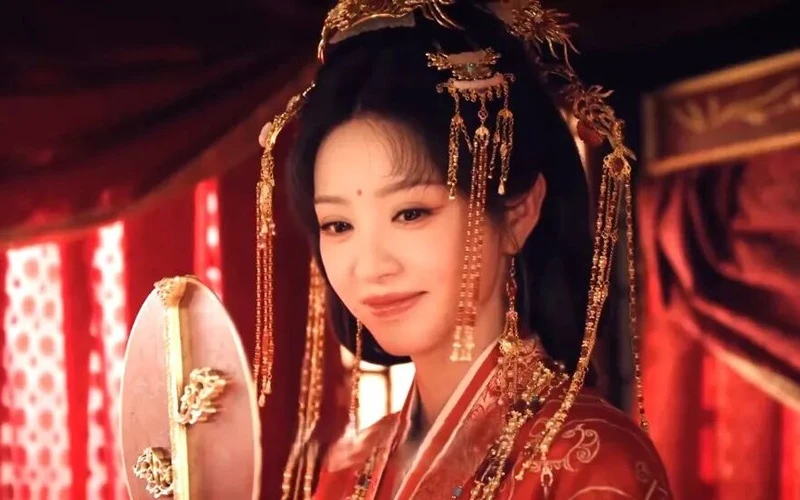
In Where the Mask Ends (嫁金钗), Wei Rao (魏娆) enters her second wedding under a gold Buyao (步摇) that looks almost impossible. Gold arms stretch sideways from her crown; long strings of red agate hang near her shoulders. The full length reaches at least 40 cm, with a drop above 20 cm. Viewers may ask whether such a headdress ever existed in old China. The short answer is no in exact shape. Tomb finds and written records show no identical piece. Long Buyao did exist, however, in other forms. The show borrows a real idea, then pushes size and silhouette for story and camera. This article separates historical evidence from television design.
Ancient Origins
The Buyao appears before the Qin empire. By the Han dynasty it entered ritual dress. Han court texts stress formal gold ornament and patterned gold, not swinging bead curtains. Han examples keep a solemn line. They do not fan out wide to both sides, and they do not rely on very long strings to attract the eye. The headdress marked rank and ceremony. Its visual power came from metalwork, not from a red bead curtain reaching the collarbone.
Later, Xianbei (鲜卑) elites of the Murong (慕容) clan wore flower-tree Buyao. Some excavated pieces stand about 28 cm tall. Their movement runs upward or diagonally upward. Small gold leaves drop only 2–4 cm. That is a tall crown with tiny tremble, not a horizontal bar with shoulder-length beads. The difference matters. Height, direction, and weight all change how the wearer moves and how the ornament reads on screen. A tall tree crown signals rank from afar; a wide bead curtain frames a face. Both are Buyao, but they solve different visual problems.
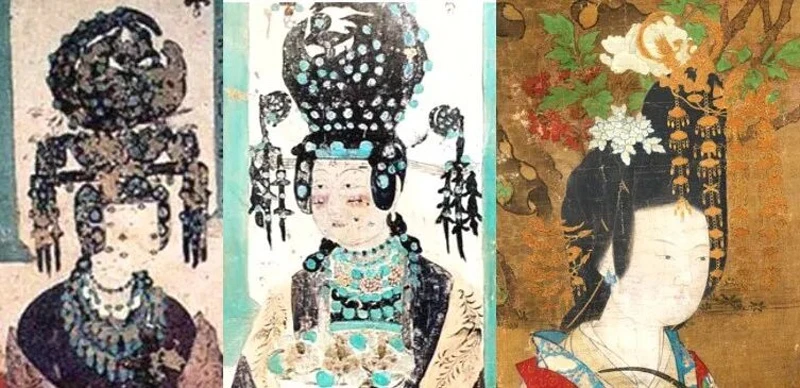
By the Tang dynasty, dangling Buyao had become common. Most surviving pieces combine a hairpin and a swaying ornament. They are more modest than Han ritual examples, often under 20 cm overall. Tang women wore them in daily dress, so restraint made sense. A heavy, wide frame would catch on hair, cloth, and movement. The historical record does not support a single rule that longer meant grander. Context mattered: court ritual, daily fashion, and local custom each produced different scales. The television piece takes the familiar dangling principle and exaggerates it far beyond these everyday examples.
Long Drops
The Five Dynasties period opens more room for drama. Donor portraits at Dunhuang (敦煌) show horizontal bar Buyao with drops ending above the shoulder, roughly 10–15 cm. A painting known as Court Lady Playing the Sheng (吹笙仕女图轴) goes further. Its dangling ornament drops past the ear, beginning at a high bun, at least 20 cm. That drop length is close to Wei Rao’s on screen. The shape is not. The painted piece follows the body; the drama piece spreads sideways like a small canopy. This is the key gap between inspiration and invention.
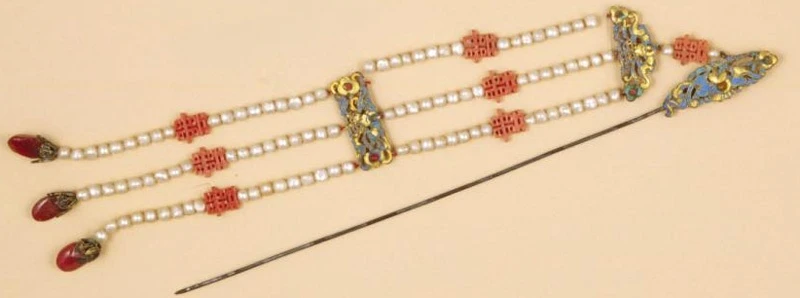
Qing tassel picks show that very long head ornaments were possible. Some surviving examples measure 43 cm overall, with drops over 20 cm. They hang vertically, close to the head and back. They do not open into a wide horizontal frame. A long drop can be practical if it follows gravity and stays near the body. A wide frame changes balance, weight, and sightlines. It also demands stronger support from the hair. The drama’s design is therefore not a simple copy of a Qing piece. It selects one feature, length, and changes another, direction.
These examples weaken a simple claim that ancient people never wore long Buyao. They did. They wore tall Buyao, long vertical Buyao, and modest daily Buyao. What they did not wear, according to current evidence, is the exact combination in Where the Mask Ends: a gold horizontal frame with red agate strands falling past the shoulders. That combination belongs to costume design. It uses historical grammar but writes a new sentence. For viewers, the useful question is not “is this real?” but “which parts are borrowed, and which parts are invented?”
Why So Big?
The first reason is plot. Wei Rao’s first wedding to Lu Zhuo (陆濯) is a deal. She takes another woman’s high-status identity, so her dress must look rich, but her position is fragile. Her first Buyao is already ornate, yet it stays within a controlled scale. The second wedding comes after mutual feeling and after she meets her birth mother. She receives the title Wengzhu (翁主). A more complex headdress makes that change visible. It shows weight, confidence, and a different balance between the two people. The bigger piece is not just decoration; it is a before-and-after marker.
The second reason is camera work. A wide gold frame increases the visual width of the head. In a crowded frame, it keeps the face from being swallowed by costume color. Shoulder-length beads catch light in slow motion and close shots. Side strands also frame the cheeks and soften the jawline. These are practical screen choices. A historical consultant might ask about weight or comfort; a director asks whether the silhouette reads in three seconds. The design answers the second question. That does not make it a fake antique. It makes it a prop built for a fictional Han-style drama, not a museum reconstruction.
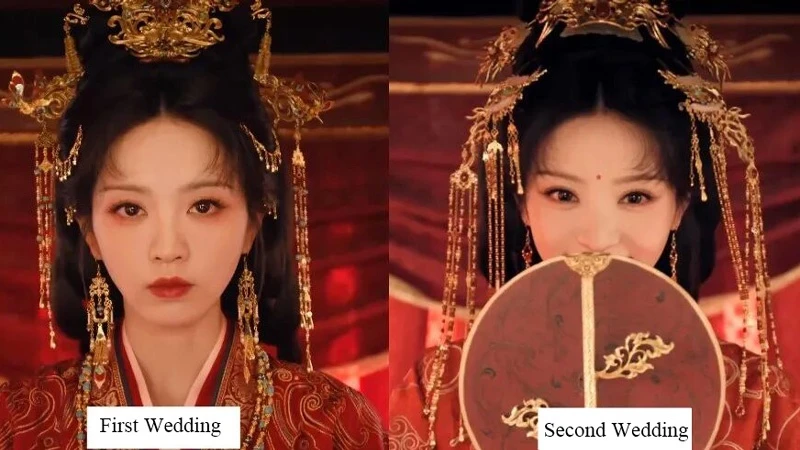
The show’s background is a fictional Han-style setting, so exact reconstruction is not its aim. Costume, hair, and makeup serve character and image. The team keeps the core of Buyao: suspension, tremble, and a sense of air around the wearer. Then it enlarges the frame and lengthens the red strands. The result is memorable, even if no tomb will ever produce it. Historical films often work this way. They take a recognizable detail, shift its scale, and let the audience feel a change in fortune. The risk is that viewers mistake drama for documentary.
So, did Wei Rao’s exact headdress exist? No known find or text matches it. Did long Buyao exist? Yes, in several eras and shapes. The honest answer holds both facts. The drama did not invent the hair ornament from nothing. It borrowed a long tradition of swaying gold, then made a bolder version for a second wedding and for the lens. That is why the piece feels both familiar and impossible. It is a television ornament with historical roots, not a historical ornament with a television budget.