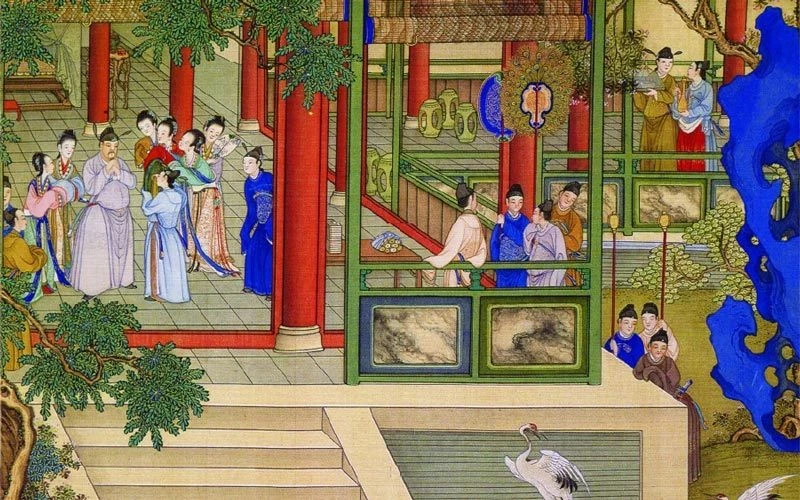
Many people picture old Chinese romance as a sealed box: parents chose, a matchmaker spoke, and the couple met under a red veil on their wedding night. History is messier and more playful. Poems, notes, contracts and paintings reveal tea-cup tests, lantern-night glances, flower gifts, clever letters and polite divorce. There were no phones, dating apps or “people nearby” function. Yet the same small dramas played out: interest, doubt, flirtation, rejection, longing and heartbreak. The settings were courtyards, riverbanks, lamp markets and garden walls. The tools were silk, tea, peonies, poems and patience. These were not museum pieces; they were social scripts that still feel surprisingly modern.
Tea-Cup Matchmaking
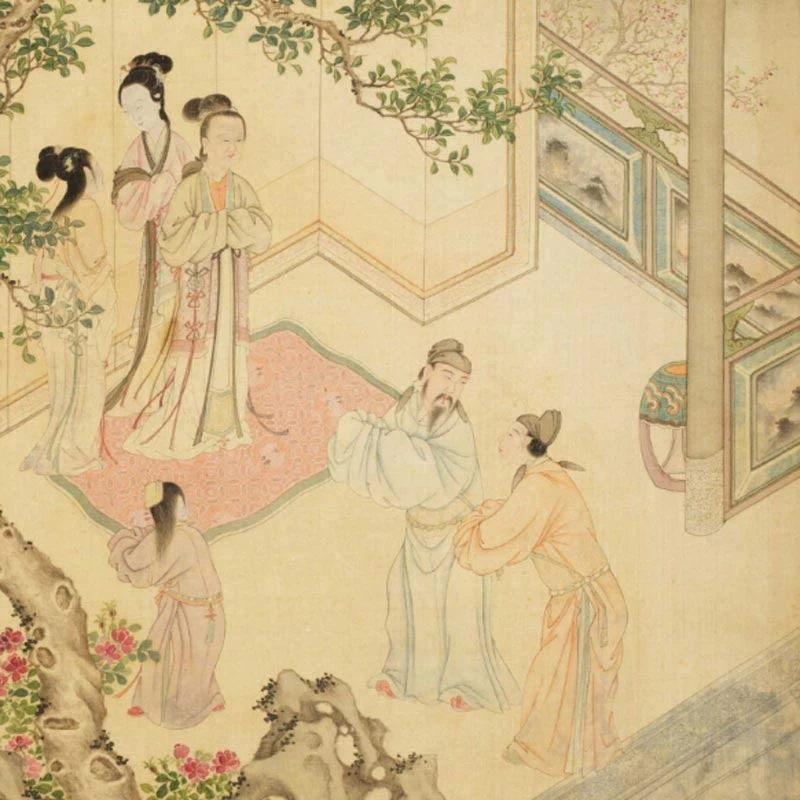
Tang and Song families sometimes arranged a formal look, and the word for it was simply “matchmaking.” A young man visited the girl’s home. Her parents asked her to serve tea. While she poured, he stole a glance. If he liked her, he placed a gold hairpin or ornament in the cup. That gesture was called “inserting the hairpin.” If he did not, he sent two bolts of colored silk instead. The silk meant “calming the shock”: a graceful way of saying, “Sorry, no harm intended.” Rejection had a script and a gift. It was more decent than leaving a message unread.
The famous embroidered-ball toss looked wilder on stage. A young lady stood on a tower, threw a ball, and married whoever caught it. Real cases were less random. Wealthy households often built a stage during a festival. The girl looked first, then threw toward a guest checked in advance. Many people in the crowd were arranged helpers. The so-called blind box had targeted delivery. Romance still needed a stage, but the throw was not pure chance.
Matchmakers mattered, but they did not control every step. Families watched reputation. Young people watched for small signals. A cup, a hairpin, a length of silk: each object carried a clear yes or no. The system was formal, yet it left room for preference and face-saving. That double language—polite outside, pointed inside—runs through many old love stories.
Festival Blind Dates
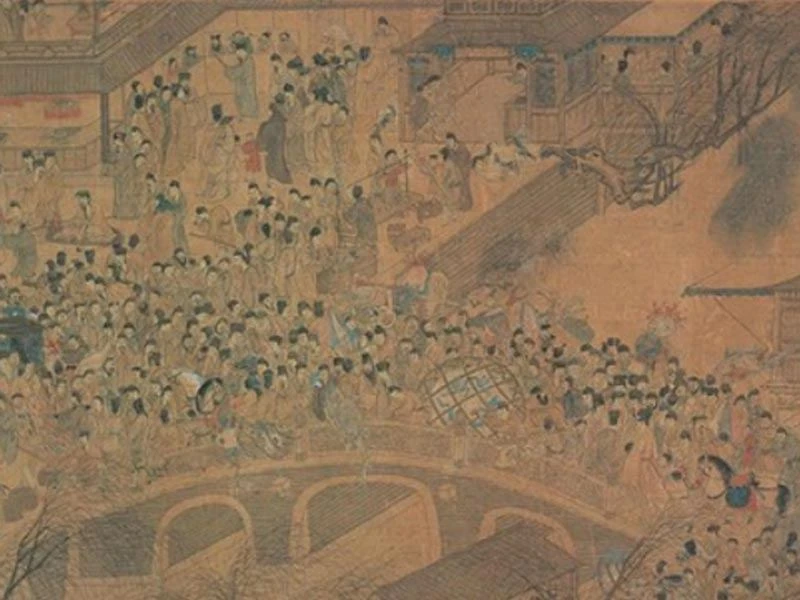
Unmarried men and women rarely met freely. Festivals opened the gate. During the Lantern Festival, girls who usually stayed inside came out to see lamps. Boys also wandered the streets. Ouyang Xiu (欧阳修) wrote about the moon above willow tips and a meeting after dusk. Xin Qiji (辛弃疾) described searching a crowd a thousand times, then turning to find the person in dim light. Those lines are lantern-night scenes: too many people, a promised tree, a long search, a sudden smile.
The Spring Purification Festival (上巳节) was more direct. On the third day of the third month, young people went to the water in spring weather. The Book of Songs (诗经) shows men and women joking together; before parting, they give a peony. The flower was a token. Accept it, and the message was clear: this is not just a friendly hello. A bloom could carry a whole conversation.
Qingming (清明) outings and temple fairs added more chances. These days were not free-for-all dating markets. Families, neighbors and servants still watched. But the street offered a rare window. A glance could become a poem; a poem could become a meeting; a meeting could become a story. The calendar, not a phone, set the time.
Letters That Bloom
Qian Liu (钱镠) wrote to his wife, who was visiting her family: “The flowers along the path have opened; you may come back slowly.” He never used the word “miss.” Yet every character asks her to return. The line is famous because it turns longing into a landscape. He does not pull; he opens a road. That is a high-level love letter: warm, patient and quietly urgent.
Gui Youguang (归有光) remembered a loquat tree his wife planted in the year she died. By the time he wrote, it stood like a canopy. He describes the tree, not his grief. The page never shouts. Still, readers feel the empty room. A plant becomes a clock; its shade measures years without her.
Shen Fu (沈复) recalled his wife Yunniang (芸娘) in Six Records of a Floating Life (浮生六记). On summer nights, lotus buds closed; at dawn they opened. She put a small gauze bag of tea leaves inside a flower. Next morning, she brewed that tea. The scent was extraordinary. Shen wrote this after she had died. He never says “I cannot forget her.” The tea says it for him.
Graceful Goodbyes
Zhuo Wenjun (卓文君) answered Sima Xiangru (司马相如) when his heart changed. Her poem says: “I hear you have two minds; I come to break clean.” Then comes the famous wish: “I want one heart, to grow old without parting.” The message is simple. If you cannot give single-hearted love, we are done. No begging, no public shaming.
A Tang divorce contract found at Dunhuang (敦煌) is even calmer. It tells the couple to release resentment and stop hating. “One parting, two wide; each grows happy.” The document settles accounts and wishes both sides peace. A thousand years ago, a split could be handled with paperwork and dignity, not a messy public fight.
These farewells are not cold. They protect memory. They admit that love can end without turning both people into villains. That restraint is its own kind of style.
Poets in Love
Li Qingzhao (李清照) and Zhao Mingcheng (赵明诚) lived apart after marriage. She wrote that a feeling could not be erased: it left her brow and pressed on her heart. He was stung. He shut himself away, wrote fifty poems, and mixed hers among them. A friend judged them. The best lines, the friend said, were hers. Zhao had to accept defeat in his own study.
Lu You (陆游) met Tang Wan (唐婉) again after a forced divorce. He wrote a poem on the wall of Shen Garden (沈园). She answered with her own. Soon after, she died in sadness. Lu lived to eighty-five. In his last years, he still wrote about that wall. One poem could hold a lifetime. The garden became a page that never dried.
Ancient lovers did not have it easy. They had rules, watchers and slow mail. They also had imagination. A flower, a cup of tea, a lamp-lit street, a tree, a wall: each could carry what could not be said aloud. A letter took months. By arrival, longing had fermented into something stronger. They were not clueless about love. They wrote the manual in verse.