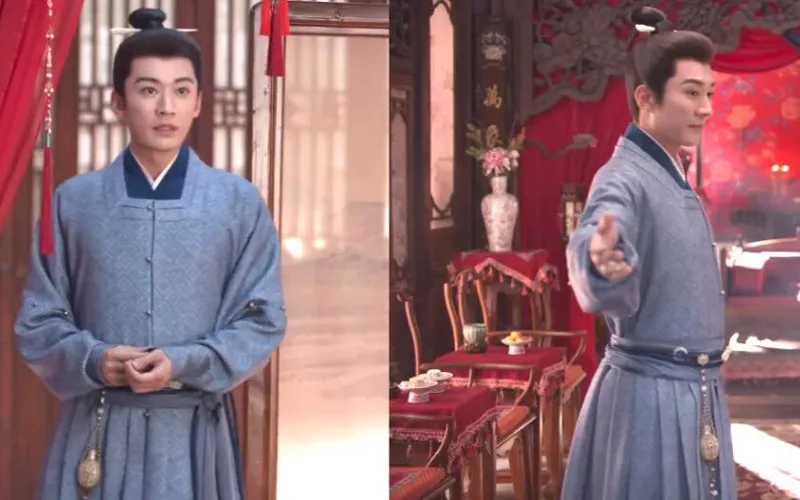
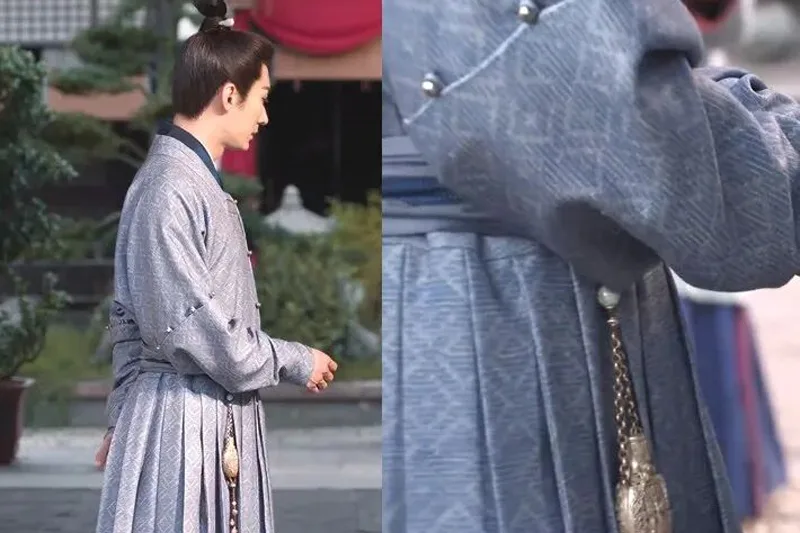
In Against the Current (兰香如故), a blue square-collar robe and a small metal object at the belt draw attention before any line of dialogue. The wearer is Lin Jinqi (林锦岐), eldest grandson in the household of the Minister of Personnel. Servants and relatives call him Lord Lin. After his wedding to Xu Lanxiang (许兰香), the camera often finds him in that robe, with a carved shell and bead tassel hanging at his waist.
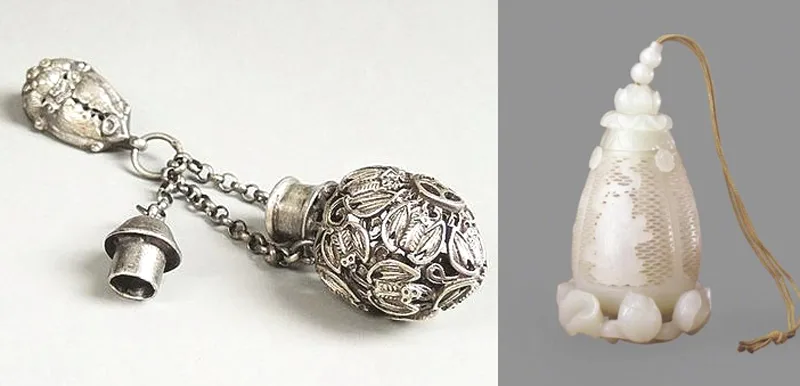
At first glance it looks like a tiny bottle. It is not a prop for wine, medicine, or magic. It is a sachet, and its shape carries a long practical history. The object also does quiet storytelling: it marks his rank, his grooming, and his place inside a strict household.
Metal, Not Cloth
A sachet is not always a cloth pouch. Historical examples use metal, jadeite, nephrite, wood, and woven fabric. The piece on Lord Lin has an openwork metal shell. A fragrant paste or pill sits inside. Air passes through carved gaps, so scent reaches the robe without staining it. The tassel adds movement. On a formal belt, the object also works as jewelry. It says the wearer has time, money, and a servant who keeps the scent fresh. A cloth bag can be hidden; a metal shell is meant to be seen.
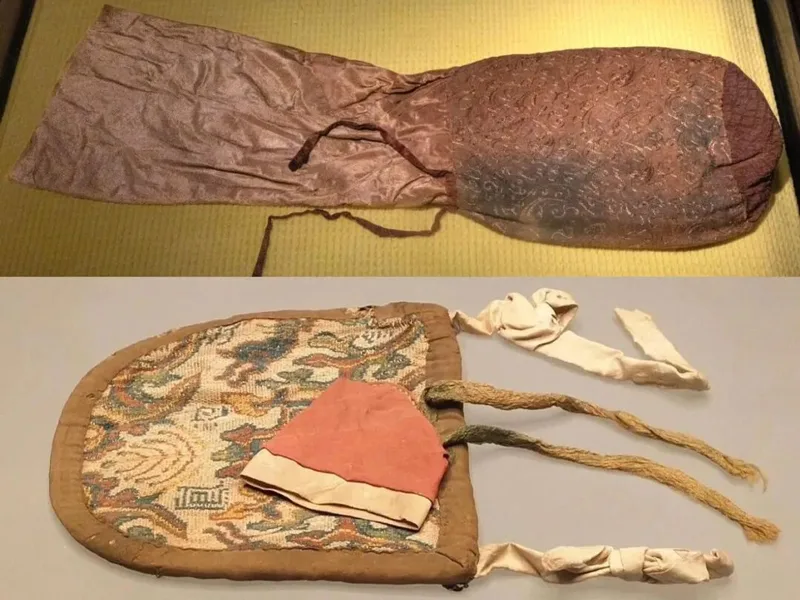
Scent containers existed before the word “sachet” became common. Early texts describe an odor pouch worn by young nobles when they visited elders. Book of Rites records the custom. Cloth was the usual material, and dried herbs went inside. Men and women wore them to soften body odor and add freshness. The shape was simple because the job was simple: carry a clean smell close to the body. In a world without daily baths and sealed wardrobes, that small bag did real work.
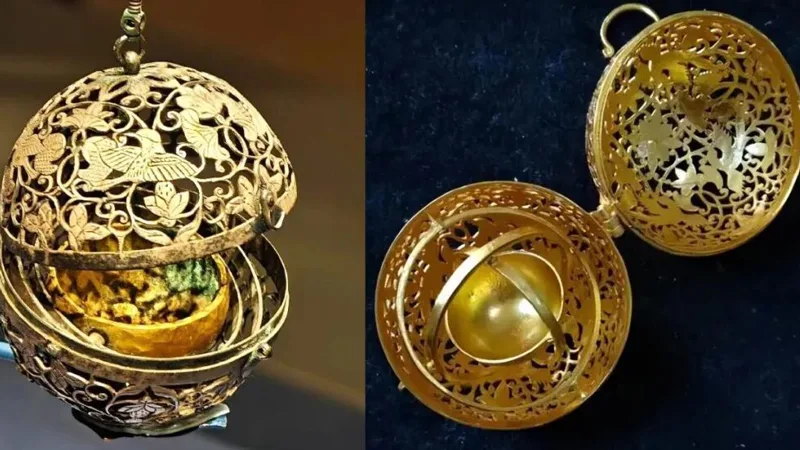
By the Han, Wei, and Six Dynasties, the term sachet appears in poems and daily records. The Peacocks Fly Southeast (孔雀东南飞) mentions one hanging by a bed curtain. Poem of Lasting Love (定情诗) uses the word too. Use had widened. A sachet could perfume a room, serve as a gift between lovers, or stay on a person all day. Cloth bags from Ma Wang Dui (马王堆) and Niya (尼雅) show embroidery and brocade. Metal spherical sachets are described in older writing, but many surviving examples date to the Tang period. Those spheres held a tiny incense cup inside a balanced ring system. Ash stayed put when the ball turned. People hung them, carried them, or placed them under bedding.
Such metal work was clever and costly. It belonged to wealthy households, while ordinary people still used silk or brocade bags. The custom lasted through the Song, Yuan, Ming, and Qing periods. A Ming essay on student life notes that men wore sachets. Openwork bottle shapes survive mainly from the Qing period. That detail matters for the screen design. Lord Lin’s accessory looks like a dramatized Qing bottle sachet, not a random fantasy prop. The carved shell, the hanging beads, and the small scale all fit a man whose clothes are inspected by family, servants, and rivals.
More Than Scent
A belt sachet was only one way for a man to manage scent. A heated incense cage could perfume a robe before a banquet or an official visit. A thin fire shield held a fragrant cake, and the cloth lay over the cage. One session could leave the fabric fragrant for days. This was not rushed grooming. It was scheduled preparation, often handled by servants. The result was subtle. A man did not want to smell like a spice shop. He wanted a clean cloud around his collar, sleeves, and official cap.
Some men carried fragrance in the mouth. Small aromatic pills were made from blended spices. A scholar could place one under his tongue before an audience or a formal meal. Breathing and speech carried a clean note. Han Official Ceremonies records the practice. The pill worked like an early breath freshener, though its ingredients also hinted at wealth and taste. It was easy to carry and easy to offer. In close court spaces, good breath was not vanity. It was manners.
Incense plaques and beads offered another option. Spice powder was pressed with a binder into flat plaques or round beads. Men hung them at the waist or rolled them in the hand. They were scent objects and playthings for the desk. Song craftsmen had mature blending methods. By the Qing period, plaques appeared in many materials and patterns. A nobleman’s belt could hold several small signs of rank and refinement. The bottle sachet belongs to this language of small accessories. It is not loud. It simply rewards a close look.
Lord Lin’s metal bottle sachet fits his position. He is not a rough soldier who ignores details. He is a young man raised inside rules, where a belt ornament, a robe collar, and a hint of fragrance all speak before he does. The bottle shape may look odd to modern eyes, but it does its job: it keeps scent close, shows status, and gives the character a quiet vanity. Does it look good? Yes, if one reads it as a small machine for manners, not as a mystery bottle. He wears it like a seal, not a toy. Its charm is in that restraint.