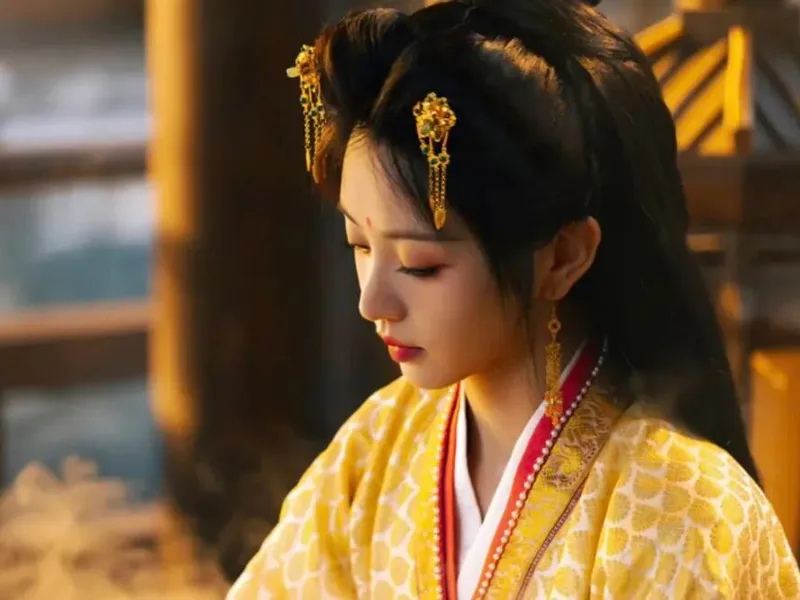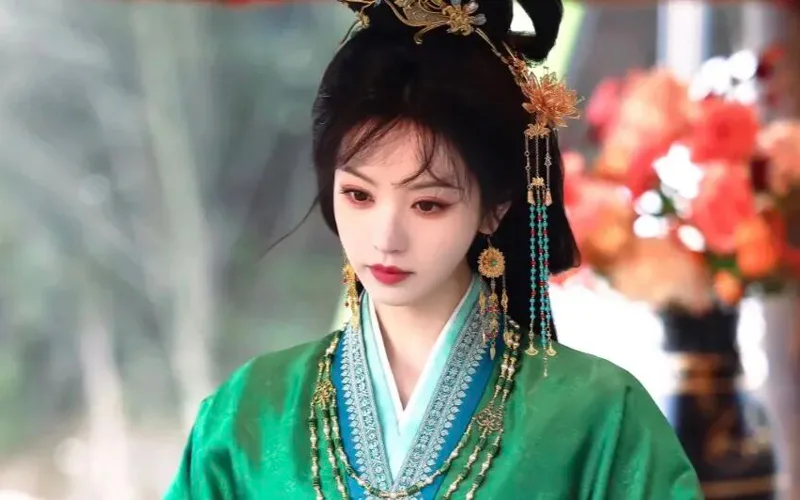
A costume still from Where the Mask Ends (嫁金钗) shows Tian Xiwei in dangling ornaments, and viewers asked a sharp question: are these the “bright moon pendants” praised in Peacock Flies Southeast (孔雀东南飞)? The poem made the phrase famous, yet fame is not proof. A line can echo for centuries while its object remains misunderstood. The real Han dynasty story is stranger and more interesting than a simple yes-or-no answer, because tomb goods, poems, and portraits do not tell the same tale.
Piercing Question
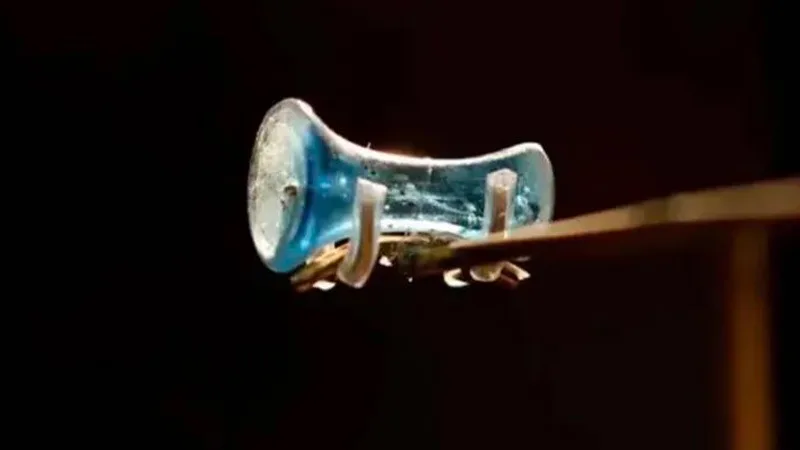
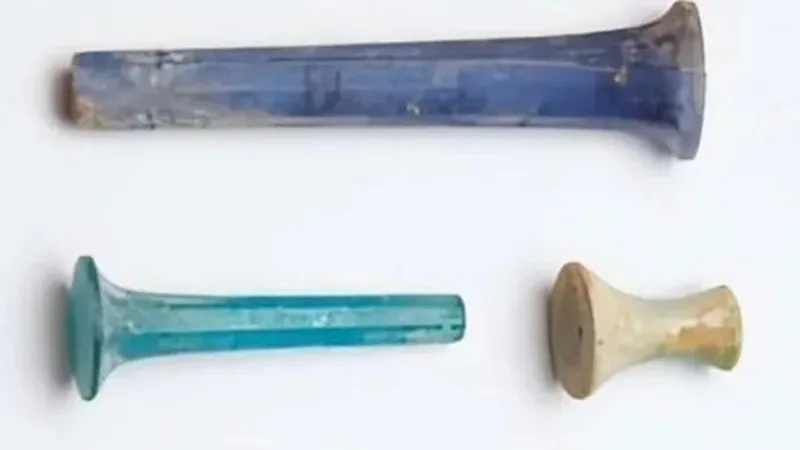
Archaeologists have recovered many Han ear pendants made of gold, bronze, nephrite, and glass. Blue, red, green, and milky white examples sit in museum cases. Their shape is distinctive: a waisted barrel, wide at both ends and narrow in the middle, usually two or three centimeters long, with a hole through the center. This is the object poets likely meant by the bright moon pendant. Yet a tomb find proves only that the ornament existed. It does not prove that every Han woman punched her earlobes to wear it.
Liu Xi (刘熙), writing in Explanation of Names (释名), left a useful clue. He said piercing the ear and adding a bead was called dang, and that the custom began among border peoples; later, people in the central plains copied it. That sentence matters. It frames ear piercing as an imported fashion, not an ancient native habit. Confucian teaching also treated the body as a gift from parents, so cutting the earlobe was not a casual choice. Murals and pottery figurines rarely show Han people with pierced ears, even when tombs contain pendants.
How, then, did the pendants stay on? Three methods probably coexisted. One was direct piercing, with a stretched hole holding the waisted shape. Another used silk thread through the central hole, turning the pendant into a hanging ornament that rested over the ear without a piercing. A third tied it to a hairpin near the temple, so it dangled beside the cheek like an earring. That last style, often called a hairpin pendant, explains the mismatch between abundant tomb objects and scarce pierced-ear images. Most Han women may have enjoyed the look without the needle.
The debate matters because modern retellings often flatten it. A single image of a woman with earrings becomes “all Han women did this,” when the evidence points toward a mix of customs. Some women followed a new fashion and accepted piercing. Others used thread or hairpins. A few may have worn nothing at all. The bright moon pendant was not a rule; it was a choice shaped by class, region, and taste. That flexibility is more revealing than a neat costume rule.
Later Shifts
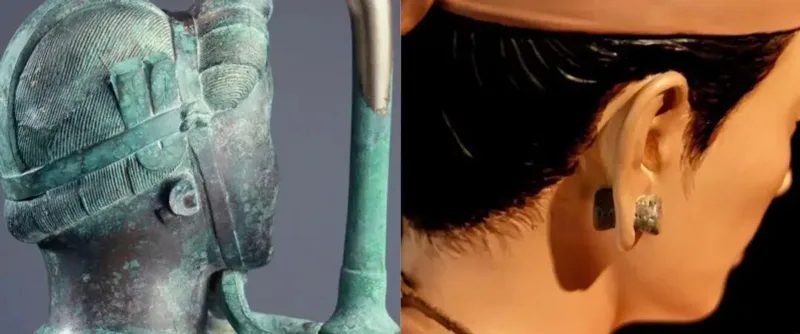
Older ear ornaments reach much further back. At Xing Long Wa (兴隆洼), a site about eight thousand years old, jade slits called jue appear; scholars think many were hung rather than inserted through flesh. Southern regions such as Chu had pendants before the Han period, but the fashion did not dominate the central plains. During the Han dynasty, trade along the Silk Road helped the pendant become a stylish item in poetry and daily display. Still, display and body modification are different acts.
Interest cooled in the Tang dynasty. Tomb murals and figurines from that era seldom show women in earrings. By the Song dynasty and Ming dynasty, with Neo-Confucianism shaping expectations, pierced ears became far more ordinary for women in the central plains. The habit hardened into custom. What modern viewers assume was always true is actually a later layer, built slowly through changing manners, trade, and ideas about the body.
This history should not spoil the fun of costume drama. Where the Mask Ends borrows Han-inspired clothes but remains a fictional production; modern earrings can serve character and camera. The mistake is treating screen styling as a textbook. A Han woman could wear a glass pendant at her temple, a thread over her ear, or, in rare cases, a pierced lobe. The bright moon pendant was flexible, just as the women who wore it were.
So the next time a costume still sparks a debate, ask better questions. Who is wearing the ornament? What material is it? Does the scene show a pierced ear, a thread, or a pin? Those details turn a pretty prop into a small doorway into daily life. The old poem gave us an image; archaeology gives us the messy, human choices behind it. Which method feels more plausible to you: pin, thread, or needle?