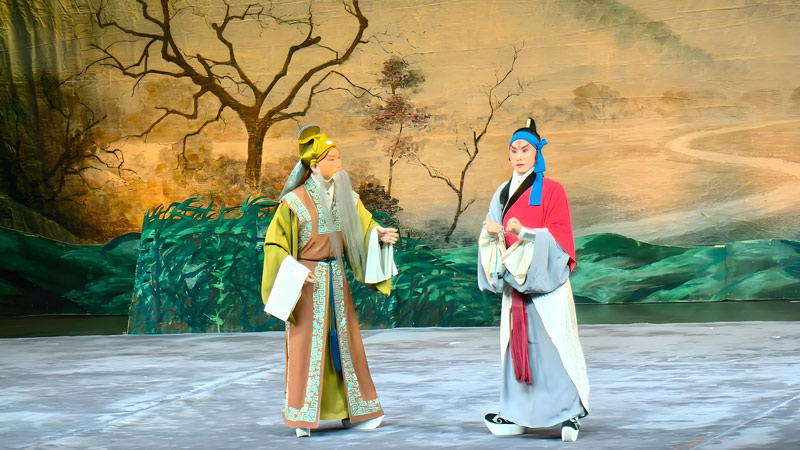
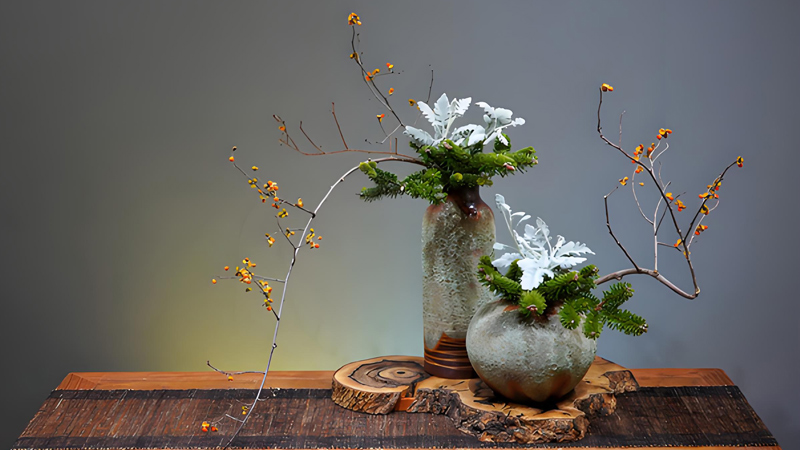
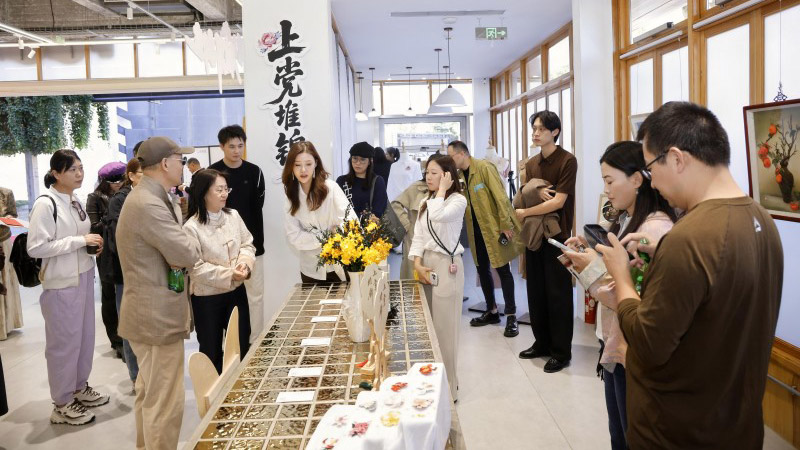
On October 1, a craft better known in southeastern Shanxi opened in a Beijing factory-turned-art district. “Pile Brocade of Shangdang, Breaking Boundaries to Be Born Anew”, a themed exhibition of Shangdang pile brocade, began at the 751 Shulin Gallery in the 798 Art Zone and runs to October 15, carrying the craft out of Shanxi and into the capital. The Changzhi culture and tourism bureau organised the show, with the Changzhi culture and tourism development centre and Beijing Guantang Culture and Art Co. carrying it out.
Silk, Cotton and a Dozen Hand Steps
Shangdang pile brocade, also called Changzhi pile flowers, entered the national intangible heritage list in 2008 and is nicknamed a “standing painting” in silk. It is not built on the needle. Instead it takes silk and satin as its surface and cotton as its filling, worked through more than a dozen hand steps, cutting, layering wadding, stacking and painting among them, into a raised relief.
Seen from a distance it reads as a fine brush painting; up close it is a soft carving whose petals have depth, whose robe folds rise and fall, and whose satin carries its own sheen. The 798 Art Zone grew out of an old industrial park, and its rough factory texture and contemporary art mood make a fitting carrier for the craft: cold concrete against woven pattern, heritage stepping past the usual walls of a museum and taking root in a fashion-led art space. No two works are alike.
Fifty Works, Old Myths to New Design
More than 50 pile-brocade works and cultural products fill the show. Their subjects run across time, from ancient myths such as “Shennong Tasting a Hundred Herbs” and “Jingwei Filling the Sea” to historical figures including Lord Guan and Confucius.
Newer pieces move the craft toward daily design. One study follows a Qing painting of New Year offerings; others take the Shangdang Gate, a Changzhi landmark, as the starting point for themed garments, round fans and other cultural goods. A further work fuses the craft with the Lihou tiger (黎侯虎), another national-level local heritage, so that two traditions meet on a single panel of brocade.
Carvers Who Teach in Person
Over the run, carriers Han Ling, Yan Xiangjun, Li Weidong and Wang Junting stay on site and demonstrate the core steps, shaping wadding and painting and gilding. Visitors can watch a piece of silk turn into a petal and a clump of cotton take the fold of a robe, and hear the story behind each work.
In the hands-on area the gallery opens 50 free places a day: guided by a carrier, a participant cuts, layers, stacks and colours a piece of their own to take home, a draw for families and study groups. Behind the show sits a Beijing-Changzhi counterpart-cooperation framework, and the placement is deliberate: by opening on the capital’s art platform the craft widens its reach and tests a “heritage plus industrial art space” model that brings traditional work toward contemporary taste. Across the run the gallery also teaches a pile-brocade kit class, and overseas visitors have stopped at the cases to look at the Eastern aesthetic the craft carries.