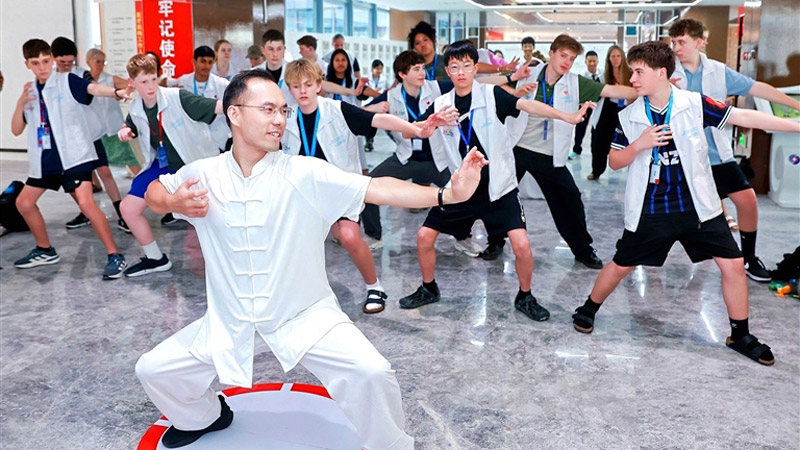
If you want to see how Chinese wellness is landing with visitors from abroad, start at an airport. Outside the one-stop service centre for foreign travellers at Terminal 2 of Shanghai Pudong International Airport, a group of overseas passengers follows staff through a set of Baduanjin (八段锦) movements, the slow eight-section exercise that has become one of the easiest ways in. Around them the airport set up four zones: Shanghai-style traditional Chinese medicine (TCM) culture, herbal sachet making, service introductions and a TCM body-type check.
Stretching at the Airport Gate
“I think the sachet smells really good, and it is a wonderful thing,” said a German traveller, Leon. The session is part of Shanghai’s wider effort to smooth entry for foreign arrivals, linking resources across the Yangtze River Delta and building a warm “available on arrival” welcome that gives travellers, home and foreign alike, a TCM wellness stop on the way in.
In Tianjin, a museum holding more than 600 classical texts and specimens condenses a century of China’s medicine industry. The visitor Luis noted the information was dense and that such a large pharmaceutical building, so many formulas and so long a history came down to a single word: remarkable. In the hands-on area, choosing herbs, grinding them and making incense by hand proved the most popular activity for overseas guests, and when they pack the sachet and its story into their bags and carry them home, the culture crosses the sea again.
Where Auckland Students Meet the Craft
Another traveller, Rui Gonçalves, described his own route into the tradition: “I fell in love with Chinese medicine when I was about 16 or 17. I was practising martial arts and got injured, and started receiving acupuncture and tuina treatments. From then on I was curious, I began to use Chinese medicine, and I fell in love with it.” His is not an isolated case but one slice of how inbound visitors now experience Chinese culture on the ground.
In Sanya, Hainan, TCM serves as a bridge for young people from China and abroad. From September 28 to October 3, more than 30 students and teachers from Pinehurst School and Wentworth School in Auckland, New Zealand, visited the island, moving through Haikou, Wuzhishan and Sanya for ecological study, city visits, school exchanges and traditional-culture sessions.
On October 3, at the Sanya International Friendship TCM Convalescent Hospital, doctors demonstrated tuina therapy and acupoint work and explained the principles of TCM health care. Filling a herbal sachet, Wentworth student Caleb Sidney Mann sorted herbs, packed the pouch and tied it shut with full attention. “The herbs smell fresh and healing, and they make you feel very relaxed,” he said, adding that he would take the Hainan-made piece home to New Zealand to share with his family.
Why Inbound Travel Is Climbing
Over the holiday, Du Fu Thatched Cottage in Chengdu also drew visitors from many countries, who read classical verse, identified herbs and made sachets of their own. Ekaterina Baije, a Latvian visitor, marvelled that culture could be connected through herb scent and health, while Nicaraguan visitor Natalia Caldera remarked that she really liked Chinese medicine and had made a small sachet with everyone.
Behind this “Chinese wellness” interest is a warming inbound market. Platform data show that during the 2026 Mid-Autumn and National Day holidays, inbound trips kept up double-digit growth, one-day inbound orders rose more than fourfold year on year, ticket sales were up over 220 percent and train tickets over 170 percent, with China’s long holiday turning into a high season for foreigners coming to spend the festival here. The source markets are broadening past East Asian neighbours to reach Europe and Oceania, and the visitors’ footprint is spreading out from the biggest cities. At the Suifenhe crossing in Heilongjiang, exit-entry traffic over the 2026 National Day period is projected at about 24,000 people, up 60 percent on the same period in 2025. At the airport service centre, on the museum bench and in the resort hall, TCM and Chinese wellness are giving an abstract idea of culture a form that a visitor can carry home and share.