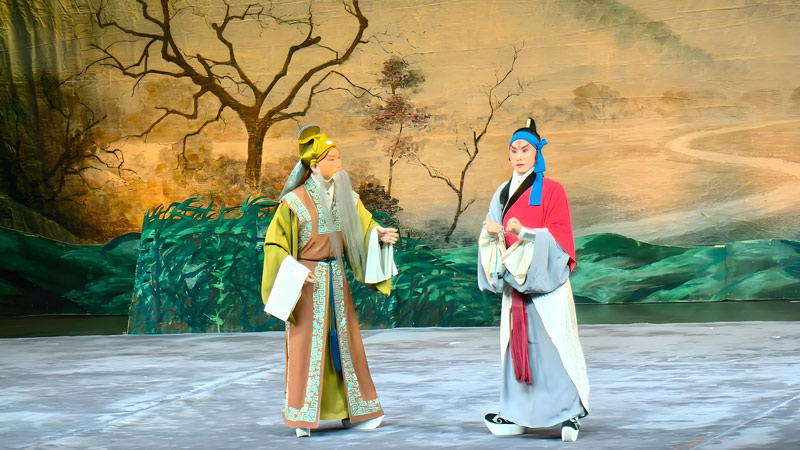
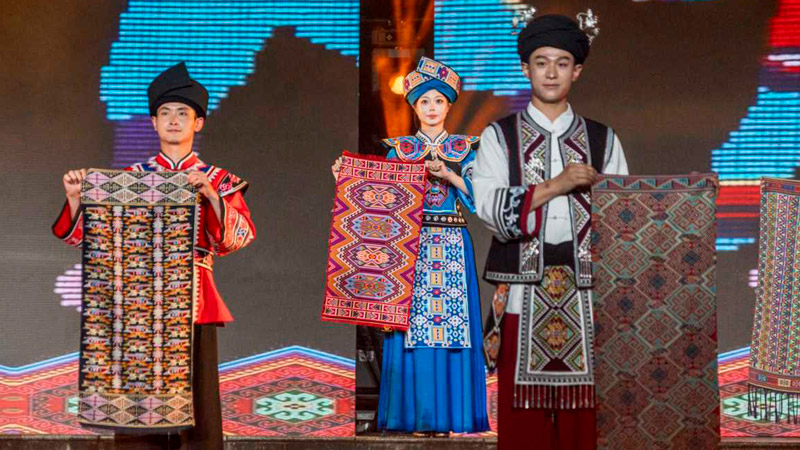
Over the National Day holiday, a costume pageant in Laifeng county, Hubei, sent 12 examples of Xilankapu down a stage alongside Tujia dress, drawing crowds to a craft most visitors had only read about. Behind the show, the county’s ethnic museum had news of its own: its first batch of 23 century-old, endangered Xilankapu textiles had come through systematic restoration, closing a gap in textile-artefact conservation research in southwestern Hubei.
Inside the museum, Huang Lin (黄林), a deputy to the National People’s Congress, a national inheritor of the craft and the museum’s director, told staff to handle the newly restored pieces gently: “Open it slowly, do not pull hard, take your time.” A two-metre by one-metre panel lay flat on a table, its dull cloth carrying the marks of age. The piece, graded a third-class cultural relic, had a badly damaged edge a year earlier and an old patch about ten centimetres square. The restoration team removed the patch and rewove the missing area with silk thread of the same material and colour, following the original pattern, until the repair blended into the whole.
Xilankapu is the Tujia-language name for Tujia brocade, meaning “flower bedspread.” It is a dowry that Tujia girls wove by hand before marriage, and its dense patterns and fine technique carry the customs and knowledge of the Tujia people. In 2006 it joined the first national list of intangible cultural heritage. Older homes in the countryside once held pieces left from an earlier generation’s weddings, but damp, mould and insects took their toll, and the classic patterns that record Tujia totems, farming and marriage legends gradually faded.
Huang and his colleagues began collecting Xilankapu from village households in 2024. All 23 pieces turned out to be third-class relics or above, more than a century old, their signature motifs such as the eight-hook, twelve-hook and chair patterns bearing witness to a thousand years of weaving where Ba and Chu cultures met. Restoration began in 2025. The worst case was a piece from Badong, its fibres so decayed that a slight touch sent fragments falling.
For Huang, the difficulty lies in matching the original not only in material but in weave and colour; anything less risks a “similar shape with a different spirit.” To get there he brought in experts from the Palace Museum and Tang Hongxiang, an inheritor of the craft, and worked out a plan that moves through classification and grading, dust removal and fibre consolidation, thread-by-thread repair, traditional colour matching, and finishing.
The team works the way a conservator would. Tweezers comb the surviving threads back into their original direction and mark the gaps, so the new weaving does not throw the warp and weft off course. Then the missing threads are woven in to match the original material, pattern and colour.
The Nine-Person Team Behind It
Nine people carry out the work, most of them local specialists in heritage protection and artefact repair across the Wuling Mountains. Zhang Qun joined the Laifeng cultural and museum service in 1997 and has spent 28 years on the front line, a Tujia native who grew up around Xilankapu weaving and still travels to villages across the county to collect old pieces. She said the brocade is the Tujia people’s own cultural root, and that the worn textiles should be kept whole by scientific means so that the motifs carrying migration, ritual and marriage stories stay visible for later generations. Training local restorers, she adds, is how heritage work in the Wuling minority areas can stand on its own.
After nearly two years of systematic restoration, the diseases affecting all 23 textiles have been cleared: the fibre structure is stable, the patterns are complete and legible, and the pieces have shed the risks of mould, breakage and fading, so they now meet the conditions for regular display. The museum has submitted a plan to upgrade its galleries, adding a dedicated digital hall for Xilankapu where projection and 3D rotation will let visitors see the whole of a piece and the course of its repair. Once the upgrade is complete, the museum will stage a special exhibition of the restored work and run heritage study sessions and live weaving demonstrations with inheritors, bringing the long-stored textiles out of the vault.
A Digital Hall and a Stage
The holiday pageant that prompted the attention ran at Zhaxitai Cultural Square under the title “Clothing Carries a Millennium,” tracing the development of Tujia dress and weaving in national-level Xilankapu technique together with modern stage design. Tinkling Tujia silver, plain headscarves and richly coloured Xilankapu appeared in turn across four sections. Breaking with the conventional runway, the show mixed everyday scenes with stage aesthetics, moving from the heavy, ancient dress of the ancestors through the vivid traditional costume to modern designs that fold in Xilankapu motifs. Fu Jing, head of the culture and art section of the Laifeng culture and tourism bureau, explained that the pageant draws on Xilankapu and Tujia folk resources while balancing traditional character with modern taste.
Laifeng’s “Follow the Hand-Waving Dance” culture week, which ran from September 25 to October 7 around heritage, sports, rural tourism and folk experience, made the pageant one of its centrepieces. At the September 29 opening, invited teams from Youyang in Chongqing and Longshan in Hunan joined more than a thousand Laifeng residents in Tujia dress decorated with Xilankapu patterns to perform the national hand-waving dance. A parade then moved from the county sports centre along Wuhan Avenue to Zhaxitai Cultural Square, with Da’anqing and dilongdeng lantern performances taking the stage, and a bonfire hand-waving dance drew more than a thousand participants. A bureau official noted that the hand-waving dance is Laifeng’s most representative cultural symbol, and that the county will keep turning its ethnic heritage into a driver for local growth.